Editor’s note: This story was produced for Our Living Lands, a collaboration of the Mountain West News Bureau, Koahnic Broadcast Corporation, and Native Public Media focusing on the impact of climate change on Indigenous communities across the country.
Mobile Health Clinic Brings Critical Care to Nevada’s Tribal Communities
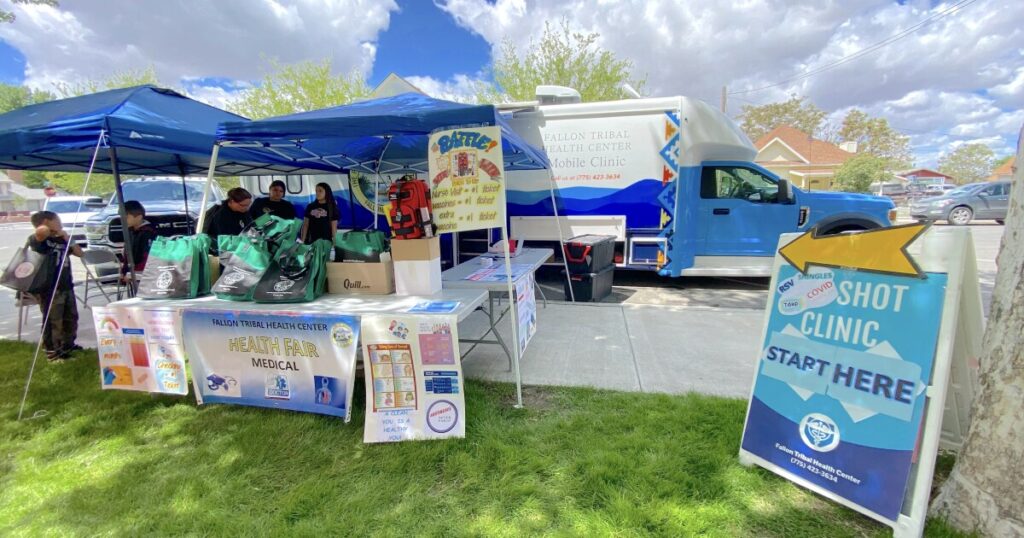
In Lovelock, Nevada, the Fallon Paiute-Shoshone Tribe’s mobile health clinic, a converted motorhome equipped with patient rooms, a lab, and a bathroom, is making healthcare more accessible to Indigenous communities. At a health fair hosted by the Lovelock Paiute Tribe, residents like Gabriel Bourne are receiving essential medical services without the need for long-distance travel.
Bourne, who lives in Lovelock but is a member of the Fallon Paiute-Shoshone Tribe, shared his gratitude for the mobile clinic: “Having access to this, I was able to get some shots I needed – that I should’ve probably had a long time ago but didn’t get.” The convenience of the clinic, which eliminates the two-hour round trip to Fallon, allowed Bourne to catch up on overdue medical needs, including eye exams and cancer screenings.
Joy Schultz, a registered nurse with the Fallon Tribal Health Center, emphasized the mobile clinic’s impact: “Just the fact that we were here, we got all of those health issues connected with care.” This traveling clinic addresses the longstanding challenge of healthcare access for tribal nations, particularly in rural areas where Indian Health Service facilities are scarce and often understaffed.
The clinic was purchased last year with a $673,000 grant from the U.S. Department of Agriculture, part of an initiative to bolster rural healthcare following the COVID-19 pandemic. Jon Pishion, director of the Fallon Tribal Health Center, explained that the pandemic underscored the need for mobile services: “A lot of healthcare facilities were being shut down,” he said. “And with all the services being closed, we needed something to go out to the communities.”
Covering about 200 miles, the mobile unit serves approximately 2,000 patients across Nevada, including visits to the Lovelock Paiute and Yomba Shoshone reservations. Despite challenges like weather and distance, the clinic strives to visit each tribe monthly, providing consistent care that enhances proactive health management.
Dr. Christopher Chai, who works at the clinic, notes its dual role as a provider of both preventative care and urgent medical attention. “We will get the random rancher come in with a broken finger and say, like, ‘What do I do with this? It sliced open,’” Chai said, highlighting the clinic’s ability to offer immediate solutions.
Barbara Bonta, an elder of the Walker River Paiute Tribe, benefits from the clinic’s presence in Lovelock, avoiding long car rides that aggravate her health issues. Her daughter, Tia Happy, vice chair of the Lovelock Paiute Tribe, appreciates the convenience: “With my mom, she can’t sit for a long time in a car to go to Fallon or elsewhere to appointments,” Happy said.
The Fallon Tribal Health Center’s mobile clinic plans to further expand services by adding dental care, continuing to bridge healthcare gaps for Indigenous communities in Nevada.
This story was supported by the Indigenous Journalists Association and Solutions Journalism Network’s 2024-25 Health Equity Initiative.
This story was produced by the Mountain West News Bureau, a collaboration between Wyoming Public Media, Nevada Public Radio, Boise State Public Radio in Idaho, KUNR in Nevada, KUNC in Colorado, and KANW in New Mexico, with support from affiliate stations across the region. Funding for the Mountain West News Bureau is provided in part by the Corporation for Public Broadcasting.