Innovative Artificial Reefs Enhance Lake Norman’s Ecosystem
Lake Norman is set to become a more vibrant fishing hub, thanks to two newly installed artificial reefs funded by a grant from Duke Energy. These structures, strategically placed at Lake Norman State Park and the Beatties Ford Access, aim to enrich the aquatic environment and support local fish populations.
Lake Norman Wildlife’s secretary, David Myers, emphasized the project’s goal: “The purpose is to further enhance the fishing experience at Lake Norman and increase and improve fish habitat.”
As part of its hydroelectric licensing obligations, Duke Energy regularly allocates funds to environmental projects along the Catawba-Wateree watershed. This network of 12 dams stretches from Lake James to Lake Wateree. Last year alone, the company distributed over $500,000 in North and South Carolina for various habitat restoration initiatives, including stream rehabilitation and land conservation efforts.
Lake Norman Wildlife board member Billy Wilson recalls past challenges faced by the community, especially after Hurricane Helene. “We stood on this pier two years ago, overlooking the lake, and just saw tons and tons of debris, Styrofoam, propane tanks, and so on, and it seemed like a very inundating task,” Wilson said, reflecting on the massive cleanup efforts.
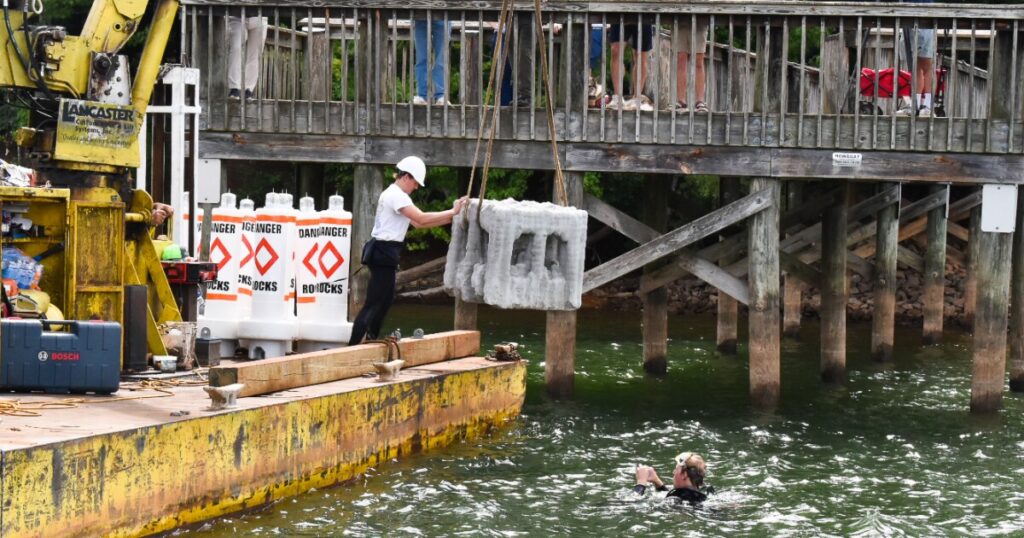
The reefs are the work of Natrx, a Raleigh-based firm that specializes in 3D printing. Manager Drew Keeley described the innovative design: 25 cement cubes that resemble whimsical beachside drip castles. “They’re intentionally designed that way,” Keeley explained. “It’s supposed to have like an irregular, natural look to them instead of more of like a precast mold or standard way of forming concrete.” This design not only mimics natural formations but also provides varied spaces for both adult and juvenile fish.
Stretching from the pier at Lake Norman State Park in a unique ‘five-finger’ pattern, these reefs are expected to transform the local fishing scene. Myers expressed optimism that the structures would enable anglers to enjoy “less fishing and more catching.”