Historic Settlement Reached Following Major Kansas Oil Spill
A significant legal resolution has been achieved three years after a substantial oil spill occurred in Kansas, marking one of the most significant inland spills in recent history. The Kansas state authorities, the federal government, and the operating company of the affected pipeline have collectively agreed to a $70 million settlement.
The agreement involves the U.S. Environmental Protection Agency (EPA), the U.S. Department of Justice, and the state of Kansas with South Bow, the company responsible for managing the Keystone pipeline. This pipeline had ruptured in 2022, just south of the Nebraska border in northern Kansas.
According to a statement from the EPA, South Bow violated the Clean Water Act. Jeffrey A. Hall, Assistant Administrator for EPA’s Office of Enforcement and Compliance Assurance, stressed the importance of pipeline maintenance, stating, “This case demonstrates why the oil pipelines crossing our heartland must be maintained properly. The oil spill blanketed land and water, rendering the waterway lifeless and useless and requiring extensive cleanup and remediation.”
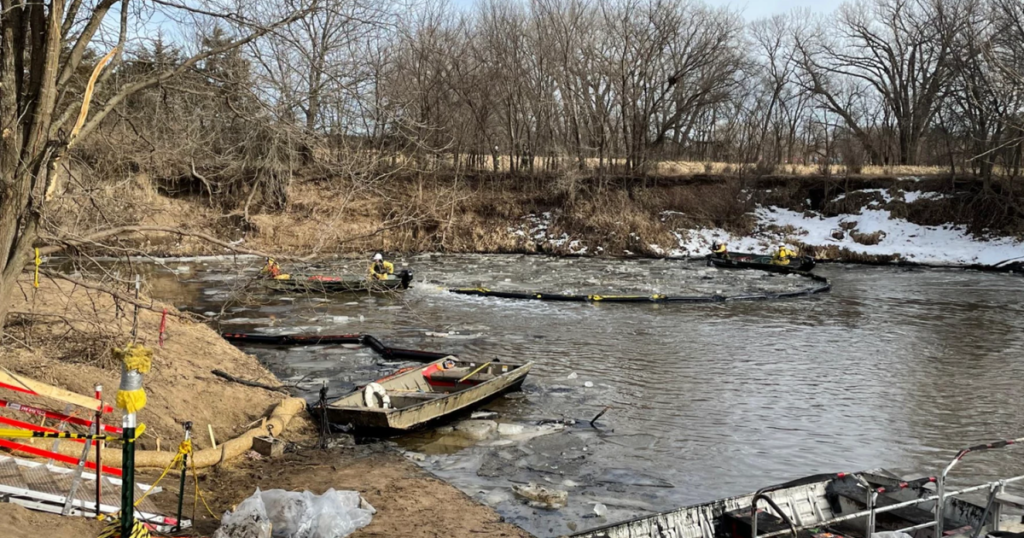
The rupture of the Keystone pipeline occurred near Washington, Kansas, in December 2022, spilling 543,000 gallons of oil. The aftermath of the spill saw South Bow agreeing to pay nearly $27 million as a civil penalty and committing to projects that are projected to cost around $40 million to prevent future incidents.
In addition to these measures, South Bow will contribute over $3 million towards natural resource restoration projects in Kansas. At the time the spill occurred, the pipeline was owned by Canadian oil company TC Energy, which later transferred this segment of its business to South Bow in 2024.
The spill was attributed to defective welding, leading to what South Bow described as an “instantaneous rupture,” which released tar-like crude oil, affecting the Kansas native prairie, croplands, and Mill Creek.
The Department of Justice highlighted the severe environmental and health risks posed by the incident, noting it “created an imminent and substantial threat to human health and the environment.” The EPA’s legal documentation indicated that oil residue was found across 35 acres, impacting or killing over 2,700 animals.
U.S. Attorney Ryan A. Kriegshauser for the District of Kansas emphasized environmental responsibility, stating, “It is important that we are all good stewards of the environment. The incident had a massive impact on the State of Kansas, and we are happy that this settlement will mitigate that damage.”