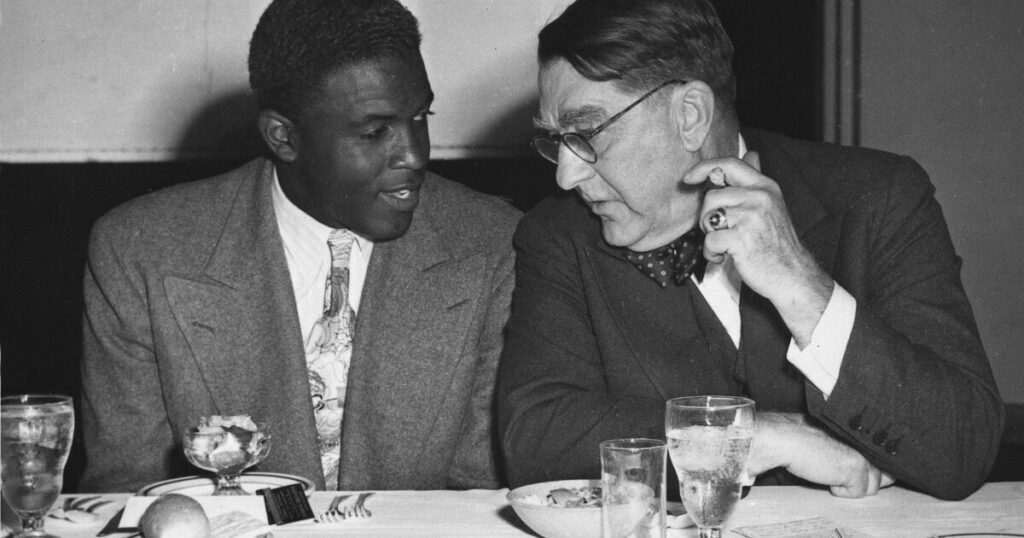
Branch Rickey’s legacy in baseball history is undeniable, notably for his pivotal role in integrating Major League Baseball by signing Jackie Robinson. His story, replete with courage and moral conviction, continues to inspire generations.
Rickey, who served as the president and general manager of the Brooklyn Dodgers, signed Robinson to a minor league contract in 1945, paving the way for his debut in the major leagues on April 15, 1947. This move effectively shattered the racial segregation that had been a longstanding but unwritten rule in baseball since the late 1800s. More about Rickey can be found here and about Robinson here.
Among those who have chronicled Rickey’s life is his great-grandniece, Marjorie Maddox. An author based in Williamsport, Maddox has penned a new book titled “A Man Named Branch: The True Story of Baseball’s Great Experiment,” published by Sunbury Press, which aims to introduce Rickey’s story to younger audiences.
Maddox shared insights into her book and familial recollections in a recent interview with WVIA News, detailing Rickey’s defense of civil rights, including supporting Black player Charles Thomas who faced discrimination during the early 1900s. More about Rickey’s historical role can be found here.
Q: Do you have any personal memories of your great-granduncle?
A: I was born in 1959 and he died in 1965, so I don’t have real vivid memories. I have memories of those birthday parties that we had in the basement of my Aunt Marjorie, and you know lots of family members would gather there, and I remember that pretty vividly. I do remember a lot of interactions with his daughter, Mary Eckler, one of his five daughters. In fact, she even came to my first book signing, for my first book.
But I just grew up with all these family stories, you know, and those were repeated over and over again throughout my life. And then when I started drafting this book, which was like 15 or 20 years ago, I kept talking with my mother on the phone or in person, going over these stories with her and with other relatives.

Q: How old were you when you realized who Branch was and what he had done?
A: I think maybe 10, 12, something like that, when those stories started sinking in.
And then maybe even more so again when I moved to Williamsport — you know, with all the Little League stuff. I was in my 30s at that point, and had kids.
Then the movie “42” [about Jackie Robinson] came out later [2013] and I started talking about baseball and baseball history much more as I was writing and drafting all this. But I’ve always been interested in the stories.

Q: There’s a lot out there publicly about Branch. What do you bring to the book from his personal life?
A: I think just his love of family, his deep faith convictions. But there are other stories.
When my mother and I watched “42” together, and they showed a little depiction of his terrible driving, she said, “Oh, that’s just like Uncle Branch.”
So, you know, I heard those stories too — not only about his keen intellect, but also sometimes how he was a little forgetful. I heard stories about him going to the grocery and forgetting everything on the list. That kind of stuff was what’s fun to hear. It made him a little more human, I guess.
Q: You spoke about his faith. What do you think motivated him to stand up to the prevailing cultural orthodoxy of this country at the time?
He did have a strong moral conviction about the importance of standing up for others, the dignity that everybody has, and that everybody should be treated with respect.
One of the things that I tried to bring out in the book was some of these early situations — at this one-room schoolhouse, when he was 17, he was standing up to bullies who were spitting at the teachers and causing fist fights. At that point he used his fists, and but later he really believed in using his words to get things done.
And then you know the whole situation with Charlie “Tommy” Thomas, and standing up for him. There’s that scene where Thomas is trying to rub off his black skin, you know, and that famously sticks with with Branch.
So all these things came together … and that’s what I wanted, to show to and adults — not only to stand up to bullies, but to continue standing up for what is right in all areas of life.

Q: When you started writing the book, did you have an idea whether you wanted it to be for young people or for adults?
A: I think I wanted it to be kind of for 10 to 15, but I kind of think this book is really maybe eight through adult.
There are wonderful biographies about Branch Rickey for adults. I also wanted to bring the story to the younger generation to show it’s important what you do and say and how you treat other people, and don’t just be a bystander all the time.
I’m primarily a poet. I write poetry, fiction, creative nonfiction, and children’s literature, but I was driving to school one day and I had this phrase pop into my head, “his name was Branch, and in his brain was brewing a great experiment,” and you kind of have the metrics going there, the meter going.
That became kind of a chorus in the book that I kept coming back to, and and it helped me think: “How did he start thinking about these things? How did these ideas start percolating?” Big change doesn’t always happen all at once.
I love the quote by Martin Luther King Jr. that says you’ll never know how easy it was for me because of Jackie Robinson. And so you have Branch Rickey influencing what happened with Jackie Robinson, and Jackie Robinson and his great courage influencing, you know, what happened with the civil rights movement, too, so you know one thing kind of leads to another.
Q: This book is not just for the world, right, but this is something you’ve done for your family. What do they think of it?
A: We talked about these stories when they were growing up, and we all, as a family, went to see “42.” I saw it with my mom, and then also with my husband and my kids.
So they’re excited about it, they’re proud of it. They helped me with the cover, and gave me feedback on different things.
Q: This is your 20th book. Was it harder writing a book about your own family? Was there more pressure with this?
A: Not too much, because it was very familiar in many ways to me, and it’s several generations removed.
My mother was part of the Orla Rickey family — Branch’s older brother — but my mother died before the book came out.
Also Ida Jane Pugh, who was Branch Rickey’s granddaughter, I had corresponded with her quite a bit, and she died beforehand.
I had written the draft, I tried to get it published, I’d put it aside for a while, I’d come back to it, and so when I finally got back to kind of finding all the family photographs, that was hard, not not having those people to talk to again, that older generation.
Q: The creative process from concept to completion took over a decade. What was that like?
A: It didn’t take long to draft it. I just kind of holed myself away for four days and churned this out. I had a stack of books with me for research as well, but I kind of molded it mostly around the stories. I worked for a while with an editor at an electronic publisher, but they went under and so that so that didn’t work out, so it was accepted at one place, but it’s much nicer to have it in print, and hold it in your hands.
Q: Do you think the older generations of your family would enjoy the book? Would they be pleased with it?
A: I think they would love it. My mother was very excited about when I had it in the electronic version, and you know, I was sorry that that didn’t work out, but in retrospect, it’s better that it didn’t. This is nicer.
Q: How did you come to publish with Sunbury Press?
A: I had sent it out lots of different places, maybe 50, maybe 100 places, you know, over the 15 years or so, and so it was a long process. got a lot of good comments, actually, but you know, a lot of times it comes down to marketing, and they weren’t sure that they could market it.
Sunbury Press took it, and it was a relatively quick process, maybe six months or so. Sunbury Press is right in Pennsylvania, and they have a focus on Pennsylvania books, historical books. The editor, Lawrence Knorr, is also a big baseball fan, so that helped, I think.
Q: You also wrote a book of baseball poems, and twice were named Little League World Series official author. What was that like?
A: That was a lot of fun. They even put it up on the scoreboard.
Q: Perhaps most memorably, you met Jackie Robinson’s widow Rachel at Cooperstown. What was that like?
A: I presented at Cooperstown twice, and I met Rachel Robinson there once.
I went in 1997, three months after my daughter was born, for the 50th anniversary celebration of Jackie Robinson signing [with the Dodgers]. It’s me, a baby carriage with a little girl, and my husband, and I was one of the few women there.
Rachel Robinson was speaking, and she was so kind and gracious. I explained to her who I was, and she just said, “Oh, Mr. Rickey, that wonderful man.”
That kind of answered all the questions for me. Her response was just very loving and very grateful and enthusiastic.