Rainfall Brings Partial Drought Relief to Eastern Nebraska
Recent rainfall has brought some relief to drought-stricken areas of eastern Nebraska, offering a glimmer of hope amidst ongoing dry conditions.
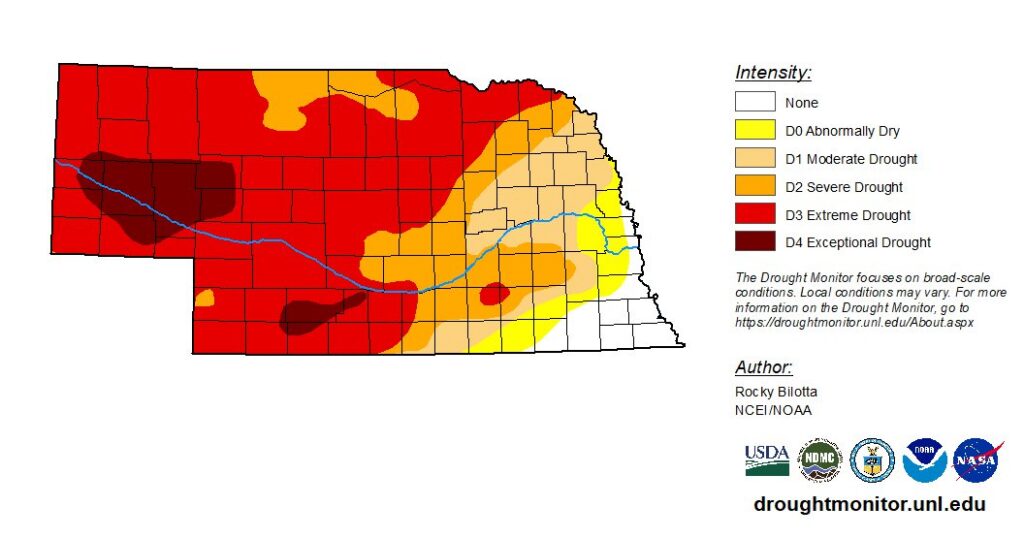
The National Weather Service reported that Lincoln received almost 2.3 inches of rain on Saturday, followed by over an inch from Sunday to Monday. This influx of precipitation has helped alleviate drought conditions in Lancaster County and much of southeast Nebraska, as indicated by the latest Drought Monitor from the University of Nebraska-Lincoln.
However, the situation remains dire in western Nebraska and the Panhandle, where rainfall was minimal, ranging from a tenth to half an inch across most areas.
“In powerful contrast, intense convective activity generated a sharp corridor of heavy rainfall across eastern portions of Kansas and Nebraska,” U.S. Drought Monitor authors Rocky Bilotta and Tsegaye Tadesse noted. “Totals in this localized zone rapidly climbed between 2.5 and 5.5 inches, with departures ranging between 1.5 to over 4.5 inches above normal, resulting in improvements to moderate (D1) to exceptional (D4) drought in Nebraska and moderate (D1) to extreme (D3) drought in Kansas.”
According to Taylor Nicolaisen, a meteorologist with the National Weather Service in Valley, southeast Nebraska has been relatively fortunate in terms of precipitation over recent months.
“The northeastern corner of the state’s still too dry, still running behind schedule for precipitation. So kind of a split story there, down the half of the eastern side of the state,” Nicolaisen explained.
While the eastern regions are seeing some easing of drought conditions, reflected in improvements from abnormally dry to moderate levels, the wider picture for the state remains concerning, with 95% of Nebraska still experiencing drought.
“We’ve actually been running ahead of normal for precipitation based south of Omaha,” Nicolaisen mentioned. “We’ve run ahead of precipitation if you look at it over the last 30 days, or the last 60 days, 90, 120 days, regardless of how you look at it, areas south of Omaha have been doing well for precipitation, and then the rest of the state’s the exact opposite.”
Nicolaisen also highlighted that the lack of winter precipitation has been more severe than usual, contributing to the expansion of drought conditions over the past six months.
“Those drought conditions really expanded over the last six months or so,” added Nicolaisen.