With advances in technology, researchers are now utilizing GIS and GPS transmitters to accurately track the movements and behaviors of prairie chickens. This technology allows for precise location tracking, providing insights into the habitats these birds prefer and avoid, and areas where they experience varying levels of nesting success.
In the regions of Nebraska and Kansas, researchers are actively studying the movements and population dynamics of prairie chickens. They aim to identify beneficial habitats and understand the factors leading to mortality. Additionally, the research extends to analyzing the prairie chickens’ diet, gut microbiomes, and genetics.
One particular group near Fort Riley, Kansas, has become isolated, leading to concerns about potential changes or decline in their population. Much of the data collected focuses on female prairie chickens, as they are more active and critical to understanding nesting success.
“The hens are arguably the most important thing here, because we’re really wanting to see not only habitat use, but we’re wanting to see where they’re nesting, how successful their nests are, where they are, and what type of habitats their broods are using,” Walker said. “Because ultimately, if they’re not being produced, if they’re not being successfully raised to adult status, to where they can reproduce – that’s really the most important component of this, is figuring out what works best for the hens and the broods.”
Banded Birds and Little Lunges
From her vantage point in the blind, Klosterman whispers, “The birds are over there! Here they are,” as she observes the prairie chickens through her binoculars. The males and females exhibit distinct behaviors, with males sticking to patterns and females providing broader insights into species-wide impacts.
O’Connor notes that male prairie chickens mainly focus on survival post-lekking season, whereas females engage in nesting and brood-rearing activities, offering more comprehensive data on the species’ lifecycle.
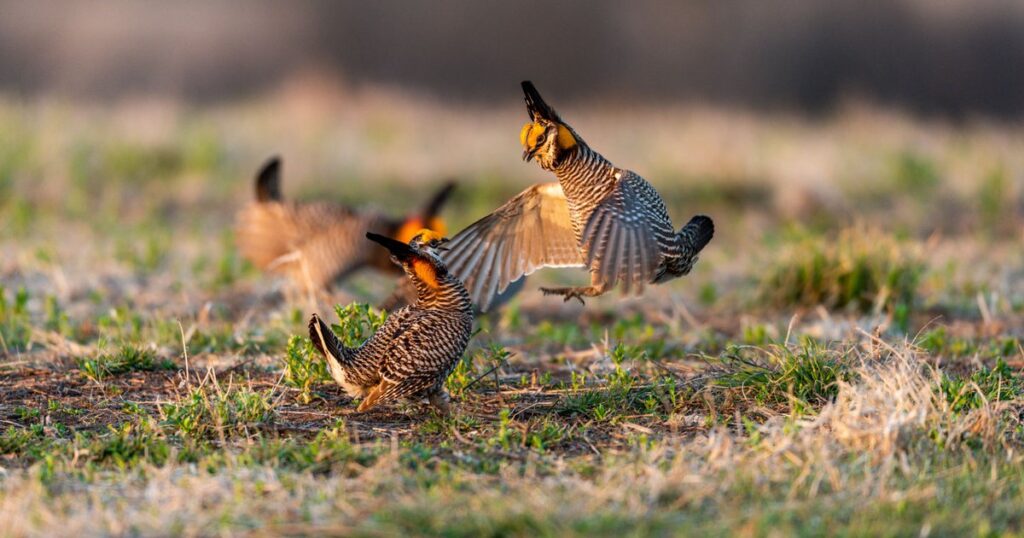
At a lek in Rock County, a lone female is surrounded by 15 males. As the males display their plumage and perform mating dances, the female remains largely unimpressed. The cold, rainy weather appears to have subdued the usual vigorous activities, but as mating season progresses, competition among males is expected to intensify.
“Usually, they’ll lunge at each other a little bit,” Klosterman comments. “In some really rough fights, you’ll see one of them will get the other with its feet and just start flapping around and trying to drag the chicken out of the spot that it wants to be in. There’s a lot of bluffing and a lot of little lunges.”
Klosterman meticulously records notes about the weather and interactions on a large notepad, observing that stronger males tend to take central positions within the leks, while younger males linger on the periphery.
Despite attempts to trap the sole female, one male inadvertently leads her away from the trap’s gate. Klosterman reflects on the variability of research days, having captured six females previously, with a particularly successful morning yielding three captures in succession. Quick action is taken to band and sample new captures to minimize their stress.
As raindrops intensify and fog creeps over the meadow, the female bird momentarily locks eyes with the researchers before the fog obscures their view, prompting the birds to retreat into the tall grass. “Well, if that ain’t the middle finger,” O’Connor jokes, as the researchers realize they must wait longer for their next opportunity.
With the meadow now empty and the birds dispersed, O’Connor explains that the sudden fog prompted their flight to more secluded areas, leaving the researchers to plan their next steps in their ongoing study.