This story is brought to you through a collaboration between BPR and Grist, a nonprofit environmental media organization, along with WABE, Atlanta’s NPR station; and WBEZ, a public radio station serving the Chicago metropolitan area.
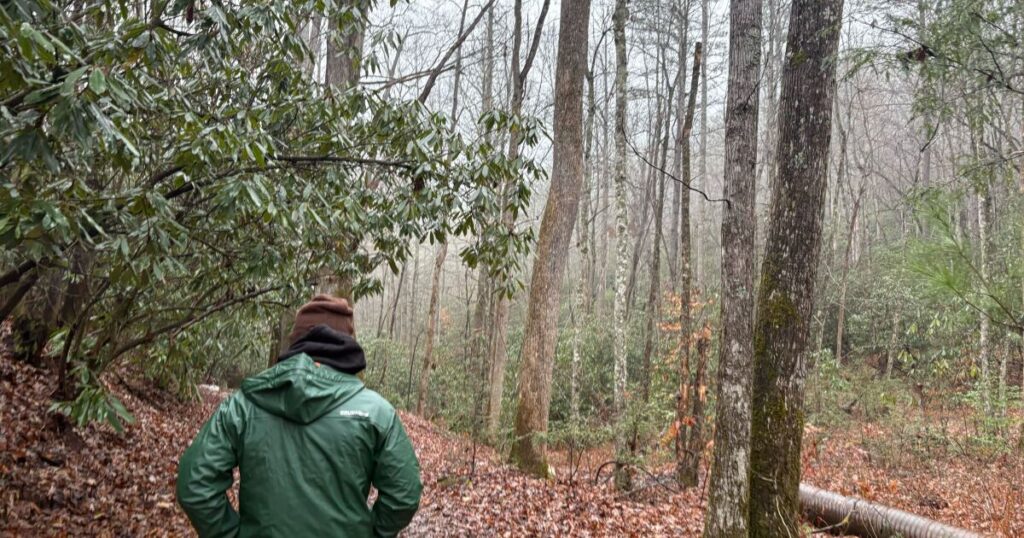
As the fog hung low over the South Mills River near Brevard, North Carolina, outdoor guide Heath Cartee observed the loose soil slide into the cold water, a visual reminder of the silt accumulating in the river. “They can’t even keep up with what they got,” he remarked, highlighting the sediment that fills the riverbed, affecting aquatic life.
Cartee stood on what used to be a road, now abandoned and disrupted by Hurricane Helene, leading to a damaged footbridge. This river, along with its 8,600-acre surrounding tract, is part of North Carolina’s 172,000 acres of roadless forests. Over time, Cartee has witnessed many Forest Service roads deteriorate, their remnants spilling into water bodies and affecting habitats where creatures like salamanders and trout thrive.
“Those interstitial spaces don’t exist anymore, and therefore that life doesn’t exist anymore, and it begins to sterilize the river,” he noted.
South Mills, despite its similarity to other Western North Carolina forests, holds a special place for Cartee, who prefers it over nearby Pisgah National Forest, which he feels has suffered due to extensive access and development. For Cartee, places like South Mills offer a glimpse into true wilderness, a concept he fears people may lose. “How do you explain what chocolate cake tasted like if they’ve never tasted it and it doesn’t exist?” he pondered.
This roadless area spans nearly 12 miles along the river adjoining Pisgah, requiring challenging hikes and stream crossings to reach prime fishing spots. This effort, according to Cartee, is part of what makes trips here rewarding for his clients.
The area, along with 416,000 roadless acres in the Southeast and about 2 million nationwide, is safeguarded by a distinctive federal policy that is now under threat of repeal.
A Contested Regulation
In 2001, the U.S. Forest Service recognized the issue of maintaining a vast network of roads and introduced the Roadless Area Conservation Rule. This rule prohibited road construction and logging over nearly 60 million acres across 39 states, protecting undeveloped national forests. In the East, these areas are vital ecological havens amidst dense development.
Last fall, the Trump administration initiated efforts to repeal the rule, allowing a brief 21-day public commentary period. Despite this, over 220,000 comments were submitted, with nearly all opposing the repeal, citing concerns for wildlife, tourism, and water quality, as per an analysis by Roadless Defense.
The administration is determined to proceed, seeing this as part of a larger strategy to boost logging and transform the nation’s second-largest land agency. Recently, 57 of the 77 Forest Service research stations were closed, impacting studies on climate change and forest health. Additionally, the headquarters is set to relocate to Salt Lake City from Washington, D.C., with nine regional offices shutting down.

Since returning to office, Trump has pushed for increased timber production, including easing legal pathways to facilitate logging. With the Department of Agriculture seeking to overturn the roadless rule, the debate extends from policy circles to the woods and adjacent communities.
According to the Department of Agriculture, which oversees the Forest Service, the Roadless Rule hinders efforts to manage wildfire risks and maintain firefighter access. Brooke Rollins, Secretary of Agriculture, criticized the policy as “absurd obstruction,” arguing that repealing it would enhance forest protection and support rural economies.
Nevertheless, some former Forest Service leaders disagree with the rollback. Four former chiefs, with 150 years of combined experience, have advocated for preserving the rule. Vicki Christiansen, former agency leader, warned, “Removing protection of these precious lands that belong to all citizens, rich and poor, would be an irreparable tragedy.”
Having grown up in the Carolina mountains, Cartee’s connection to these woods is both personal and professional. He operates Pisgah Outdoors, guiding clients on fishing trips into the South Mills River wilderness. The area’s remote watersheds are crucial for species like trout and bass, which attract many returning visitors.
Outdoor activities are pivotal to the economy of Western North Carolina, contributing up to $4.9 billion annually. Many of those engaging in hunting and fishing lean conservative, yet the proposal to repeal the roadless rule has galvanized their opposition.
Jordan Linger, a bowhunter from Backcountry Hunters and Anglers, emphasized the appeal of the challenge: “People want to have that challenge of, ‘Hey, I hiked eight to 10 miles, camped out, and came out with these birds, this trout, and one of the most amazing deer I’ve ever seen in my life.’” He noted that hundreds have contacted the organization to voice their displeasure.
Roadless Areas and Wildfire Concerns
In the Southeast, not everyone accepts the administration’s claims about firefighting.
The Chattahoochee National Forest in northern Georgia, a remote and breathtaking expanse, comprises about 751,000 acres. Although only 7% remains roadless, this area represents a rare, untouched wilderness in the East.
“If lightning hit one of those peaks and started burning, starting a fire, it would get a fair way before they could maybe do much about it,” explained JP Schmidt, an ecologist with Georgia Forest Watch.
The U.S. Forest Service argues that limited road access hampers firefighting efforts, with the 2016 Rough Ridge fire, which burned 28,000 acres, illustrating these concerns. James Sullivan of Georgia Forest Watch recounted how the fire threatened local communities but ultimately burned uncontrolled in many areas.

Fire, when managed properly, can benefit forest health by clearing debris and reducing fire risk. “You’ve got all these fuels taken care of,” Schmidt said, “and there’s much less threat of a major fire again any time soon.”
Historically, the Forest Service prioritized fire suppression, but perspectives shifted in the 1960s, and now controlled burns are widely used to enhance forest health.
Laura Fitzmorris, a Forest Service spokeswoman, highlighted the role of prescribed fire in maintaining healthy forests. These roadless areas are small and interspersed with communities, making access a factor but not the sole consideration in wildfire response.
Human activity is a significant cause of wildfires. From Virginia to Texas, people were responsible for 23,980 fires in 2024, while lightning caused only 809. Roads can facilitate access for both firefighters and those who might accidentally or intentionally start fires, said Sam Evans of the Southern Environmental Law Center. He criticized the administration’s reasoning, calling it “malarkey.”
Back in North Carolina, Cartee reflected on the changes he has witnessed over his lifetime: roads transforming from dirt to gravel, to paved, fragmenting the forest. He perceives this as more than just a physical change; it’s a loss of something sacred.

“When you go to the wilderness you have to go there for spirituality,” Cartee said. “It doesn’t mean that you’re going to find ‘God’. It also doesn’t mean that you’re going to find the devil. You’re likely to find both.”
As Cartee left South Mills, the natural scenery gave way to civilization, prompting him to consider the profound impact of roadless areas. They offer a chance to connect with nature and reflect on one’s place within it, a sentiment shared by many who venture into these wild spaces.