In a remarkable display of human exploration, NASA’s Artemis II mission has set a new record, taking humans further from Earth than ever before. This historic milestone has captivated space enthusiasts, including amateur astronomer Tom Wildoner, who expressed his amazement at the stunning images from the mission.
“Absolutely incredible,” said Wildoner, a resident of Carbon County, as he admired the breathtaking view of Earth setting behind the Moon. “The Earthset behind the moon, that’s my new desktop image.”
The mission offered its four-person crew the rare opportunity to witness both the Moon and Earth simultaneously, unveiling a previously unseen side of the Moon. The research-focused mission tested NASA’s latest spacecraft, marking a critical step toward future Mars expeditions.
The Wilkes-Barre Astronomy Club hopes that the achievements of this mission will spark interest in space exploration among the public, as there is still much to uncover.
A Unique Hobby
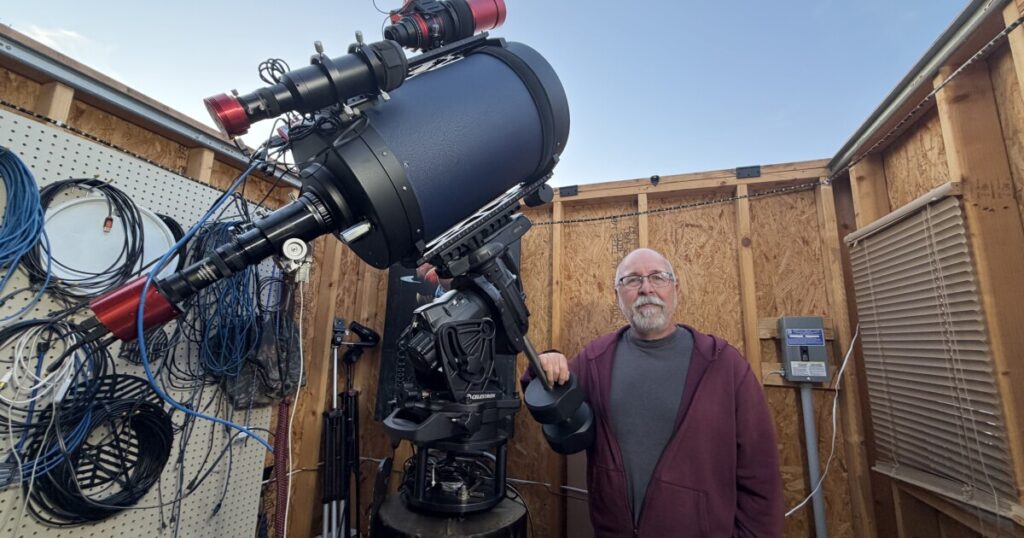
Tom Wildoner, who owns four telescopes and a personal observatory in Packer Township, is deeply immersed in the world of astronomy. His work, captured through his Dark Side Observatory, has been featured in numerous publications, including the Washington Post.
Wildoner utilizes a digital telescope, which he operates via a smartphone app. “Type in Venus … It will slew the telescope and point it to Venus,” he explained. “It’s got USB ports right here, you put a thumb drive in it and it saves the images right on the thumb drive. You take it into the house, pull them up and process them.”
Having started his hobby in the 1970s, Wildoner has seen the transition from film to digital, which required him to relearn the craft in 2010. “I did my own processing, my own film, and then I got out of it for a while,” he said. “When I got back into it in 2010, everything was digital. So I had to learn it all from scratch.”

Tom Wildoner
/
The Dark Side Observatory
As a member of the Wilkes-Barre Astronomy Club, Wildoner shares his knowledge and passion, hoping to inspire others to explore the cosmos.
Wilkes-Barre Astronomy Club
Founded by Jon Belanger, the Wilkes-Barre Astronomy Club aims to be an accessible resource for the community, welcoming individuals regardless of their technical background.
“It’s something I’ve been thinking about for a very long time,” Belanger shared. “I really love just being able to show people stuff in a telescope.” The club plans to offer free events and collaborate with schools and local organizations to cultivate interest in astronomy.
Belanger, who also serves as the Friedman Observatory assistant at Penn State Wilkes-Barre, emphasizes the club’s inclusive nature. “I want it to be a resource for the community, where anyone can feel they can come out, regardless of technical background or experience or anything,” he said. “We’re a welcoming group of people.”
The club’s initiatives include hosting star parties, where members set up telescopes for public viewing. “Everybody picks a different target. People come out and they go from telescope to telescope,” Wildoner explained. The next star party is scheduled for May 16 at Francis E. Walter Dam in White Haven, with plans for monthly events throughout the summer.
“[Space] is our last place to really explore. And really all you need to do is buy a telescope and point it,” Belanger said. “There’s always this wow factor. I really enjoy doing that, and in doing that, I also learn a lot myself.”