
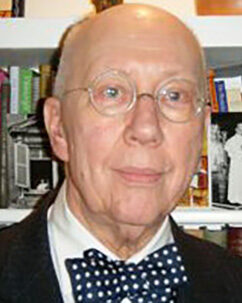
An Illustrious Scholar and Revered Educator: The Legacy of Charles Witke
Renowned for his scholarly contributions to Latin literature and beloved for his engaging personality, Charles Witke, professor emeritus of Greek and Latin, passed away on March 21, 2026. His academic journey and personal anecdotes paint a picture of a distinguished career and a life dedicated to the pursuit of knowledge.
Edward Charles Witke was born on September 22, 1931, in Los Angeles, to Emil Ernst and Ethel Ann (Martin) Witke. His academic path began with a B.A. from the University of California at Los Angeles in 1953, followed by an A.M. and Ph.D. from Harvard University in 1957 and 1962, respectively.

Witke’s teaching career commenced at the University of Chicago, soon after which he joined the University of California at Berkeley, attaining the role of associate professor and chairing the Committee on Mediaeval Studies from 1964 to 1970. His academic journey then led him briefly to the State University of New York at Binghamton, before becoming a prominent figure at the University of Michigan in 1971. There, he served as a professor of classical studies and director of the Program in Comparative Literature.
His leadership roles at the University of Michigan included serving as associate dean of LSA from 1971 to 1974 and being part of the executive committee from 1975 to 1978. Witke also pursued a spiritual path, becoming ordained as a deacon in 1988 and a priest in 1989 within the Episcopal Church. He retired in 2001 and is survived by his wife, Aileen Gatten.
Professor Witke’s legacy in Latin literature is marked by his significant monographs on Roman satirists like Lucilius, Horace, and Juvenal. His later research interests shifted towards medieval and Renaissance texts, contributing to fields such as Latin paleography and the Western Christian church’s theological history. In one of his notable accomplishments, he translated Erasmus’ “Hyperapistes.”
Italy played a pivotal role in Witke’s academic life, with a Fulbright Fellowship and the Rome Prize from the American Academy in Rome awarded to him in the early 1960s. His connection with the Academy was enduring, culminating in his appointment as a Resident in 1997. Additionally, he received grants from several universities and the National Endowment for the Humanities.
Witke’s legacy is further characterized by his wit and charm. Known for his humor, he once humorously critiqued a work on Roman satire as a satire itself. His bow tie became an iconic symbol, with the mirror he used to tie it daily being cherished by the Department of Classical Studies.
During his time as associate dean, he played a role in approving tenure-track positions for archaeology and Greek literature, even drafting the decision letter in Latin. A memorable exchange with D. R. Shackleton Bailey followed, marked by an ongoing debate over which letter displayed greater elegance.
Anecdotes from students also highlight Witke’s character. One student, tasked with housesitting, recalled his calm and caring reaction when informed of an accidental dent in his car: “Are the dogs OK?” he asked first, and after ensuring no damage was done to the garden, remarked, “Well, then nothing important was damaged.”
— Submitted by Basil Dufallo, professor of classical studies, LSA



