Stranded for days in New York due to severe weather and flight delays, Susan Kluttz and her husband made a pivotal decision. Abandoning their plane tickets, they opted for a journey on Amtrak’s Carolinian train, which conveniently brought them directly to Salisbury, NC, mere blocks from their home.
Susan Kluttz, a staunch rail advocate and former mayor of Salisbury, now serving as mayor pro tem, values the train service and hopes for similar connectivity in Asheville. “It connects you with the world,” Kluttz shared with BPR. “And Asheville is just too cut off right now. And we need to get that back. Asheville and Western North Carolina need to have the advantages that we’ve experienced in Salisbury, of being right on that line.”
Felicia Sonmez
/
BPR News
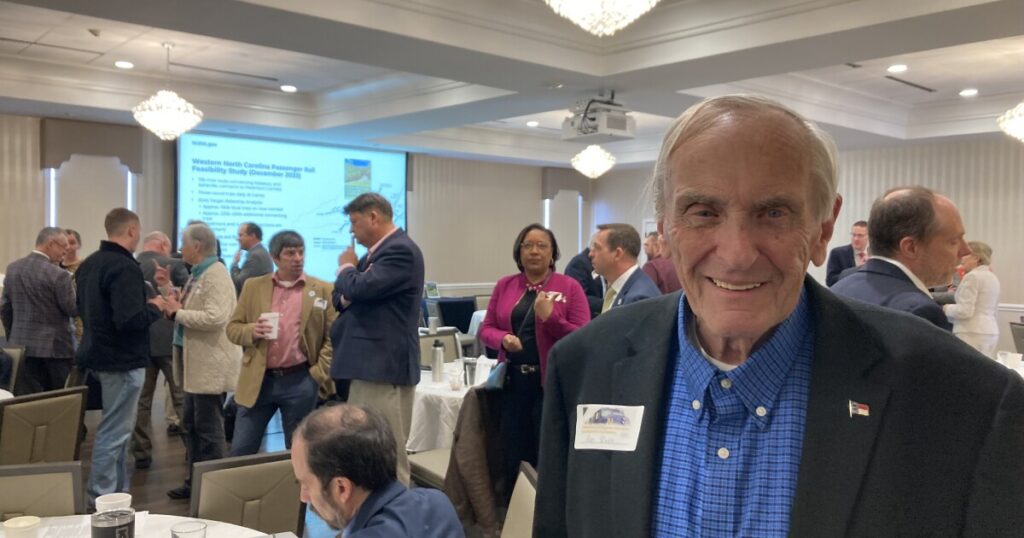
Recently, Kluttz addressed a rail conference in Morganton where 140 participants gathered to deliberate on the proposed Asheville-to-Salisbury rail connection. This gathering was organized by the Western North Carolina Rail Committee, a nonprofit advocating for rail service restoration in the area.
The concept of reintroducing the passenger train service, which last operated in 1975 between Asheville and Salisbury, has gained significant traction. Proponents argue that the new rail line will not only alleviate traffic congestion on Interstate 40 but also enhance connectivity with the broader state and bolster economic growth, particularly following the devastation of Hurricane Helene.
A study from North Carolina State University earlier this year anticipates a $1 billion economic impact during construction and $60 million annually thereafter. The project is predicted to generate hundreds of jobs and nearly $2 million in state and local tax revenue annually.
Ray Rapp, co-chair of the WNC Rail Committee and former state legislator, expressed renewed optimism about the rail project. “It is fast becoming a reality – the potential for this corridor project. And so, we need to be ready,” Rapp conveyed at the Morganton conference.
Local Governments Eye Funding Solutions
The proposed rail line would span 139 miles, offering three daily round trips between Asheville and Salisbury, with each journey taking approximately three and a half hours. A feasibility study conducted for the North Carolina Department of Transportation outlines the potential route and logistics.
While the project is under federal consideration, funding remains a critical hurdle. Rapp emphasized the necessity for local and state financial contributions.

“Many small towns are going to have to rely on tourism development authorities [and] economic development organizations similar to the ones we heard today, to help them get grants,” Rapp noted, highlighting the importance of community involvement to secure necessary funding.
The total cost of the project is estimated at $665 million, with the federal government anticipated to cover 80%, contingent upon local and state funding of the remaining $133 million.
Asheville, still grappling with financial recovery post-Hurricane Helene, is exploring partnerships to bridge its budget gap. “We will be looking for private partners, whether it’s the Tourism Development Authority or other funding sources to help make sure we have our part in the game,” Asheville Mayor Esther Manheimer explained.

Courtesy of Norfolk Southern
Asheville faces a $14 million budget gap for the upcoming fiscal year. Manheimer remains hopeful, leveraging external support to ensure the rail project’s success.
The Buncombe County Tourism Development Authority noted that it remains early to determine specific funding proposals, awaiting submissions from local governments and nonprofits. In past discussions, the WNC Rail Committee has engaged with TDA leaders and city staff regarding grant applications.
Deciding on Asheville’s Depot Location
Determining the location for Asheville’s train depot stands as another crucial decision for local authorities. While city-owned land near Biltmore Village was previously considered, flooding from Hurricane Helene has raised questions about its viability.
The River Arts District has surfaced as an alternative, albeit with an additional $5 million cost according to the feasibility study.

Felicia Sonmez
/
BPR News
State House Speaker Destin Hall, the keynote speaker at the Morganton rail conference, acknowledged the project’s importance but withheld specifics about legislative funding support, stating, “That’s something we’re looking at.”
Community involvement is crucial for the rail project’s progress. “What we need right now is we need champions,” said Paul Ballard, WNC Rail Committee member and former interim director of Asheville’s Transportation Department. “People who are willing to come up, speak up, show up and talk about how important the train is to them, and how it will improve their lives and the lives of their families.”