Rising Latino Voter Participation Among Youth in Mecklenburg County
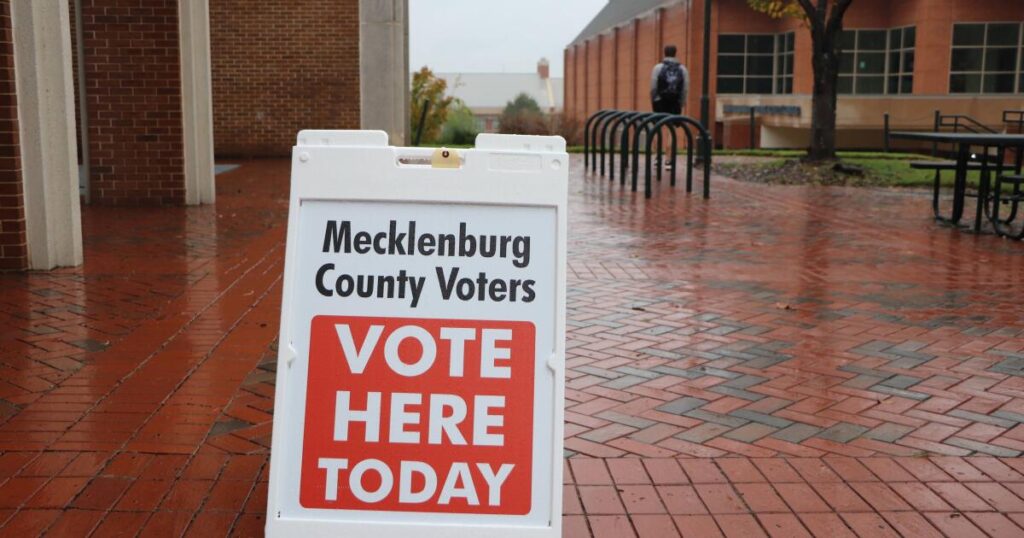
Amid a backdrop of evolving political dynamics, young Latino voters are making their presence felt in Mecklenburg County. The 2026 primary election witnessed increased participation from this demographic, signaling a shift in engagement levels compared to prior years.
Carolina Quintana Ocampo, a young voter from the University area, expressed her motivation for participating in the election. “I just came out here to vote because I want my voice to be heard,” she stated. “This is one of the few ways I can still do it.” For Quintana Ocampo, whose parents are not citizens, voting holds a personal significance. “My parents can’t really vote, and I just want to represent that part of myself too in these elections,” she added.
Recent data from Mecklenburg County reveals a notable increase in young Latino voter turnout. Specifically, 930 Latinos aged 18 to 25 voted in the 2026 primary, compared to 328 in 2024 and 196 in 2022. Lennin Caro from the Camino Research Institute remarked, “This is breaking expectations based on last years.” Caro also noted that events in Charlotte in 2025, such as increased immigration enforcement and more Latino candidates, may have contributed to this uptick.
Despite the promising trend, disparities remain, particularly in gender participation. This year’s primary saw more than double the number of young Latina women voting compared to their male counterparts, a recurring theme in past elections. Caro emphasized, “While this is a good thing to celebrate, we should be wary that there is still that fundamental issue of low male Hispanic participation.”
Overall, Latino voter turnout remains underwhelming, with only 8% of registered Latinos participating, in contrast to 15% of all registered voters in the county. Community organizers highlight the role of outreach in addressing this gap. Jess Villatoro from Siembra NC pointed out the lack of direct engagement, saying, “The doors of Latinos are not being knocked. You’ll get to a door and they’re like, ‘Oh, no one’s ever come to talk to me about who I’m voting for.’” Siembra NC concentrated its outreach efforts in certain Charlotte neighborhoods, employing tactics such as door knocking and community discussions.
Villatoro attributes the heightened engagement among young Latinos to recent issues, particularly immigration enforcement, impacting their communities. “This election came at a time where there was still a lot of uncertainty, as there still is in our community,” Villatoro observed. “I think that’s why people felt like they needed to take action now.”
Nevertheless, primary election turnout remains significantly lower than that of the upcoming November general elections, where voter participation traditionally spikes. Campaigns are already intensifying efforts to engage Latino voters ahead of November. The LIBRE Initiative, endorsing Republican U.S. Senate candidate Michael Whatley, is ramping up outreach in Latino communities through door knocking and Spanish-language engagement. On the other side, Democratic U.S. Senate candidate Roy Cooper’s campaign is emphasizing Latino outreach via listening sessions with Latino leaders and the distribution of Spanish-language literature.
Both political parties recognize the potential influence of Latino voters in what promises to be a pivotal race, underscoring the importance of their inclusion.