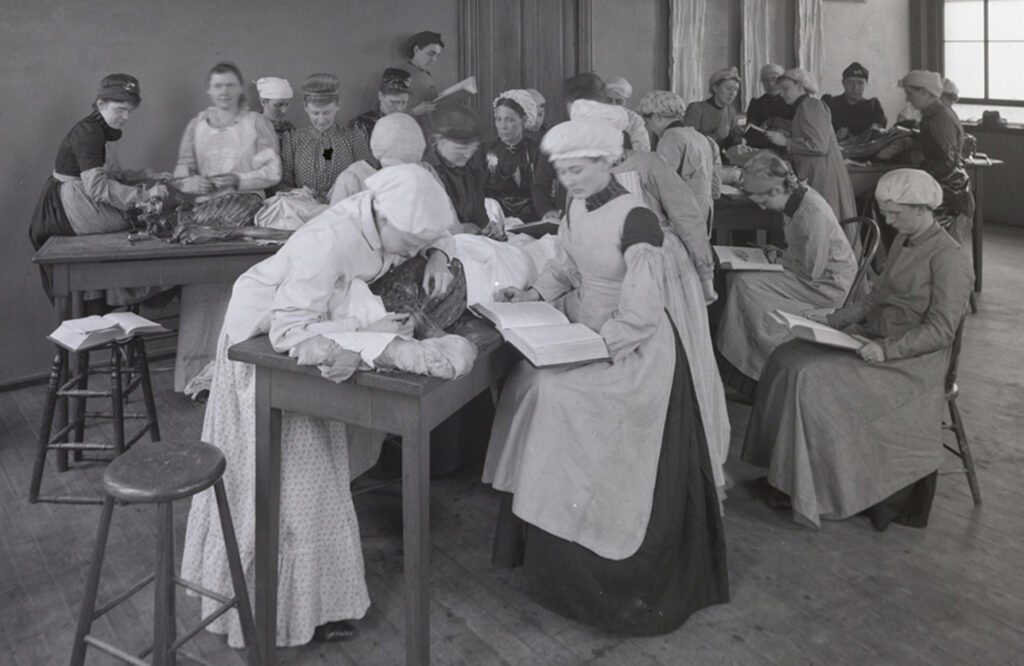
A Historical Leap: Women Pioneers in Medicine at the University of Michigan
The year 1870 marked a turning point in the realm of medical education when the University of Michigan’s Board of Regents voted to permit women to study medicine, a revolutionary decision at the time. This move opened doors for countless women to enter the medical profession and contribute significantly to healthcare and research advancements.
Despite the groundbreaking decision, the integration of female students was not without its challenges. That fall, 18 women enrolled in the medical program, yet they were required to attend their classes separately from male students with only one exception.

Emma Call, one of the first female medical students, chronicled her experiences: “The first class of women … were naturally the objects of much attention, critical or otherwise (especially critical) so that in many ways it was quite an ordeal. I believe that only one of the medical faculty was even moderately in favor of the admission of women, so that it speaks well for their conscientiousness when I say (with possibly one exception) we felt that we had [a] square deal from them all.”

Amanda Sanford made history in the spring of 1871 by becoming the first female medical graduate from U-M. Despite facing hostility during her graduation, she went on to have a remarkable career in upstate New York, also advocating for women’s suffrage.
The subsequent year saw Sarah Gertrude Banks, fondly known as “Gertie,” receive her medical degree alongside five other women. Yet, their achievements were minimized as their names appeared after male graduates in the program, and they were excluded from the class photo. Banks, however, rose to prominence in Detroit, serving patients across the social spectrum and supporting the suffrage movement.
By the fall of 1874, while coeducation in classrooms was realized, gender segregation persisted with women and men seated apart, divided by curtains or lines.
Eliza M. Mosher graduated the following spring, having worked as an anatomy demonstrator throughout medical school. After practicing in New York, she returned to U-M as its first female faculty member, contributing significantly as a professor and the first dean of women. The Mosher-Jordan residence hall honors her legacy.

In 1878, Grace Roberts broke another barrier by becoming the first Black woman to graduate from U-M, earning her degree from the homeopathic medical school, which later closed in 1922.
By the dawn of the 20th century, 394 women had earned medical degrees from U-M, comprising 20% of the graduating class at that time. Today, women represent over half of incoming medical and biomedical science students, and notable advancements have been made in faculty representation, though disparities remain in higher ranks and the distribution of endowed chairs.
—By Kara Gavin, Michigan Medicine. For more information on women making history at Michigan Medicine, go online to myumi.ch/jJ9NG.