Charlotte’s Ambitious Silver Line Extension Faces Financial Hurdles
The expansion plans for Charlotte’s Silver Line light rail are facing potential financial setbacks, as extending the route deeper into east Charlotte and Matthews requires additional funding. A recent proposal by the Metropolitan Public Transportation Authority (MPTA) suggests that a new sales tax might be necessary to complete this ambitious project.
Set to begin operations this summer, the MPTA will oversee Charlotte’s transit system, supported by a newly introduced one-cent sales tax. This tax, approved by 52% of voters in Mecklenburg County despite opposition in Matthews and east Charlotte, designates 60% of its revenue for trains and buses, while 40% is allocated to road infrastructure.
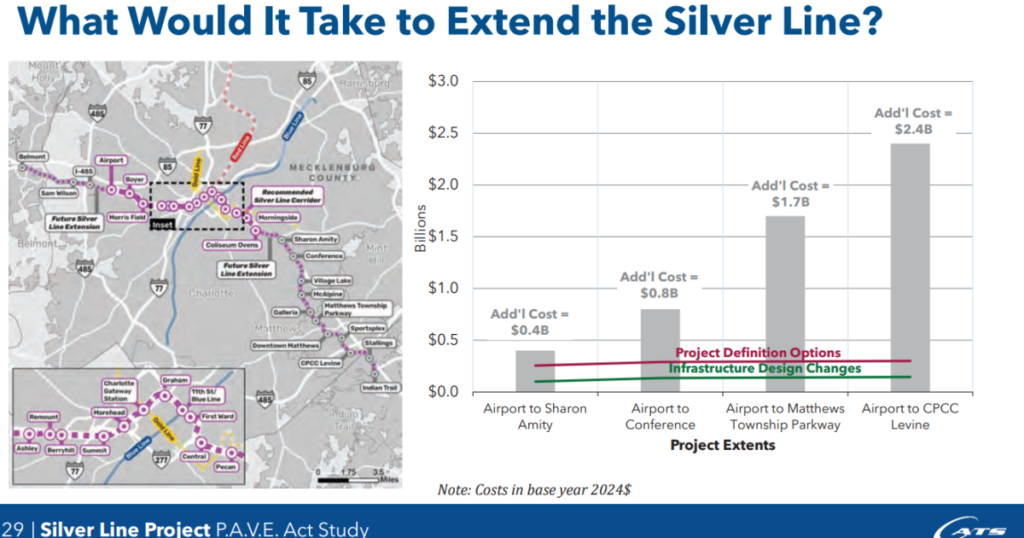
The initial Silver Line plan extends from the airport to Bojangles Coliseum, but extending it to Sharon Amity Road would incur an additional $400 million, and reaching Central Piedmont Community College in Matthews would cost an extra $2.4 billion.
Consultants from WSP have suggested potential savings of $200 million for the Silver Line’s first phase. Proposed cost-cutting measures include consolidating certain stations in west Charlotte, modifying the route in uptown, and repositioning the line near Bojangles Coliseum.
WSP also explored the possibility of bringing the Silver Line closer to Charlotte Douglas Airport’s terminal. Currently, the plan places the airport station on Wilkinson Boulevard, roughly a mile from the terminal. A new proposal suggests a closer station, reducing the distance to half a mile, and aligning the line with existing Norfolk Southern rail tracks.
Despite these potential savings, extending the line to Sharon Amity would still require additional funding. A further extension to Matthews might necessitate a new quarter-cent sales tax, marking the county’s third transit-related tax.
Alternative funding strategies, such as selling naming rights for stations, have been considered but are unlikely to generate significant revenue. The legislative framework for the existing transportation tax, known as the PAVE Act, prioritizes the construction of the Red Line commuter train to Lake Norman, estimated at $1.4 billion, before the Silver Line extension.
Recently, the Charlotte City Council authorized $37.9 million for ongoing engineering work on the Red Line, which will refine cost and ridership estimates. Any increase in projected costs could further challenge the Silver Line’s eastern extension. Additionally, if the Federal Transit Agency does not provide a 50% construction cost grant, the project’s feasibility may be compromised further.