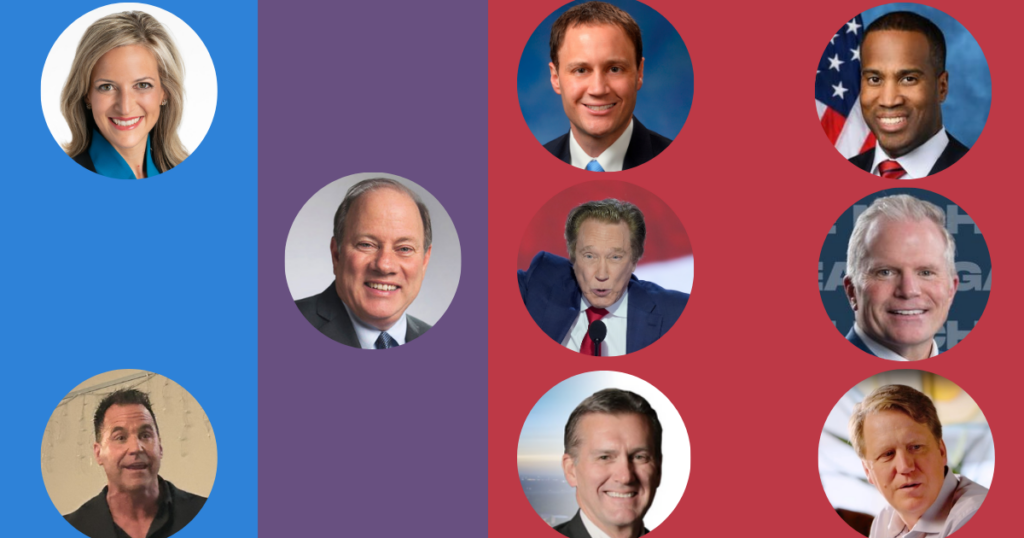
Michigan’s upcoming gubernatorial election brings education to the forefront, with candidates vying to address significant challenges in the state’s school system. From literacy issues to teacher shortages, the new governor will face a daunting task.
K-12 education emerges as a pivotal topic among voters, as highlighted by the Bridge Listens survey, prompting nine gubernatorial candidates to share their strategies on pressing educational matters.
Each candidate, spanning Republican, Democrat, and independent affiliations, provided insights on six critical education topics. Their responses reveal varied approaches to tackling Michigan’s educational challenges.
Childhood Literacy
Michigan’s ranking of 44th in fourth-grade reading performance has prompted candidates to propose solutions for improving literacy. Many agreed on the necessity of hiring more literacy coaches and tutors, though Swanson and Johnson did not specify this approach.
Several Republican candidates, including James and Cox, emphasized phonics-based teaching. The forthcoming 2024 law mandates reading science training for teachers by 2027-28, with options like LETRS gaining attention through a bipartisan bill.
Johnson highlighted the diversity of Michigan’s educational landscape, suggesting a focus on results over rigid policies. Swanson proposed expanding early childhood education as a means to enhance literacy.
Leonard and Nesbitt called for reinstating the third-grade reading retention law repealed in 2023, while Johnson advocated for a focus on educational outcomes rather than strict regulations.
Choice and Charters
The debate over public school choice and charter schools sees Republicans favoring parental control over school selection and funding. Democrats, however, prioritize strengthening public schools.
The Education Freedom Tax Credit, part of Trump’s tax legislation, allows refunds on donations to scholarship-granting nonprofits. Critics view it as a “school voucher scheme,” yet it has been adopted by 23 states, excluding Michigan.
Republicans largely support the tax credit program, though Johnson emphasized the importance of flexibility and parental choice. James advocated for immediate participation in the federal choice program.
Duggan and Benson, leaning towards public school support, argue for holding charter schools to similar standards as public ones, emphasizing resource allocation to neighborhood schools.
College Readiness
With only 27% of high schoolers deemed college-ready, candidates stress the importance of expanding post-high school opportunities, particularly in skilled trades.
Duggan proposes a substantial increase in funding for career and technical education (CTE) pathways, aiming for a five-fold rise over five years. Benson envisions a graduation standard combining academics and career skills.
Republicans like Leonard look to emulate programs from Tennessee and Colorado, while Johnson emphasizes the need to refocus on fundamental skills. Swanson advocates for military service and opportunities for formerly incarcerated individuals.
Staff Challenges
Addressing teacher shortages, candidates propose simplifying certification processes and enhancing compensation.
Benson suggests raising starting salaries to $60,000, with Swanson supporting similar measures. Duggan promotes teaching apprenticeships and simplifying out-of-state teacher certifications.
Leonard and James advocate for alternative certification pathways, while Nesbitt stresses rewarding top educators. Cox highlights structural mismanagement in schools, calling for a balance between administration and teaching staff.
Changing School Metrics
Michigan’s school accountability measures have evolved, with candidates offering varied solutions.
Republicans Nesbitt, Rebandt, and Cox support reverting to the A-F grading system. Swanson seeks a bipartisan task force for a new grading approach.
Leonard proposes grading based on student growth and proficiency, while James aims for transparency in school assessments. Duggan suggests an accountability office under the governor’s supervision.
School Funding and Equity
While Michigan’s per-pupil funding has increased, disparities persist in district resources. Candidates differ on funding reforms.
Benson criticizes the current funding model, advocating for a transparent system meeting unique school needs. Republicans argue for a focus on educational results over funding formulas.
Several candidates, including Swanson and Duggan, oppose budget diversions from the School Aid Fund. On student meals, Nesbitt and Leonard propose income-based access limitations, while James pledges an audit to optimize meal spending.