An Artistic Homage to America’s Bison: Staab’s Journey from Missouri to the Smithsonian
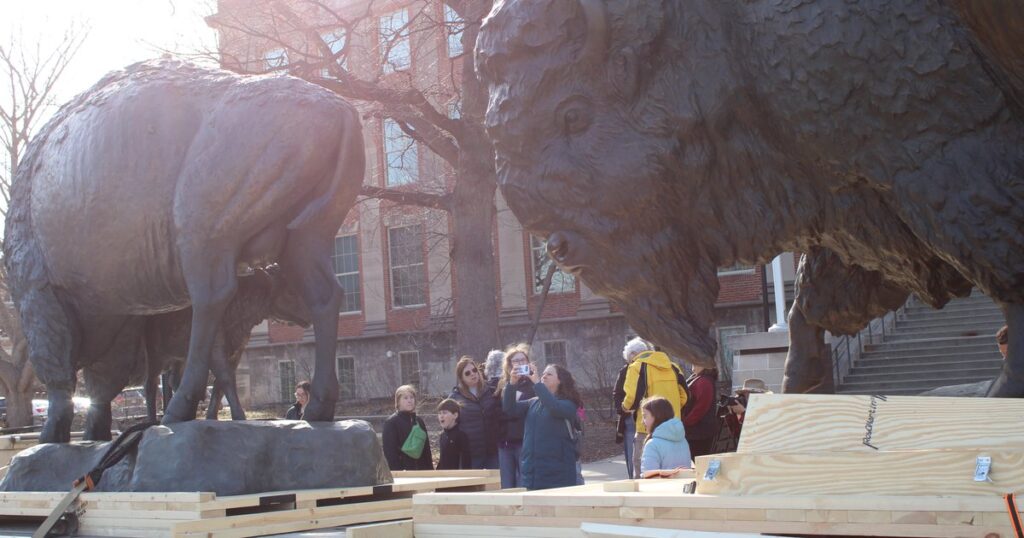
In a remarkable fusion of art and history, James Staab’s larger-than-life bison sculptures are set to debut at the National Museum of Natural History. These sculptures, towering three feet above their living counterparts, are poised to captivate visitors while paying tribute to America’s national mammal.
Staab’s fascination with animals began in Kearney, where he spent his formative years. “I was a feral child out there,” Staab recalled. “I got to catch snakes and box turtles and fish and do all that good stuff.” His early passion led him to taxidermy by age 11, and later, to a career in art and biology, with internships at prestigious institutions like the Smithsonian and the British Museum of Natural History.
The creation process for Staab’s bison sculptures was meticulous and immersive. “The process starts with just trying to gather as much information as you can about your subject,” Staab explained. For him, this meant spending considerable time at a conservation site in Missouri, where he observed and interacted with a small herd of bison.
Staab’s hands-on approach involved feeding the bison and studying their movements closely. “Like with any of these subjects, you want to breathe the same air as that animal,” he noted. This closeness allowed him to authentically capture the poses and gestures of these majestic creatures in his art.
Over six months, Staab developed miniature models to fine-tune the anatomy and expressions of the bison before scaling up to full-size clay molds. The final bronze casts, reinforced with stainless steel, are designed to withstand the test of time and will soon grace the museum’s entrance.
As Staab crafted the sculptures, he delved deeply into bison history. The bases of the sculptures feature replicas of empty rifle cartridges, symbolizing the dark period when bison were hunted nearly to extinction for sport. “It’s such a deep story,” Staab reflected. “We go from at their height about 45 million animals. And we get down to a point where there’s probably less than 500 animals.”
Today, bison populations have rebounded to nearly half a million, predominantly in commercial herds. Kirk Johnson, director of the National Museum of Natural History, emphasized the sculptures’ significance in honoring both the bison’s history and the nation’s heritage. “There really remains a really strong, enduring bind to all Americans to this animal that nearly went extinct and was saved from extinction,” Johnson stated.
The Smithsonian’s connection to bison dates back to the late 1800s, when a herd was brought to the area to highlight the importance of conservation. As the museum prepares to unveil its ‘Bison: Standing Strong’ exhibit this May, Staab’s sculptures will serve as a powerful reminder of the enduring legacy and the conservation success story of America’s bison.