Major Solar and Battery Project Approved in Rock County
A significant renewable energy initiative is set to transform Rock County as state regulators have granted approval for a major solar and battery project. This development promises to supply clean energy to over 45,000 homes, marking a substantial advancement in Wisconsin’s renewable energy efforts.
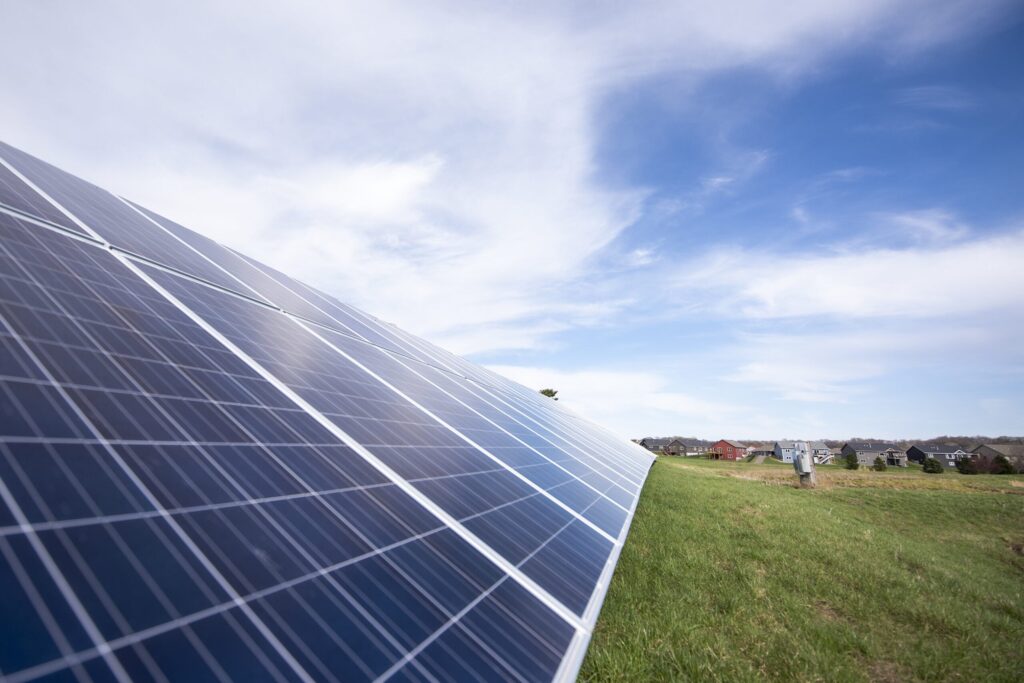
The Public Service Commission gave a unanimous nod to the acquisition plan submitted by We Energies, Wisconsin Public Service, and Madison Gas and Electric. The utilities are set to acquire the Dawn Harvest Solar and Battery Energy Storage Facility, a project spearheaded by the Chicago-based Invenergy. This facility is poised to contribute 150 megawatts of solar power and 50 megawatts of battery storage to the state’s energy grid.
We Energies is set to take the lead as the majority owner, holding the entire battery storage and 120 megawatts of the solar generation. The remaining solar capacity will be divided equally between Wisconsin Public Service and Madison Gas and Electric. Notably, Wisconsin Public Service and We Energies share a parent company, WEC Energy Group.
The acquisition and construction of the Dawn Harvest project are projected to cost approximately $443 million, with operations expected to commence in 2028. This project forms a part of a larger $2 billion renewable energy strategy announced in 2024, which encompasses five wind, solar, and storage initiatives.
Brendan Conway, representing WEC Energy Group, emphasized the long-term financial benefits of these projects, stating, “Over the long-term, these projects really lower costs for our customers. They require no fuel costs. They’re less expensive to operate.”
In a related statement, Madison Gas and Electric President and CEO Jeff Keebler described the company’s investment in Dawn Harvest as a crucial step towards their renewable energy aspirations. Keebler noted, “With our current plans, by 2030, we will have added more than 40 renewable generation and battery storage projects since 2015, totaling more than 750 MW, propelling us toward our goal of net-zero carbon electricity by 2050.”
Additionally, We Energies has requested state regulators to approve a comprehensive plan to add nearly 3 gigawatts of power to the grid, aimed at meeting the rising energy demands of data centers. This includes ownership stakes in several proposed solar projects and natural gas power plants. Conway highlighted that Dawn Harvest is likely to support a significant data center campus in Port Washington.
Should the data center rate proposal receive approval, the project in Port Washington would utilize a significant portion of the solar and battery output from We Energies’ share. “It makes a lot of sense to have the data centers subscribe to portions of various renewable projects if they want,” Conway remarked. “They have clean energy goals similar to ours.”
Concurrently, a state Senate committee is considering a bill that would require local government approval for large-scale solar and wind projects before state endorsement. Proponents of the bill argue it enhances local control and safeguards farmland, while clean energy advocates, including the Clean Economy Coalition of Wisconsin, contend it introduces undue uncertainty to the approval process.
Andrew Kell, policy director for RENEW Wisconsin, highlighted the economic potential of solar and wind projects, noting their role in providing lease payments to landowners and utility aid payments to local municipalities. He emphasized, “We don’t have fossil fuels here in the state. To the extent that we can develop our own resources to serve our energy needs, that’s really going to benefit us in the short-term and the long-term.”