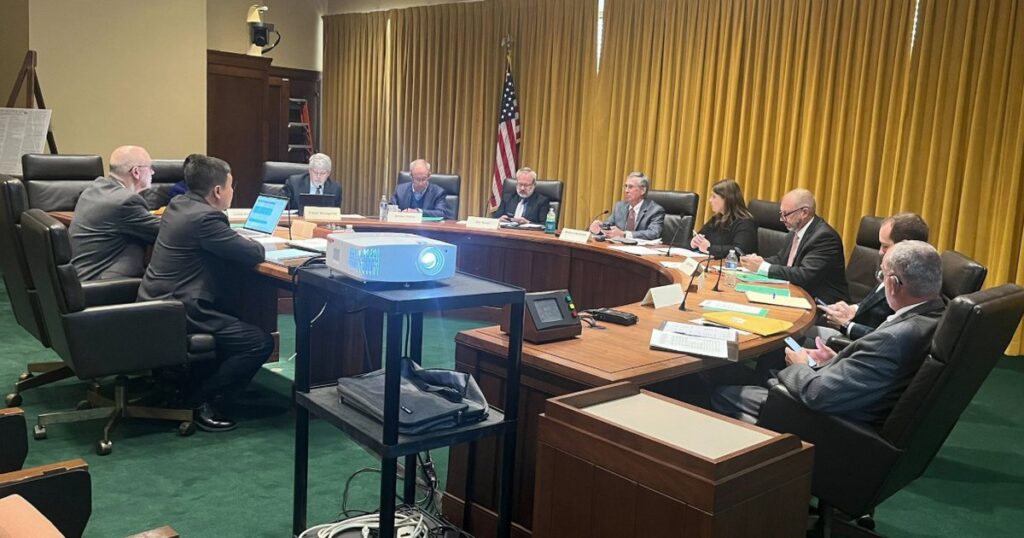
The Nebraska Legislature is grappling with a significant budgetary challenge as it attempts to finalize the second half of its biennium budget. The Nebraska Economic Forecasting Advisory Board recently adjusted its projections, adding $20 million in revenue for fiscal year 2025-26 while simultaneously cutting revenue forecasts by $175 million for the 2026-27 fiscal year, leaving lawmakers with a $155 million shortfall to address this session.
These forecasts are crucial for legislators in determining the funds available in the state’s General Fund, which are allocated to various state agencies and programs. The revised projections for 2025-26 are now $6.97 billion, a slight increase from the previous estimate of $6.95 billion. However, this additional revenue is earmarked for the state’s School Property Tax Relief Fund, not the General Fund, as clarified by the Legislative Fiscal Office.
Looking ahead to the 2026-27 fiscal year, the board projects revenues of $6.625 billion, a decrease of $175 million from the earlier estimate of $6.8 billion. This adjustment negates the positive news from January’s tax receipts, which had exceeded forecasts by about $35 million (source).
At the start of the session in January, the Legislature faced a $471.5 million budget shortfall. Governor Jim Pillen has proposed addressing this by redistributing $192.6 million over two years from cash funds to the General Fund, with the Department of Health and Human Services experiencing the most significant cuts, including $130.4 million in 2026-27. Pillen emphasized the need for further reductions to maintain fiscal balance.
“Today we have a great opportunity to be strong fiscal conservatives. I am looking forward to working with the Legislature to respond to updated projections like all Nebraskans do and tighten our belts to reduce government spending and support more efficient and focused outcome-based approaches to running government,” Pillen stated.
Some lawmakers argue that cutting expenses is insufficient to resolve ongoing budgetary issues, suggesting a reassessment of the income and corporate tax cuts implemented in 2023. Rebecca Firestone, of the OpenSky Policy Institute, recommends a long-term approach, advising that the legislature consider revenue-raising measures rather than depleting finite cash reserves.
Lexington Plant Shutdown
The closure of the Tyson plant in Lexington has had a significant impact on the state’s financial outlook. This plant, a major employer with approximately 3,200 employees, closed in January, affecting the economy of the entire state. The University of Nebraska-Lincoln estimates this closure will result in an annual economic loss of nearly $3.3 billion for Nebraska (source).
The February forecast from the board included this closure due to its significant impact on state tax revenues. Board chair Rich McGinnis noted a slowdown in various sectors, attributing it to the effects of the plant’s shutdown. “Retail sales are down. New car sales are down. We’re still growing, but I believe it’s at a slower pace than before. I don’t think that’s going to change,” McGinnis told the board.
McGinnis highlighted a silver lining in the form of increased tourism, especially around the Sandhill Crane migration. However, the coming years will be challenging due to the plant’s closure, with a Kansas City Federal Reserve report predicting a surge in Dawson County’s unemployment rate from 2.9% to 27% within three years (source).
Board member Steve Seline from Omaha mentioned efforts by Omaha charities to assist families relocating from Dawson County, indicating a potential shift in the workforce. Despite some positive developments in Omaha’s economy, the Lexington situation serves as a stark reminder of the fragility of some Nebraska communities, as noted by John Kuehn.
Supreme Court Tariff Ruling
In other economic news, a recent U.S. Supreme Court decision on tariffs from President Trump’s administration could positively impact Nebraska’s economy. The court ruled that the administration’s tariffs under the International Emergency Economic Powers Act were unconstitutional (source), prompting some businesses to seek refunds.
HoaPhu Tran, an economist from the Department of Revenue, indicated that the impact of this ruling on Nebraska remains uncertain. “That’s actually the issue with the tariffs. It’s the uncertainty of tariffs, not the tariffs itself, right?” Tran explained. Some Omaha businesses view the tariff repeal positively, while others in rural Nebraska see other factors like insurance costs as larger barriers to growth.
Kuehn emphasized the importance of building resilient communities across the state, stressing that the challenges faced by counties like Dawson underscore the need for a unified state approach to economic stability.