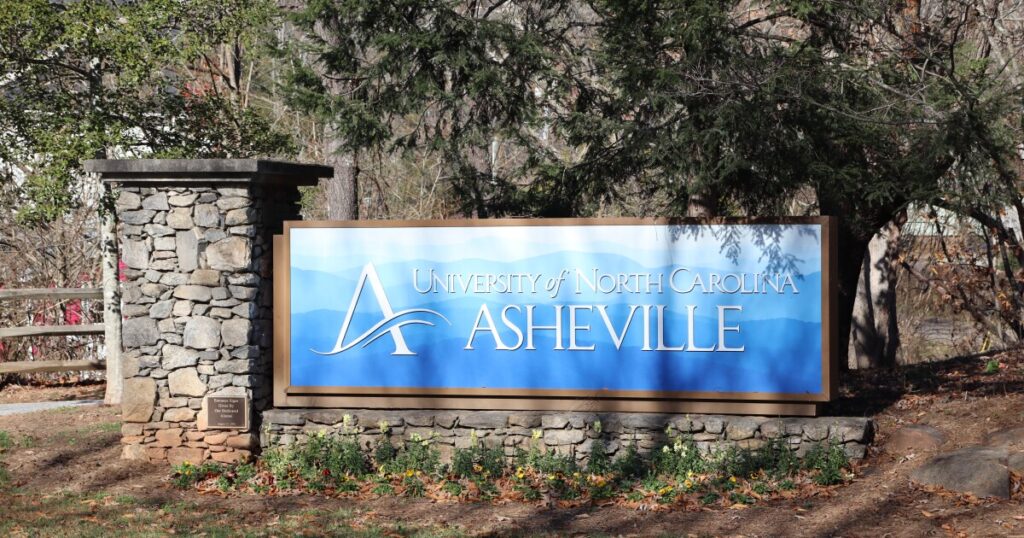
In anticipation of a major winter storm in Western North Carolina, UNC Asheville’s Department of Atmospheric Sciences took decisive action. Led by Professor Doug Miller, the team launched a weather balloon to gather critical atmospheric data, a move prompted by National Weather Service forecasts predicting severe winter conditions.
The forecasts indicated a mix of snow, freezing rain, and ice, conditions that could potentially disrupt the region. Such predictions left no doubt in Miller’s mind about the necessity of deploying the balloon. “When we see a storm that’s going to be rather long-lived or have the potential of creating quite a lot of precipitation — and also, if there’s a lot of uncertainty as to what the form of that precipitation is going to be — that’s pretty much going to trigger our, ‘Yes. Let’s do this,’” Miller explained to BPR.
The weather balloon, notable for its 5 to 6-foot diameter, is equipped with a sophisticated “mini radio station” that records temperature, moisture, wind speed, and direction. This data is transmitted to a ground antenna and processed through specialized software, ultimately stored on the department’s computer system.
This data is invaluable for understanding and predicting complex weather events like Winter Storm Fern. “Knowing the moisture and the temperature information can really help both forecasters and emergency manager planners to know what to anticipate over the next several hours,” Miller noted.
The findings from the balloon are shared with the NWS and broadcast meteorologists, aiding in more accurate forecasting. Often, these observations reveal discrepancies in the computer models, allowing for adjustments. “More often than not, what they see in the weather balloon observations is some sort of pattern or signature that is showing them that the model is a little bit off,” Miller said. “If the model is a little bit off and they can understand in what way it’s off, then they can adjust their forecast to make it more accurate.”
While the NWS routinely launches weather balloons from various stations nationwide, they largely depend on computer models for predictions. However, the nearest balloon stations to Asheville are located in Greensboro, NC, and Nashville, TN, which complicates forecasting in the mountainous areas of Western North Carolina.
Jake Wimberley, a meteorologist at the National Weather Service’s Greenville-Spartanburg office, pointed out the challenges posed by the region’s varied terrain. “The mountains create weather and if you have moist air that flows up the sides of mountains, it tends to mix cloud and precipitation,” he explained. “For that reason, the mountains southwest of Asheville are some of the wettest places in the Eastern U.S. just because they can either have this moist air flowing up from the Gulf (of Mexico) or in from the Atlantic (Ocean).”
Despite relying on small automated stations and cooperative observers like Miller and his students, Wimberley acknowledged the ongoing challenge of mountain weather forecasting. “We’re always trying to learn when we forecast an event and it doesn’t work out the way we expected,” Miller said.
The data from UNCA’s weather balloon observations will eventually be posted here.