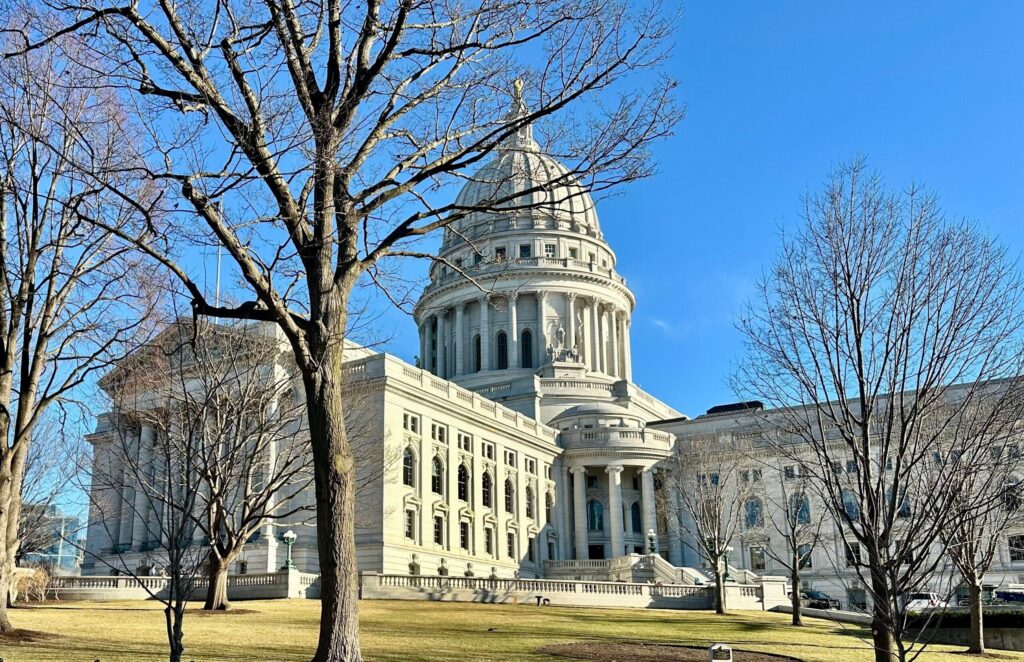
For the first time in over a decade, both major political parties in Wisconsin are vying for control of the state Assembly and Senate. This newfound competitive landscape is largely attributed to recent changes in the state’s voting maps.
According to John Johnson, a researcher at Marquette University Law School, the new voting maps implemented two years ago have significantly altered the political balance. Previously, the Republican Party retained dominance in both chambers for 15 years, a tenure bolstered by GOP-crafted legislative districts following their 2010 electoral success. However, in a pivotal shift, late 2023 saw the state Supreme Court’s liberal majority declare those districts unconstitutional. This led Republicans to pass new maps drawn by Democratic Governor Tony Evers, forestalling the possibility of the court dictating new districts.
Throughout Governor Evers’ term, Wisconsin experienced a divided government, with the Democratic governor frequently clashing with Republican legislative leaders. This year, Democrats are aiming for a “trifecta,” hoping to secure the governor’s office and legislative control. Johnson highlighted the rarity of such a scenario in the state’s political landscape, mentioning, “Think about how unusual that is in Wisconsin’s recent political history.”
Wisconsin’s Senate elections occur in staggered four-year terms, meaning only half of the Senate is up for reelection in 2024 under the new maps. Johnson remarked, “Now, in the second election with these new maps, truly either party could win it all.” He anticipates a likely scenario of a divided government, with at least one legislative chamber and the governor’s office being split between the parties.
Wisconsin Senate’s Shift Towards Democrats
In 2024, the Democrats managed to reduce a Republican supermajority in the Senate to a narrow 18-15 majority. To gain control, Democrats need to secure a net gain of two seats out of the 17 up for election. They already hold 10 seats that are not contested this year. Johnson’s analysis designates seven of these Senate races as either “safe” or “lean D” for Democrats.
One of the most contentious races is in the 17th Senate District, which has seen substantial financial involvement from both parties. The district, represented by Sen. Howard Marklein since 2014, is considered a “tossup” by Johnson. State Rep. Jenna Jacobson, who emerged from a competitive Democratic primary, will challenge Marklein. She has secured nearly $280,000 from Democratic sources, while Marklein has over $1 million in campaign funds.
Retirements of notable Republican incumbents have further buoyed Democratic prospects. For example, Sen. Van Wanggaard’s retirement in the 21st District opens a competitive seat, now rated as “lean D.” Similarly, the 5th District has become more competitive following Sen. Rob Hutton’s decision not to seek reelection, with the race now considered “lean D” by Johnson.
In the 31st District, a late GOP reshuffle has enhanced Democrats’ chances of maintaining control. Incumbent Sen. Jesse James announced his retirement following legal issues involving his daughter, leaving the race rated as “lean D.”
Assembly’s Competitive Landscape
While the Senate offers a promising landscape for Democrats, flipping the Assembly remains challenging. Republicans hold a slim margin with 54 seats to Democrats’ 45. All Assembly seats are contested every two years. Johnson’s analysis suggests 49 seats lean Republican, 47 lean Democrat, leaving three races as pivotal “tossups.”
Among these, the 88th Assembly District could lean Democrat if not for the incumbency of Rep. Benjamin Franklin, a factor that shifts it to a “tossup.” Similarly, Rep. Bob Donovan’s seat in the 61st District is a target for Democrats, who have invested heavily in defeating him. Lastly, the 51st District, held by Rep. Todd Novak, remains a “tossup” despite being traditionally Democratic.
Johnson emphasizes the incumbency advantage in these close races, noting a political paradox: “people hate the legislature and they love their own legislators.” He underscores that “State legislative Republicans in Wisconsin are consistently more popular than the Republican at the top of the ticket,” which could help them maintain their Assembly majority.