Controversy Surrounds Trump’s Executive Order on Absentee Ballots
The recent executive order by President Donald Trump has sparked significant backlash, particularly from Wisconsin officials. The order, which targets absentee ballots, has been deemed controversial and is expected to face legal challenges.
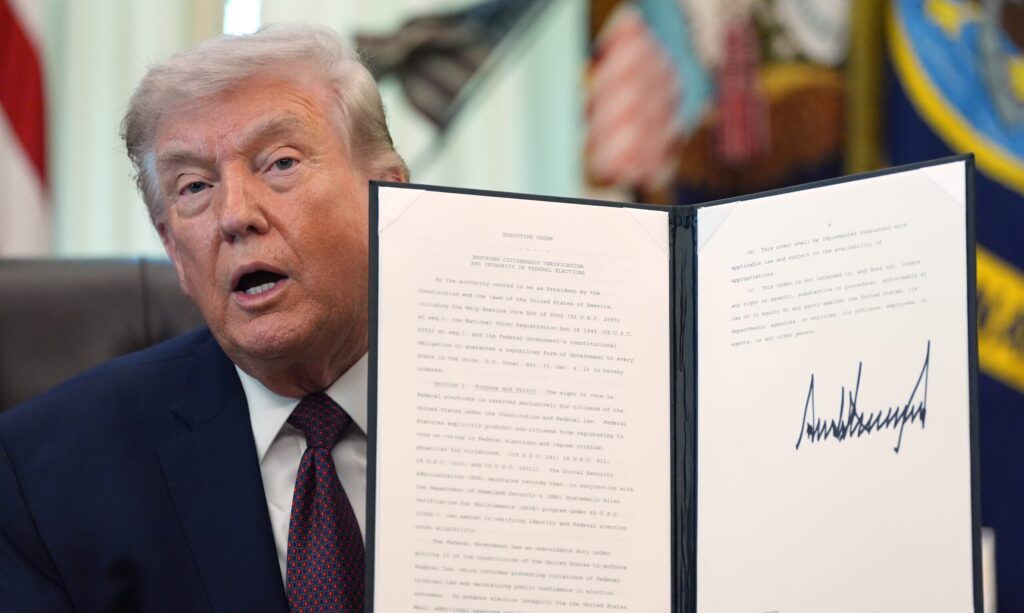
President Trump signed the executive order titled “Ensuring Citizenship Verification and Integrity in Federal Elections.” The directive mandates that the U.S. Department of Homeland Security and the Social Security Administration provide state election officials with lists of verified U.S. citizens eligible to vote. It also instructs the U.S. Postal Service to block mail-in ballots to individuals not on these lists.
Key elements of this order echo the Republican SAVE Act, which has passed the U.S. House but is currently awaiting consideration in the Senate.
This move follows years of unfounded claims by Trump about election fraud related to mail-in voting. Ironically, he himself voted by mail in Florida just last month.
Wisconsin Governor Tony Evers did not hold back in his criticism, describing the order as “bulls—” on social media. “And it’s illegal,” Evers declared, adding, “We’ll see President Trump in court.”
Wisconsin Attorney General Josh Kaul also criticized the order, stating it “transparently attacks our democracy, seeks to restrict voting, and tramples on the Constitution.” Kaul expressed confidence that critical parts of the executive order would be blocked, ensuring continued free and fair elections in Wisconsin.
Howard Schweber, an emeritus law professor from the University of Wisconsin-Madison, highlighted the constitutional complexities involved. He noted that the Constitution grants states the power to regulate elections, although Congress has the authority to modify these regulations. “The fact that Congress can do it does not mean the president can do it through an executive order,” Schweber explained.
According to Schweber, this executive order is likely to be contested in court, raising issues of constitutional separation of powers and federalism. He anticipated a federal court might rule it unconstitutional, potentially leading to an appeal by the Trump administration to the Supreme Court. Schweber remarked on the unusual situation, stating, “The Supreme Court has been asked a dozen times” about separation of powers issues but has not definitively addressed them, leaving a “very odd and uncomfortable place.”
Wisconsin Public Radio, © Copyright 2026, Board of Regents of the University of Wisconsin System and Wisconsin Educational Communications Board.