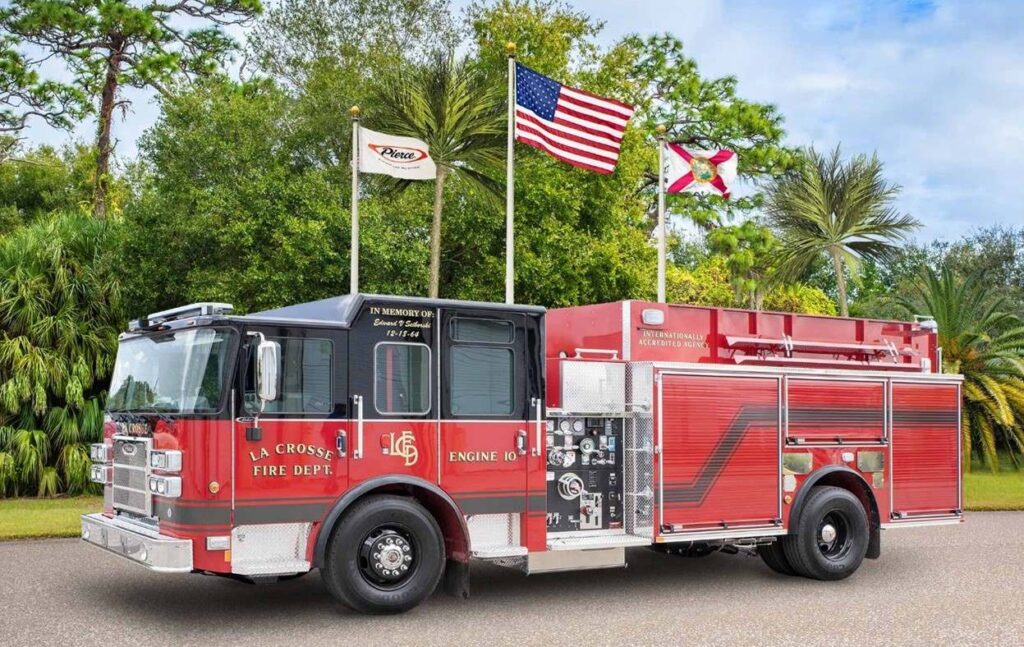
Amidst a critical fire truck shortage sweeping across the nation, Wisconsin’s fire departments are grappling with increasing delays and safety challenges. As communities strive to upgrade their essential firefighting equipment, they face the dual hurdles of prolonged wait times and surging costs.
In southeastern Wisconsin’s village of Caledonia, Fire Chief Walter Leininger remains in a prolonged wait for a new standard “pumper” truck, ordered over two years ago. Despite the village’s substantial investment exceeding $800,000 for the fire engine in 2023, its arrival is postponed until 2027, according to WPR’s “Wisconsin Today.”
“It becomes a safety concern for the public if we’re going to be able to reach them, if we’ve got equipment that’s 20-25 years old, and it’s got 180,000 miles on it,” Leininger said. “It’s taking a gamble when you start getting equipment that old. It’s not the safest.”
Back in 2016, the Caledonia Fire Department successfully acquired a fully customized fire apparatus in just 11 months, a stark contrast to the current lengthy wait. The National Fire Protection Association advises replacing fire engines every 15 to 25 years, contingent on their mileage and usage.
Leininger notes the increasing difficulty in maintaining older trucks due to scarce replacement parts and the challenge of finding skilled repair workers.
Refurbishing Instead of Replacing
Meanwhile, Racine Fire Department’s Fire Chief Steve Hansen is leveraging internal resources, utilizing two mechanics to maintain the department’s fire engines. Facing delays in acquiring new trucks, Hansen’s department is considering refurbishing existing ones to prolong their service life.
Currently, a 2003 pumper apparatus is under refurbishment at a fraction of the cost of a new truck, with completion expected in two months. Hansen shared, “We anticipate getting that vehicle back in the next two months, at which time we’re going to put it through its paces, testing the mechanical systems, testing the pump, making sure that it performs up to National Fire Protection Association standards. If that is successful, then we would potentially look at refurbishing two trucks that are due up in 2028 and 2030 as well.”
Refurbishing entails disassembling the fire engine, replacing key components, and reassembling it. This approach offers significant taxpayer savings compared to purchasing new engines. However, Hansen acknowledges that refurbished trucks lack the technological advancements present in newer models.
“Our ladder truck, which was built in 2014, has 28 individual computers on it at various points in the chassis,” Hansen explained. “They’re all together to perform different functions and provide different monitoring capabilities of the different systems that they’re installing on these trucks.”
The complexity of advanced technology is a contributing factor to the delays in new truck deliveries. Manufacturers like Oshkosh Corporation and REV Group, both headquartered in Wisconsin, attribute the shortage to supply chain and logistics challenges, alongside record demand.
Legal battles have also ensued, with the city of La Crosse initiating a class action lawsuit against these manufacturers and a third company, Rosenbauer America, accusing them of colluding to limit truck supply and inflate prices. The companies have dismissed the lawsuit as unfounded. Other cities across the nation have joined the litigation, which a federal judge recently decided to consolidate.