As the race for Sauk County sheriff intensifies, a significant topic continues to dominate discussions: immigration enforcement. At a June candidate forum in Baraboo, the conversation quickly shifted to the role of local law enforcement in cooperating with U.S. Immigration and Customs Enforcement (ICE).
“As chief law enforcement officer of Sauk County, how will you separate the demands of ICE from your duty to uphold the law and protect the residents of Sauk County?” asked Joseph Viney, President of the Baraboo Optimist Club, addressing the candidates.
Now, with the primary behind them, one candidate from each party remains, and the immigration issue remains at the forefront as the November election approaches.
“People are fired up and they’re frustrated with ICE in general from a national perspective, and it does have local consequences,” commented Ryan Jesberger, the Democratic candidate, in an interview with Wisconsin Watch and Bolts.
ICE activity in Sauk County, which is part of south-central Wisconsin, has been primarily focused on arrests made through custody transfers at the local jail, rather than large-scale operations. This is consistent with ICE’s strategy across Wisconsin since President Donald Trump’s return to office in January 2025, which contrasts with practices in neighboring states.
Sauk County, under an agreement with ICE, allows its local jail supervisors limited roles in immigration enforcement, accounting for about 100 arrests in the county since Trump’s return. This agreement is part of the 287(g) program, which involves 20 counties in Wisconsin. These agreements are voluntary partnerships that enable local officers to perform certain immigration enforcement tasks, often stirring debate within communities.
The upcoming election will determine if Sauk and Winnebago counties will continue their partnerships with ICE, as voters weigh the differing stances of Republican and Democratic candidates. Both Democratic candidates have pledged to end the 287(g) agreements if elected.
ICE Partnerships and the Local Impact
In Sauk County, the 287(g) agreement was established in November 2025 by Sheriff Richard “Chip” Meister. It empowers six jail supervisors to execute immigration warrants for individuals already in county custody. This streamlines interactions with ICE, but with Meister retiring after a 16-year tenure, the future of the agreement is uncertain.
Republican candidate Matt Burch, endorsed by Meister, plans to maintain the current focus on individuals who commit serious crimes, without expanding the partnership beyond the jail. “Our focus remains strictly on removing individuals who commit serious crimes rather than targeting members of our community solely based on their immigration status,” Burch stated in an email.
Jesberger, the Democratic candidate, proposes to terminate the 287(g) program immediately if elected, arguing that it oversteps local law enforcement’s jurisdiction. He also questions the legality of ICE detainers, which are requests to extend detention beyond scheduled release dates without judicial warrants.
Sauk County also holds a contract to provide jail space for ICE detainees, a revenue-generating arrangement that both candidates intend to maintain. However, Jesberger emphasizes the need to ensure humane conditions for detainees, contrasting with Burch’s focus on the financial benefits.
Winnebago County: A Broader Debate
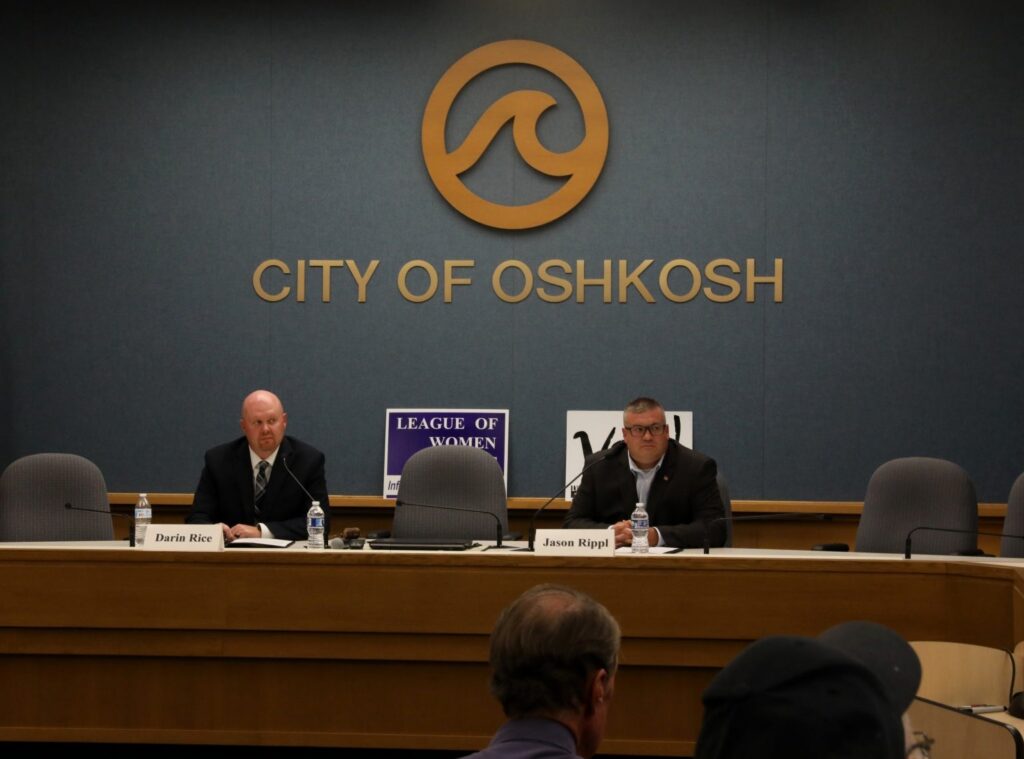
In Winnebago County, the debate around ICE involvement is intertwined with discussions on surveillance technology. Republican Capt. Darin Rice supports continuing the county’s 287(g) agreement, while Democrat Jason Rippl opposes it, citing concerns over expanding ICE involvement.
Both candidates have also expressed concerns over the use of surveillance technology, such as Flock cameras, which have recently been suspended in Winnebago County following privacy concerns.
The issue of ICE cooperation remains a divisive topic in these local elections, with implications for local law enforcement practices and immigrant communities.
The nonprofit Wisconsin Watch (www.WisconsinWatch.org) collaborates with WPR, PBS Wisconsin, and other news media, as well as the University of Wisconsin-Madison School of Journalism and Mass Communication. All works created, published, posted, or disseminated by Wisconsin Watch do not necessarily reflect the views or opinions of UW-Madison or any of its affiliates.