In the quiet hours after sunset, a group of researchers led by Donn Branstrator embark on an important mission in the Lake Superior harbor. Their objective is to track down a tiny but potentially disruptive invader: the bloody red shrimp, a species that might be altering the local ecosystem.
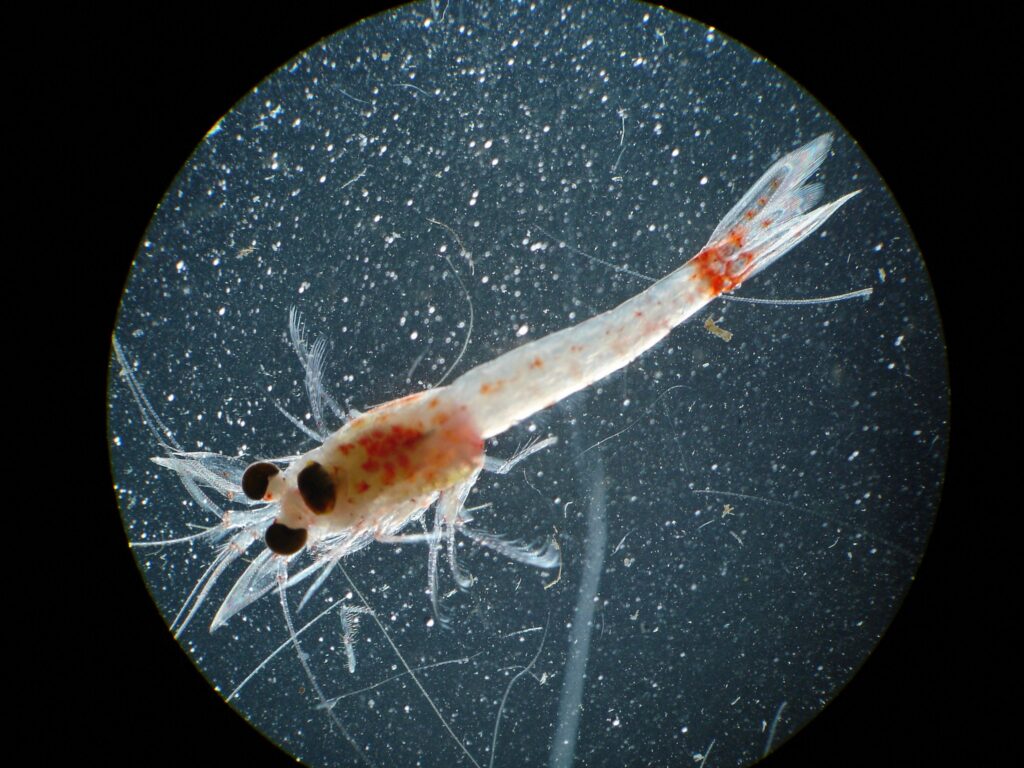
The team has been employing light traps and nets for years in search of this elusive freshwater shrimp, which is distinguished by its red color and semi-transparent appearance. Branstrator, a biology professor at the University of Minnesota-Duluth, explains that the shrimp, which grows up to half an inch long, emerges at night to avoid predators.
“They hide on the bottom within the cracks and crevices of the break wall and bouldered environments during the day,” Branstrator said. “You can go out there during the day and sample all you want, and you’re going to be hard-pressed to find them.”
This species, originally from the Black Sea and Caspian Sea regions, likely arrived in the Great Lakes via ballast water from international ships. Although first detected in the Great Lakes two decades ago, evidence of their establishment in Lake Superior was only recently confirmed.
Last year, Branstrator’s team collected 81 bloody red shrimp at Wisconsin Point and Montreal Pier. Their research, published in the Journal of Great Lakes Research, showed enough evidence to suggest a self-sustaining population has formed, marking Lake Superior as the final Great Lake to host this invasive species.
“It is there, in perpetuity one would think, if they can continue to grow and reproduce,” Branstrator said.
The shrimp were first identified in the Duluth-Superior harbor in 2017, with subsequent finds at Wisconsin Point. A study highlighted the role of ships in transporting these and other invasive species from the lower Great Lakes.
Branstrator’s colleague, Matt TenEyck, director of the Lake Superior Research Institute, notes that the impact of the shrimp on local ecosystems is still uncertain. “It’s just too soon to tell if and when they will cause problems with our local communities, if they’ll disrupt the food web,” TenEyck said.
As they grow, bloody red shrimp shift from consuming algae to eating more zooplankton, potentially competing with small fish. Yet, they might also serve as a new food source for larger fish. Despite their potential to reduce zooplankton numbers, no significant effects have been observed in the Great Lakes.

Researchers are also concerned about the potential for inland spread. TenEyck warns, “What happens if someone picks that up in their bait bucket or their live well and goes to an inland lake?” So far, they remain absent from inland lakes in Wisconsin and Minnesota.
Efforts to halt the spread of invasive species continue through initiatives like the Great Waters Research Collaborative, which tests ballast water treatment systems. Meanwhile, Branstrator’s team is expanding their research to better understand the shrimp’s distribution in Lake Superior.