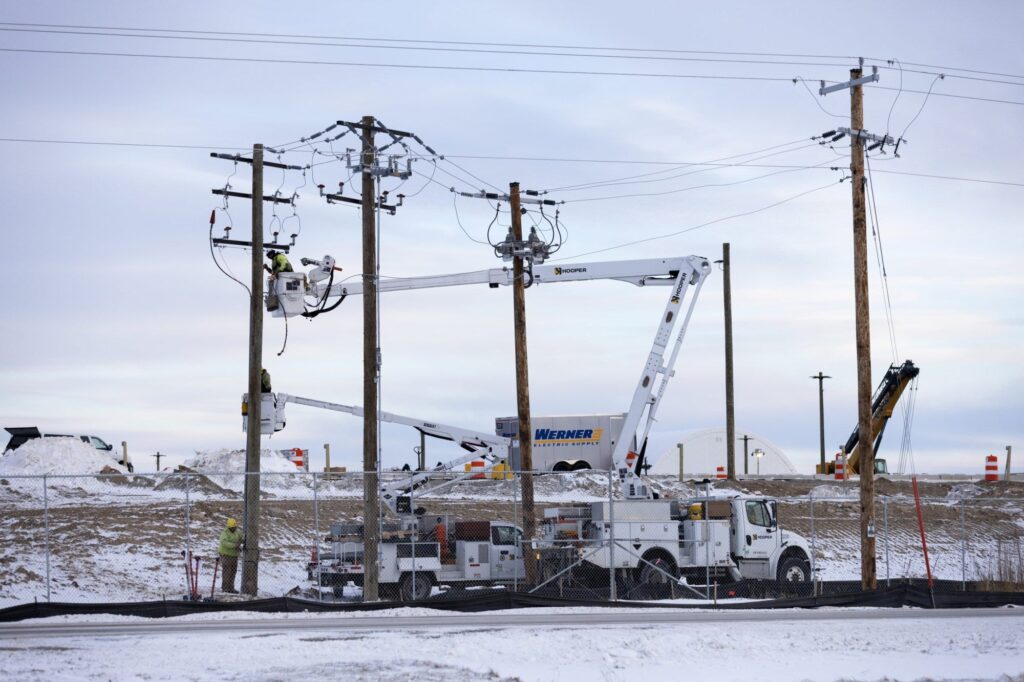
The rapid expansion of data centers in the Midwest has ignited a fierce competition among transmission developers to support the growing demand for electricity. The latest twist in this saga unfolded recently when a major decision was reversed, highlighting the complexities and stakes involved in powering this digital infrastructure boom.
In a significant turn of events, the regional grid operator for much of the Upper Midwest altered its initial decision, opting for American Transmission Company (ATC) over a developer backed by the investment firm Blackstone to construct a series of substations in eastern Wisconsin. This decision favors ATC, which controls a significant portion of the transmission lines in the region and is tasked with completing the project well ahead of the 2028 deadline when a new data center in Port Washington is set to commence operations.
This development marks a victory for ATC following multiple setbacks in the Wisconsin Assembly, where efforts to grant regional developers exclusive rights over parts of multistate projects have repeatedly failed. The competition remains open, ensuring no single entity monopolizes the transmission projects.
The decision is not expected to significantly impact costs for Wisconsin ratepayers, although ATC will incorporate the substations into a broader $1.3 billion infrastructure expansion to support the Port Washington campus. This ongoing challenge involves determining who will bear the costs of supplying power to new data centers.
Planning and Financing the Midwest’s Grid
The North American electricity grid is an ever-evolving system comprising transmission lines and substations that distribute power from generators to consumers. In many regions, nonprofit independent system operators manage these grids, overseeing wholesale electricity markets and interstate transmission initiatives. Wisconsin falls under the Midcontinent Independent System Operator (MISO), which covers a vast territory from the Upper Midwest to Louisiana.
Since 2022, MISO has sanctioned approximately $32 billion in transmission enhancements for the Upper Midwest, including robust “backbone” power lines capable of handling higher voltages. Among the latest projects are new transmission lines and substations in eastern Wisconsin, aligning with the approval of a $15 billion data center in Port Washington.
Competition Heats Up
Four transmission developers, including ATC, vied for the eastern Wisconsin upgrade project. Initially, MISO awarded the contract to Viridon, a subsidiary of Blackstone Energy Transition Partners, due to its competitive $350 million bid, which was significantly lower than MISO’s projections. However, MISO acknowledged that Viridon’s budget “may not be achievable,” citing the company’s assurances to curb cost overruns and profits as a basis for their selection.
Financing Transmission Projects
The financial responsibility for transmission projects varies depending on the developer. MISO awards enable costs to be distributed among customers in different states, effectively reducing individual financial burdens. Conversely, when a developer operates within its own jurisdiction, those costs are confined to its customers alone. These expenses are typically reflected in utility bills, with We Energies estimating that transmission-related charges constitute about 10% of customer bills.
The competitive bidding process for multistate projects, mandated by the Federal Energy Regulatory Commission (FERC) since 2011, seeks to curb ratepayer costs by encouraging competition. As regional grid enhancements gain momentum, competition among developers has intensified, with MISO at the forefront of planning substantial transmission projects.
New Players Enter the Arena
MISO’s ambitious transmission plans have attracted numerous utilities, including some of the nation’s largest, eager to secure stable revenue streams. Emerging developers, backed by influential investment firms, are also vying for opportunities. Blackstone launched Viridon in 2023, while Stonepeak, a smaller investment firm, supported Longview Infrastructure’s entry into the market in 2025.
Established utilities have their own connections to major investment firms, with companies like BlackRock and Vanguard Group holding significant stakes in Wisconsin’s leading utility firms. These ties underscore the financial interests at play as the grid expansion progresses.
Debate Over Competitive Bidding
Critics and advocates of competitive bidding have clashed over its implications. While some argue that local expertise ensures efficient project execution, others contend that competition mitigates monopolistic practices, thereby benefiting consumers. Despite Wisconsin utilities’ efforts to secure right-of-first-refusal (ROFR) laws, these initiatives have repeatedly faltered in the state’s Assembly.
As the grid expansion continues, the debate over competition versus local control remains a contentious issue, with state legislatures and courts across the Midwest grappling with its implications.
Data Center Challenges and Grid Planning
The Port Washington data center’s imminent power needs have introduced additional complexities to the project planning process. Shortly after MISO solicited bids, ATC highlighted the urgency of connecting the data center to the grid by 2027, necessitating timely substation construction. ATC’s bid reflected its commitment to meeting these deadlines, although both it and Viridon have faced regulatory scrutiny over overlapping project scopes.
MISO raised concerns about ATC’s application to build substations similar to those in its own plans, while Viridon argued that ATC’s actions circumvented MISO’s processes. However, ATC maintained that its project served distinct purposes, emphasizing the need for timely power access for Wisconsin customers.
MISO’s Decision Shifts Course
Amid ongoing discussions, MISO reassigned the substations to ATC, citing doubts about Viridon’s ability to meet administrative requirements in time. This decision marks a first for MISO, as the operator typically collaborates with developers to address challenges rather than reassign projects.
Under the revised arrangement, Midwestern customers will share the costs of Viridon’s remaining project elements and a portion of ATC’s upgrades. However, the majority of the project costs will be borne by Wisconsin ratepayers, raising concerns about the financial burden on local consumers.
As construction continues on the Port Washington data center, the Wisconsin Public Service Commission will play a crucial role in determining how the transmission projects proceed and who will ultimately finance the power supply for this vital digital infrastructure.