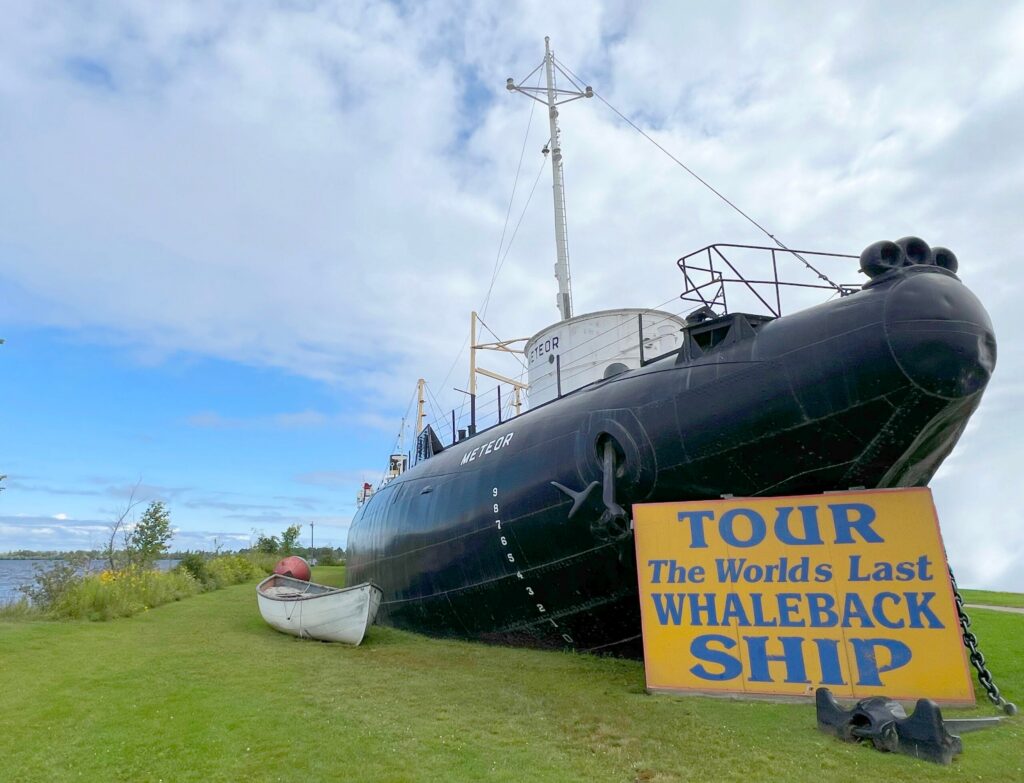
The SS Meteor, a distinctive ship that has been a part of Superior, Wisconsin’s maritime history since 1896, is celebrating its 130th birthday. Although the vessel no longer sails, it opens its doors to the public for a commemorative event.
According to Jordan Stish, manager of Superior Museums, “It’s called a whaleback because it sits really low in the water, especially when it’s full of cargo.” The ship’s unique design, featuring a rounded hull, likens it to a whale’s silhouette emerging from the water.
In an interview with Robin Washington on WPR’s “Morning Edition,” Stish and Superior Museums Director Jess McCullough provided insights into the SS Meteor’s storied past and present. The celebration takes place on May 16.
The following interview has been edited for brevity and clarity.
Is the SS Meteor still operational?
Jess McCullough: “It is no longer a floating vessel. When the city of Superior bought the boat to be a museum back in 1969, they dug a channel into Barker’s Island and floated the boat into it and filled in the channel with sand and backfill. So the boat is actually sitting on land. It’s no longer seaworthy.”
What makes the whaleback design unique?
Jess Stish: The whaleback design was revolutionary for its time. The ships were designed to sit very low in the water, so much so that only the smokestacks and pilot house were visible when fully loaded. This design, however, led to many whalebacks being scrapped or sunk, as other ships couldn’t see them in the water.
JM: The Meteor is the last of its kind, mainly because most whalebacks were either scrapped or lost. Being low in the water made them vulnerable to collisions, which is why many found their final resting places at the bottom of the Great Lakes.
Where did the SS Meteor operate?
JS: The Meteor primarily navigated the Great Lakes, venturing as far as Buffalo, New York, but always remained in freshwater.
JM: During the war, the ship had another wreck but was retrofitted to carry oil due to high demand, saving it from being scrapped.
Can you share some of the Meteor’s close calls?
JM: In 1905, the Meteor ran aground during a snowstorm near Isle Royale. Another incident occurred in 1942 off the coast of Manistique, Michigan.
What preparations are underway for the birthday celebration?
JS: Since opening as a museum in the 1970s, the Meteor has undergone significant transformations. The cargo hold has been converted into exhibit space. As we approach her 130th birthday, we are refreshing her appearance and preparing new exhibits. We’re also excited to open the SS Meteor Bar, which we’ve dubbed Superior’s best-kept secret.
Our efforts aim to respect the ship’s long history and honor those who have worked on and continue to restore her.
If you have an idea about something in northern Wisconsin you think we should talk about on Morning Edition send it to us at northern@wpr.org.