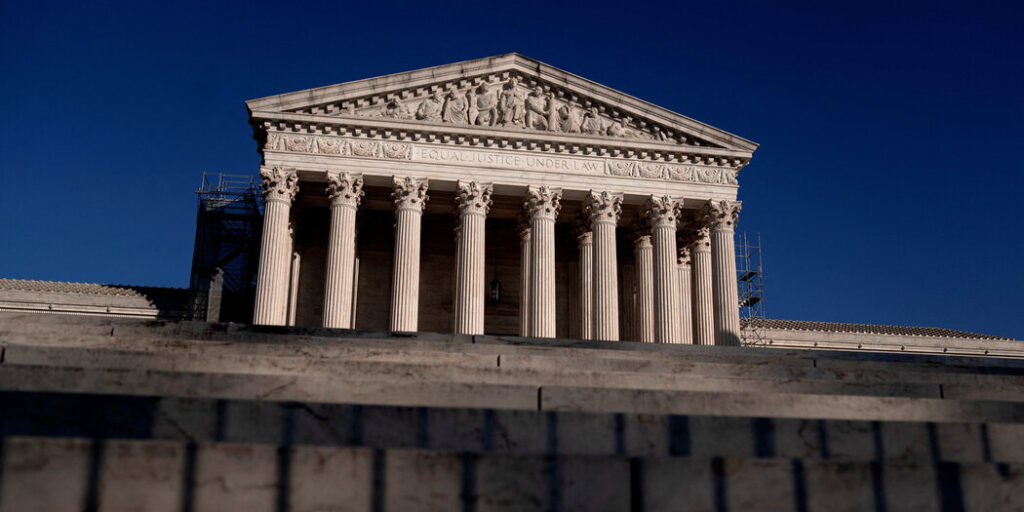
Constitutional Concerns Amidst Supreme Court’s New Term
There is growing concern among those dedicated to constitutional principles as recent developments in the United States raise significant questions. The President’s recent suggestion to use “dangerous cities as training grounds for our military” and the indictment of former FBI Director James Comey, perceived by many as politically driven, have sparked debates about the current state of the rule of law. With the new Supreme Court term commencing soon, the fragility of judicial guardrails is once again under scrutiny.
This Monday marks the 20th anniversary of John Roberts becoming Chief Justice. During his tenure, public trust in the Supreme Court has dropped to unprecedented lows. The upcoming months are set to test the Court’s credibility on issues like presidential power, voting rights, and campaign finance, all of which are crucial to American democracy.
Under Donald Trump’s first term, the Supreme Court often resisted his more egregious actions and denied overturning his 2020 election defeat. However, the current scenario appears different. In Trump v. United States, the Court significantly expanded presidential immunity. Chief Justice Roberts noted, “the only person who alone composes a branch of government,” as the Court removed a strong check against presidential power abuses.
As oral arguments are set to begin, several notable points arise. A significant part of the damage seems already inflicted, with an ongoing effort to expand presidential authority. While lower courts often attempted to curb these expansions, Trump’s legal team expedited cases to the Supreme Court. The justices, through the “shadow docket,” have frequently sided with Trump, allowing actions such as firing senior appointees against congressional laws and bypassing congressionally allocated funds.
This term, the Supreme Court must publicly address critical questions regarding presidential power. In November, it will hear a case on Trump’s ability to impose tariffs unilaterally. Lower courts have uniformly ruled against Trump’s actions, arguing the relevant statutes do not permit such unilateral import taxes.
Former federal judge Michael McConnell describes this as “the most significant case on presidential power since the steel seizure case in 1952.” This reference to Youngstown Sheet & Tube Co. v. Sawyer highlights a time when a Democrat-appointed Court opposed President Truman.
Other significant presidential power cases are looming. The justices have indicated a willingness to overturn precedents preventing presidents from dismissing commissioners of independent agencies. An ongoing question is whether Trump can remove Federal Reserve governor Lisa Cook, with a decision awaited on the shadow docket.
Debates also swirl around Congress’s fiscal authority and the legality of deploying domestic troops for law enforcement. Additionally, the Court may further challenge democratic values and institutions, an agenda seen since before Trump. In Citizens United v. Federal Election Commission (2010), the Court dismantled essential campaign finance laws, while Rucho v. Common Cause (2019) allowed partisan gerrymandering. In Shelby County v. Holder (2013), the Court weakened the Voting Rights Act’s preclearance requirement, though Chief Justice Roberts assured Section 2’s after-the-fact legal recourse would remain.
Now, on October 15, the Court will consider the constitutionality of Section 2 itself. Louisiana v. Callais arises from Black voters’ challenge to a racially biased congressional map. The Brennan Center argues, “Since the 1980s, Section 2 of the Voting Rights Act has played an indispensable role in improving representation on city councils, school boards, county commissions, and other local government bodies across the country.” The decision could severely impact political representation, especially in the South.
Furthermore, the remaining campaign finance laws face potential threats as the Court examines restrictions on coordination between campaigns and national party committees. The risk is the disappearance of meaningful campaign laws.
The Supreme Court wields vast power with minimal accountability. This year, its actions raise critical questions about the endurance of constitutional checks and balances. While doubts persist, many still hope the Court will uphold its commitment to the Constitution.