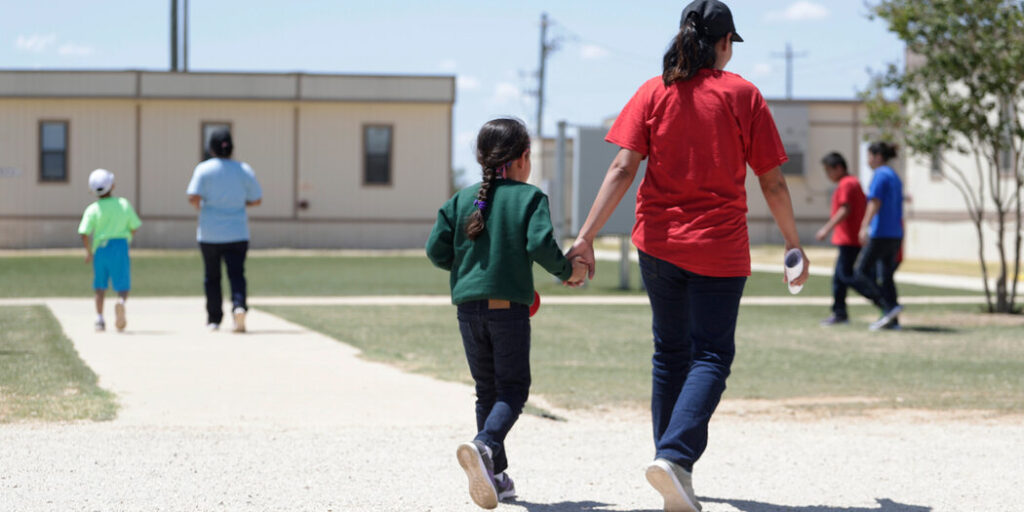
In a significant move, Congress approved a budget bill on July 1, allocating $45 billion for the construction of new immigration detention centers, including facilities designed for family detention. This expansion coincides with growing concerns about the conditions in which undocumented children are held in detention.
This legislation introduces questions about the treatment of families during deportation proceedings and the status of the Flores settlement, a 1997 agreement outlining the treatment of immigrant children in U.S. custody.
Does Immigration and Customs Enforcement put families into detention?
Under the Biden administration, the practice of detaining families with children was largely halted in 2021, shifting towards alternatives to detention such as electronic monitoring. This approach was a departure from policies during the Trump administration. The alternatives have shown success, with one program reporting a 99 percent compliance rate for immigration check-ins, and at a lower cost than detention.
However, the Trump administration is reinstating widespread family detention and implementing changes that will lead to more immigrant children entering federal custody. Policy shifts include ending programs for lawfully paroled individuals and revoking Temporary Protected Status for certain nationals. Additionally, new policies allow arrests in previously off-limits locations like churches and schools.
Who is in family detention?
Family detention primarily involves mothers and their children, as fathers are typically separated and housed in adult facilities. Evidence suggests that detention has severe health impacts on children. For instance, a study of Texas’s Karnes County family detention center revealed inadequate health screenings and care for chronic conditions, malnutrition, and mental health issues. Experts concluded there is no humane form of family detention.
The report advised that children with health needs receive appropriate care from qualified pediatric specialists and that screenings be conducted for contagious diseases like tuberculosis. Malnutrition treatment was also stressed as a necessity.
Are children in immigration detention receiving adequate care?
Evaluating the treatment of undocumented children in federal detention is challenging due to limited oversight, as the administration has closed monitoring offices within the Department of Homeland Security (DHS). The Office of Civil Rights and Civil Liberties has documented various abuses, but over 500 investigations have reportedly been halted, as noted by whistleblowers.
DHS claims the streamlining of the Office of the Immigration Detention Ombudsman aims to reduce enforcement obstacles. This office has managed more than 10,000 complaints annually and conducted inspections to preempt issues. Congress also plays a crucial oversight role but faces access restrictions to facilities.
What is the Flores settlement?
The Flores settlement agreement, established in 1997, sets standards for detaining immigrant children in the U.S. Its stipulations include:
- Children should not be detained for more than 20 days.
- They should be released to a family member or responsible adult promptly.
- Facilities must be safe and sanitary.
- Children should be housed in the least restrictive environment possible.
- Essential amenities like food, water, and medical care must be provided.
- Supervision must protect minors from harm.
- Contact with family members should be maintained.
Overseen by Judge Dolly Gee, the settlement mandates compliance with the 2020 Family Residential Standards for ICE facilities, though allegations of violations persist.
Does the Flores settlement still govern the treatment of undocumented children in custody?
The Biden administration introduced new regulations for unaccompanied migrant children under the Department of Health and Human Services, partially ending the Flores settlement’s application to that department.
The terms remain for ICE, but the Trump administration’s Department of Justice has filed a motion to terminate the agreement entirely, arguing new policies make it redundant. Lawyers have filed lawsuits to prevent this, highlighting concerning conditions at detention facilities, including medical neglect.
Who will be responsible for the new detention facilities?
Primarily for-profit firms.
Before the bill’s passage, ICE signed contracts with private prison companies to expand detention capacity. As of June 2025, ICE facilities held 57,861 detainees, up from 38,265 in June 2024, surpassing capacity by 45 percent. About 90 percent of detainees are in for-profit managed centers.
CoreCivic, a major private prison firm, announced reopening the South Texas Family Residential Center in Dilley, Texas, expecting $180 million annually. Similarly, Geo Group is transitioning the Karnes County center to house mixed populations, anticipating $79 million in revenue annually.