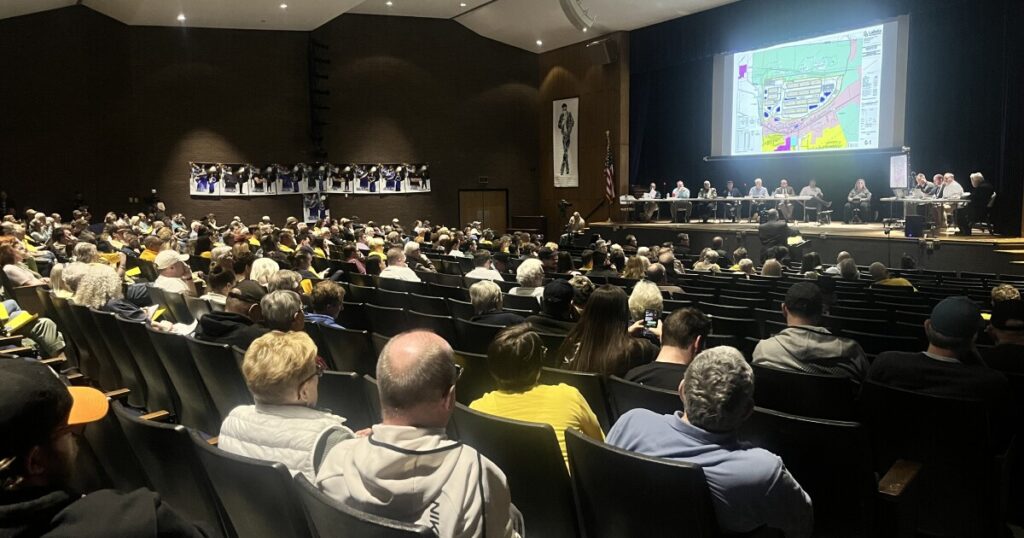
The development of a new data center in Archbald has sparked intense debate among local residents, drawing large crowds and vocal opposition. At a recent hearing, discussions about the potential environmental impact of the center, particularly regarding water usage, led to heightened tensions and public outcry.
During a hearing held at Valley View High School, expert witness Ben Mitten explained that data centers using open loop systems might require up to 21 million gallons of water daily. This statement triggered a strong reaction from the roughly 400 attendees, who shouted and booed, demanding the developers leave.
In response to the uproar, attorney Edward Campbell inquired if an open loop system was planned for the proposed center. Mitten clarified, “No, we are not,” indicating that an adiabatic system would be employed instead.
Cooling System Details
Mitten described the adiabatic system as a closed loop system utilizing air-cooled chillers, with water used only during peak summer months to optimize cooling. This system is designed to minimize electricity consumption and would be operational from May to September. The water supply would be sourced from Lake Scranton, as confirmed by Pennsylvania American Water.
When questioned about daily water usage, Mitten provided monthly estimates ranging from over 1 million gallons in May to 3.3 million gallons in July. Concerns about chemicals in the cooling system were addressed by mentioning the potential use of salt and glycol.
Community Concerns and Economic Impact
Despite assurances, many residents remained skeptical, particularly about the potential environmental and economic repercussions. The backup power plan was another focal point, with the center requiring 574 diesel-powered generators, each capable of running for 24 to 48 hours with a 2,000-gallon tank.
Questions about the generators’ emissions standards arose, with Mitten explaining the preference for tier 2 over tier 4 generators due to availability and cost-effectiveness. The campus would be required to report emissions to the Department of Environmental Protection annually.
Fiscal Analysis and Job Creation
Tom Shepstone, a professional planner, presented an economic impact study indicating the creation of 1,280 jobs and a potential $90.9 million income boost to the region. However, some council members and residents questioned the validity of these projections, citing a lack of detailed methodology in Shepstone’s presentation.
Shepstone defended his findings, stating the study was conservative and based on reliable sources, including the Bureau of Labor Statistics. His analysis did not include construction jobs, focusing instead on long-term employment opportunities.
The hearing will resume on Monday, April 13, at the Valley View High School auditorium.