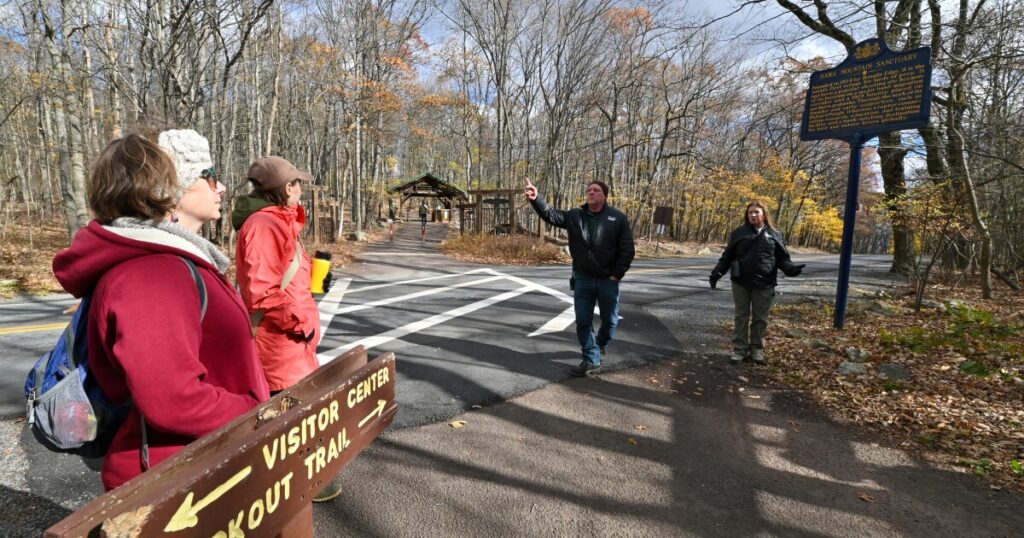
As spring ushers in the first warm rains, a remarkable event unfolds at Hawk Mountain Sanctuary. Frogs and salamanders embark on a perilous journey across Hawk Mountain Road, seeking the vernal pools vital for their breeding. This annual migration highlights the urgent need for safe wildlife corridors in Pennsylvania.
Efforts to Protect Wildlife at Hawk Mountain
Hawk Mountain Sanctuary, renowned as the world’s first refuge for birds of prey, also plays a crucial role in amphibian migration. Each spring, wood frogs and spotted salamanders brave the dangers of crossing roads to reach breeding pools. Sanctuary President Sean Grace notes, “It’s typically like one night or over a couple night(s) window,” emphasizing the narrow timeframe for their journey.
The sanctuary is actively working with PennEnvironment, an advocacy group dedicated to promoting clean air, water, and wildlife habitats. Their joint initiative aims to establish wildlife corridors across the state, safeguarding animals from vehicular threats.
Wildlife Corridors: A Path to Safety
Wildlife corridors are essential for safe animal migration. They range from large structures like bridges and tunnels to smaller culverts designed for frogs and salamanders. Dr. Laurie Goodrich, the director of conservation science at Hawk Mountain, emphasizes the importance of these corridors, stating, “It enhances survival of those species, both plant and wildlife, and in general, is just a healthier environment.”
The sanctuary itself is part of a vast protected area that includes Pennsylvania game lands and Federal National Park Service land, forming a critical wildlife corridor. Todd Bauman, the sanctuary’s director of stewardship, describes these corridors as “living pathways that sustain biodiversity.”
Challenges in Establishing Statewide Corridors
Pennsylvania faces significant challenges in creating a cohesive plan for wildlife corridors. Despite the efforts of state agencies and independent commissions, there is no formal statewide strategy for conservation connectivity. A 2024 study by the Legislative Budget and Finance Committee highlighted this gap, supported by PennEnvironment’s advocacy.
PennEnvironment’s research indicates that last year alone, nearly 147,000 collisions occurred with large animals on Pennsylvania roads. State Farm Insurance ranks Pennsylvania first in the nation for animal-vehicle collision claims, further underscoring the need for wildlife corridors.
Stephanie Wein from PennEnvironment points to successful local initiatives, such as the underpasses built by PennDOT in Fayette County, which eliminated road mortality for amphibians. However, she stresses the need for a statewide plan, saying, “There’s all this data on where these mortalities are happening. Imagine if that was used ahead of time to cite the best places to put some of these crossings.”
The Call for Action
State Rep. Mary Jo Daley and State Rep. Jason Ortitay have been instrumental in legislative efforts to address wildlife corridors. Daley emphasizes the urgency, stating, “We have the most roads out of any state in the Northeast. Balancing our footprint with the animals that have called this part of the Earth home for centuries is a step toward better environmental health, harmony and safety.” Ortitay echoes this sentiment, declaring, “Now is the time to act.”
The Hawk Mountain Sanctuary team remains hopeful for a cohesive statewide plan, as Dr. Goodrich concludes, “To have something that’s cohesive coming down from the top, identifying the key spots and hopefully linking to funding, would be super.”