In the wake of a tragic accident involving a Pennsylvania state trooper, questions are being raised about the policies surrounding commercial driver’s licenses (CDLs) issued to non-citizens. The incident has sparked a call for legislative changes to prevent similar occurrences in the future.
Union Demands Answers After Trooper’s Death
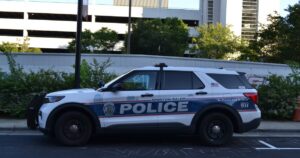
The union representing Pennsylvania state troopers is seeking clarity following the revelation that the truck driver involved in the fatal accident was in the U.S. illegally. The driver, who was operating a commercial vehicle with a Massachusetts-issued license, struck and killed Trooper Michael Pahira Jr. on Interstate 81.
Pennsylvania State Police
FUNERAL SERVICES SET
● Services for Trooper Michael Pahira Jr. will be held at the North Schuylkill Junior/Senior High School, 15 Academy Lane, Ashland, state police said.
● Visitation is scheduled for Wednesday, July 8, from 8-10 a.m., followed by the funeral service at 11. The visitation and funeral service are open to the public. Burial services will be private.
● There will be heavy traffic volume in the area, including Route 61, with delays expected throughout the day.
Details of the Incident and Legal Proceedings
Michael Bon, a 33-year-old Haitian national residing in Brockton, Massachusetts, is charged with homicide by vehicle and other offenses related to the July 1 crash. According to the Pennsylvania State Troopers Association (PSTA) President Stephen Polishan, “This individual should never have been driving such a dangerous vehicle on our highways. But he was, and now a good man is dead.” He emphasized the need for answers, stating, “Trooper Pahira was a hero, and his family, fellow troopers, and the public deserve answers.”
The Massachusetts Registry of Motor Vehicles acknowledged the tragedy, indicating Bon should face full legal consequences. They clarified that Bon was eligible for the license at the time of issuance, supported by the Department of Homeland Security’s confirmation.
Legal and Policy Implications
This case brings attention to the issuance of “non-domiciled” CDLs to non-citizens, a practice opposed by the Trump administration and addressed in proposed legislation known as Dalilah’s Law. The law aims to ensure CDL holders in the U.S. can comprehend English and mandates states to verify non-issuance of CDLs to illegal immigrants.
Rep. Rob Bresnahan (R-Luzerne) supports the proposal, stating, “You need to be able to read and write and understand English before you drive an 80,000-pound theoretical missile down our interstate.” The investigation revealed Bon’s difficulty in communication at the scene, further highlighting the significance of language comprehension for CDL holders.
Background on Bon’s Immigration Status
The Department of Homeland Security reported that Bon remained illegally in the U.S. after his humanitarian parole ended in June 2025. He was admitted as a parolee in July 2024, applied for Temporary Protected Status in October 2024, but was denied. Despite receiving a notice of parole termination in June 2025, Bon continued to reside in the U.S. illegally. He faces an immigration detainer following his arrest related to the crash.
Insights into Bon’s CDL Issuance
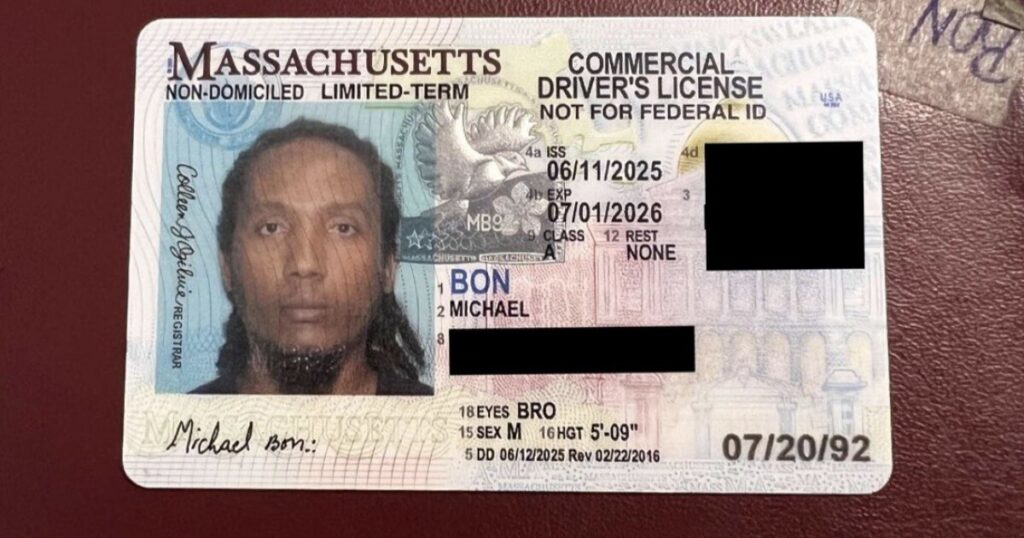
The Massachusetts RMV clarified that Bon’s eligibility for a non-domiciled CDL was determined based on federal law, with his application approved in March 2025 and renewed in February 2026. The RMV relies on the federal SAVE database for eligibility verification, confirming Bon’s status as eligible during the application periods. However, a Trump administration rule effective March 2026 prevents new or renewed non-domiciled CDLs.
A Homeland Security photo showed Bon’s license issued on June 11, 2025, expiring on July 1, 2026, the crash date. Efforts to obtain further comments from RMV were unsuccessful.
Calls for Legislative Reform
Advocates like William “Lewie” Pugh, representing the Owner-Operator Independent Drivers Association, advocate for Dalilah’s Law to reform non-domiciled CDL regulations. Pugh emphasizes the need for competent communication among truck drivers, stating, “You’ve got to know who’s behind the wheel, and they’ve got to be able to talk to people who aren’t behind the wheel.”
The push for legislative change aims to prioritize safety over cost-cutting, as highlighted by Pugh’s critiques of “CDL mills.” He supports the DOT’s recent ruling and seeks its permanence through congressional codification.
President Donald Trump endorsed Dalilah’s Law in his 2026 State of the Union address. The proposal, named after a young victim of a similar incident, aims to ensure all CDL holders comprehend English, prevent licenses for illegal immigrants, and address safety concerns associated with minimal training programs.
Rep. Bresnahan stresses the law’s importance for road safety, especially in regions like Northeastern Pennsylvania, a critical hub for the nation’s supply chain. He calls for legislative action to prevent future tragedies like Trooper Pahira’s death, which he deems preventable under stricter regulations.