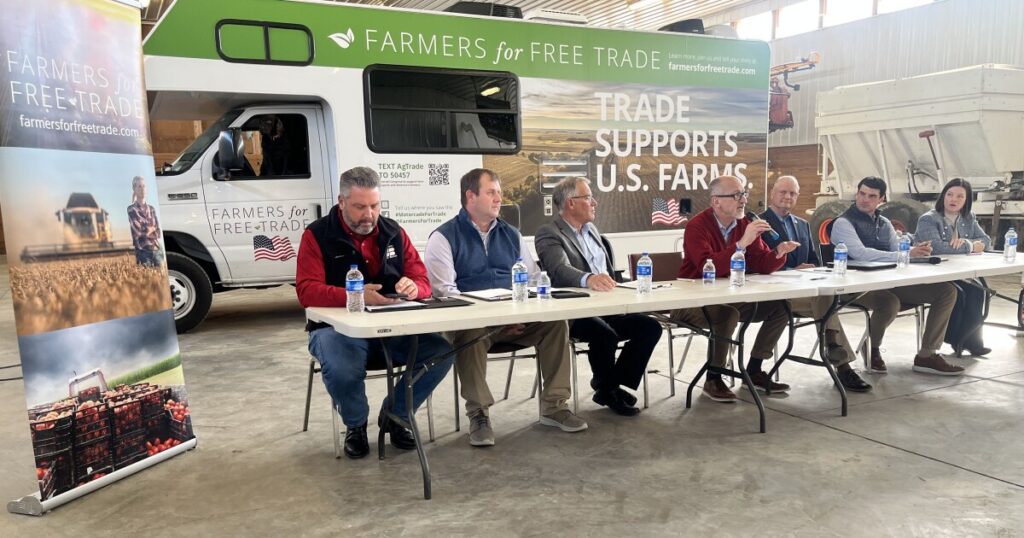
In a small town in Pennsylvania, agricultural leaders gathered to discuss the vital role international trade plays in supporting local farmers. This conversation, held at a farm in Clarks Summit, brought together two dairy farmers, two hog farmers, and a potato farmer, all advocating for enhanced trade relations to bolster Pennsylvania’s agriculture.
“If we don’t move our products, there’s only so much availability for the demand that some of us will disappear, and it’s going to be the family farm,” stated Chris Hoffman, president of the PA Farm Bureau and owner of Lazy Hog Farm and Lazy Chick Farm.
The event marked the final stop in Northeast Pennsylvania for Farmers for Free Trade, as part of their two-month nationwide tour.
Executive Director Brian Kuehl led a detailed discussion on the evolving trade landscape and its impact on the agriculture sector. The meeting took place at Eckle Farm, owned by Keith Eckle, a seasoned farmer and advocate for agricultural trade.
“But the need for free and fair trade has never changed,” Eckle emphasized during the session.
‘Farm Bill 2.0’
Farmers for Free Trade aims to highlight the critical role of trade in U.S. agriculture. Their efforts were underscored by the presence of U.S. Representative Rob Bresnahan, who represents Pennsylvania’s 8th congressional district. Bresnahan is actively involved in shaping new legislation, often referred to as “Farm Bill 2.0”, to support agriculture and food programs.
“I think it’s really important that we have meetings and gatherings like this as we work towards a Farm Bill 2.0, help me take a message back to Washington,” Bresnahan explained.
The existing Farm Bill, which outlines U.S. agricultural policy, expired on Sept. 30 and discussions are underway to form a new comprehensive policy.
Farmers share struggles
Kuehl invited local farmers to share their experiences, highlighting challenges such as rising supply costs and falling commodity prices. Multi-generational farms face mounting debt, threatening their survival.
“Overall, when you think about the economy in Pennsylvania and Ag, there’s a lot of hurt going on,” said Hoffman.
“The challenges that are facing agriculture right now are very much a concern to all of our rural communities,” noted Matt Espenshare, PA State Grange president.
Neighbors to the north and south
Discussions also touched on trade with Canada and Mexico, the top export destinations for U.S. agricultural products. Kuehl advocated for maintaining the United States–Mexico–Canada Agreement (USMCA), which is vital for continued trade.
“We should be saying yes, we’re going to keep USMCA,” Kuehl stressed, emphasizing both its importance and the need to explore new markets.
Exporting backups
Historically a major soybean supplier to China, the U.S. has faced challenges since China halted purchases in response to tariffs. Farmers are now seeking alternative markets to mitigate these disruptions.
“And how do you respond to that? Like you already have the crop in the ground, right? So we got to pivot. We’ve got to find another market. We’ve got to find another opportunity,” Hoffman remarked.
U.S. pork, exported to over 100 markets, also faces trade barriers. Courtney Gray, executive director of the PA Pork Strategic Investment Program, highlighted the potential in expanding trade with Asian nations.
“Partners like Japan and South Korea, especially those that find products in pork that are delicacies in their market, but not mainstream processed products here in the US, really help to prop up the US. Pork production,” Gray explained.
Sentiments from around the country
Kuehl concluded the discussion by sharing sentiments from farmers nationwide, emphasizing the need for stability in trade policies.
“So much of what we’re facing right now is ‘okay, we’re going to have a tariff on this country. No, we’re not. We’re going to have percent here, now it’s 15%,” he said. “Business can’t, an industry can’t plan. We need certainty. We need stability, and we need it. We need to move through this process.”