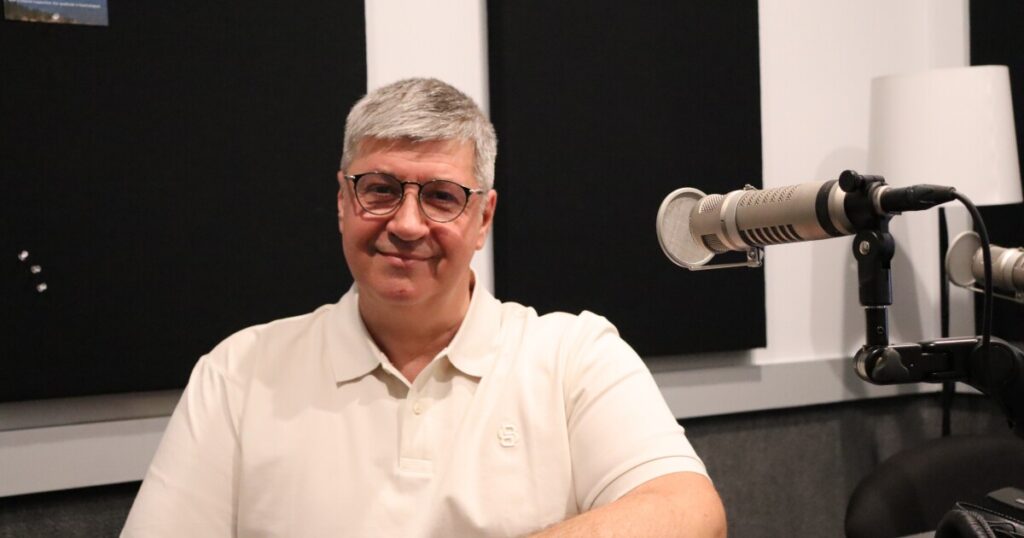
As Russia’s full-scale invasion of Ukraine in 2022 unfolded, Kyrylo Gencho found his life upheaved in Kharkiv, a city situated close to the Russian border.
Prior to the conflict, Gencho managed a clothing factory and enjoyed a peaceful and stable existence.
Everything changed in an instant.
“I was just shocked at first,” shared Gencho with BPR, speaking in English, a language he learned after relocating to the United States. “I couldn’t receive that the war started because pretty often I was in Russia. I have friends there.”
Gencho recalled the early days of the conflict as a constant barrage of explosions, sirens, and aircraft overhead.
He endured these conditions for eight months. Shortly after the war began, a Russian bomb obliterated his factory.
“I just broken totally,” he admitted. “I lost my business. I lost my money, I lost equipment, and I was just totally destroyed.”
In response, Gencho sought refuge through the Uniting for Ukraine program, allowing Ukrainians to enter the U.S. legally under humanitarian parole, provided they have an American sponsor.
Once approved, Ukrainians can apply for employment authorization in the U.S.
Gencho, with help from a friend who had fled during the Luhansk conflict in 2014, connected with American sponsors in Asheville.
“He found one family, a lady was Ukrainian and the husband was American,” Gencho said. “They are also Christians and we started to speak with them and they sponsored me.”
His humanitarian parole was approved, and he arrived in the U.S. in November 2022, carrying only a guitar, a backpack, and a suitcase.
The Uniting for Ukraine initiative, launched in 2022, became the primary legal entry program for Ukrainians escaping the invasion. Those in the U.S. could later seek temporary protected status (TPS).
While parole is obtained before entering the U.S., TPS is sought after residing in the country for a period.
Humanitarian parole offers individuals outside the U.S. a chance to enter on a case-by-case basis for urgent humanitarian reasons. However, it does not grant a pathway to citizenship or permanent residency.
The parole is valid for two years from the initial entry date.
TPS allows people from conflict-affected countries to live and work legally in the U.S. temporarily, with renewals every one to two years.
Upon arriving in Asheville, Gencho was invited by the director of a local nonprofit, Freedom in Christ, to volunteer at its recovery center. He later secured employment and accommodation there.
Gencho is among roughly 2,000 Ukrainians who have settled in North Carolina, according to the North Carolina Department of Health and Human Services.
About 500 Ukrainians have settled in western North Carolina, as reported by Lutheran Services Carolinas, a resettlement agency.
Gencho’s future is uncertain after receiving re-parole approval for 2024.
Following President Donald Trump’s executive orders in 2025, which included ending categorical humanitarian parole programs like Uniting for Ukraine, Gencho’s re-parole will expire in November, while his TPS application remains pending.
Seth Hershberger, director of the New Americans Program at Lutheran Services Carolinas, explained the significance of maintaining legal status for employment. “Their (Ukrainians) ability to work legally in the United States is tied to their status,” he told BPR. “If they don’t have humanitarian parole or TPS, then they’re at a crossroads where there’s not many other great pathways for them to work legally here in the U.S.”
Hershberger noted that many clients are reapplying for parole or TPS, facing extended wait times that affect up to 40% of clients.
“They’ll (Ukrainian clients) get their new parole period, and then their employment authorization document comes and it’s already expired. So then we have to apply for a new one, which could be another six to eight months before they actually receive that,” Hershberger said.
An NPR review of data indicates nearly 12 million applications await processing for citizenship, work permits, or other permissions to live in the U.S.
In addition to delays, visa application fees have increased due to the H.R. 1, or the One Big Beautiful Bill Act passed in 2025. Hershberger noted that the cost for Ukrainians to reapply for parole was around $600 before 2025, but has since risen to approximately $1,000, excluding additional fees.
Challenges with the program’s design have persisted, according to Julia Gelatt, associate director of the U.S. Immigration Policy Program at the Migration Policy Institute.
“The downside was that the (Uniting for Ukraine) was always temporary,” Gelatt said. “There have been some efforts to push Congress to open some kind of path to permanent status for Ukrainians, but those really haven’t moved in Congress.”
Gelatt highlighted that the program was a temporary measure by former President Joe Biden to address an immediate need, lacking a long-term solution.
“The Biden administration implemented several programs to give people from various parts of the world temporary access to safety in the United States. And I think that happened in an emergency situation, thinking that down the road a broader solution could be found for those people,” Gelatt said. “It turns out that with the change in administration, the conversation about offering more durable protections really hasn’t come up. That has left Ukrainians, but also people from other countries, sort of hanging in limbo in the United States.”
Efforts by Congress to pass the Ukrainian Adjustment Act have faced challenges. Introduced in 2023, it aimed to provide Ukrainian parolees a path to a green card, inspired by the Afghan Adjustment Act, a notable bipartisan legislation during Biden’s administration.
Although the bill was reintroduced in 2025 by Rep. Bill Keating, D-Mass., and supported by 18 co-sponsors, including Rep. Chuck Edwards of western North Carolina, it has yet to advance.
The lack of urgency in passing the bill has left many Ukrainians, who have begun rebuilding their lives, in a precarious position, Gelatt noted.
“People started to put down some roots in the United States and build their lives here and then realize that they may not be able to stay after all and might need to head back, if not to Ukraine, then to maybe a European country that will take them in,” Gelatt said.
She emphasized that while Ukrainians have not been a primary target for U.S. Immigration and Customs Enforcement, losing legal status poses risks, including potential detention or removal.
Gencho remains apprehensive about the future as his humanitarian parole nears expiration in November, with his TPS application pending.
“My attorney told me maybe I can go out of country and come back,” Gencho told BPR. “But I really scared to go out because I have no places for living.”
Gencho hopes to avoid returning to Ukraine, emphasizing his desire for peace as a devout Christian.
“I can’t take gun and go to the war. It’s not my case of life. I can’t go to war and a lot of my friends died in this war,” Gencho said.
The Uniting for Ukraine program ceased accepting new applications in January 2025. Ukrainians already in the country may still qualify for a two-year extension upon the initial parole expiration. TPS has been extended through mid-October for Ukrainians.
As Gencho prepares to reapply for re-parole, he prays and hopes for his TPS approval, eager to continue building his life with his partner, who plans to join him soon.