Historic Civil War Vessel Rediscovered: U.S.S. Monitor’s Underwater Odyssey
Emerging from the murky depths of the Atlantic, the historic U.S.S. Monitor is being vividly captured in high-definition. The recent exploration effort off Cape Hatteras by the National Oceanic and Atmospheric Administration (NOAA) and its partners has brought this Civil War-era ironclad back into focus.
Resting 240 feet below the ocean’s surface along North Carolina’s coast, the Monitor, famously known as the “Cheesebox on a Raft,” has remained shrouded in darkness for over a century. NOAA’s Office of National Marine Sanctuaries has spearheaded a mission to illuminate this relic of naval history.
Related content: Weird Science: N.C. researchers using AI to help conserve endangered species like the Right whale
“It looked like a round cheese box on top of a raft,” noted Tane Casserly, Research Coordinator for NOAA’s Monitor National Marine Sanctuary in Virginia. “That’s what they called it that.”
The Monitor, which boasted the U.S. Navy’s first rotating turret, succumbed to a storm on December 31, 1862, and sank off Cape Hatteras. “It eventually got overwhelmed with water coming into the vessel at different parts, cooling the engines and the steam furnaces, and eventually the ship was overwhelmed and unfortunately went down with 16 crew members,” Casserly explained. Two crew members’ remains were discovered in a 2002 expedition, later laid to rest at Arlington National Cemetery.

Courtesy of The Mariners’ Museum
Related content: Weird Science: North Carolina partnership offers service members a burial at sea that also supports the ecosystem
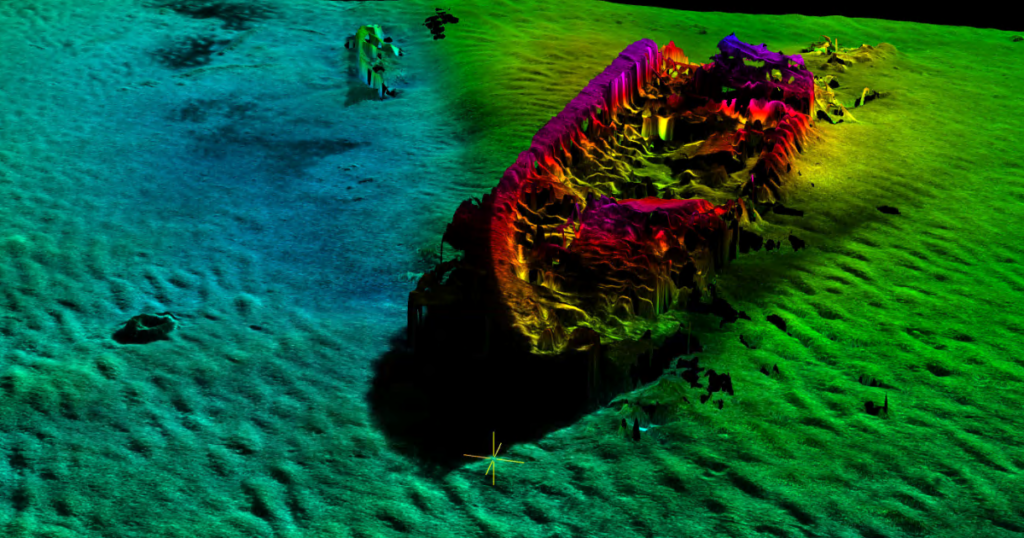
In a collaborative effort, aerospace giant Northrup Grumman utilized autonomous underwater drones with sonar technology to construct the most comprehensive 3D models of the Monitor wreck. These images, revealed at The Mariners’ Museum, offer an intricate view of the iron hull and its transformation into an artificial reef.
“It’s really difficult to visit Monitor due to the currents and the depth, just the challenges of working offshore Cape Hatteras area,” Casserly said. “So, it really has grown up with this oasis of life down there. And it’s really wonderful to see that it has a whole, essentially a second life to the Monitor’s history now, be able to support all these wonderful sea creatures.”
Watch Northrup Grumman’s YouTube video of simulation of the sinking of the U.S.S. Monitor.
Dr. Chris Taylor, a Research Ecologist with NOAA’s National Centers for Coastal Ocean Science, has worked with the Monitor National Marine Sanctuary for over 15 years.
He remarked, “It’s in 240 feet of water. It’s surrounded by miles of sand that has no other measurable features or emergent rock or reefs. And so, the fact that this thing exists there, it really is like an oasis where we encounter tropical species that we may see in areas of Florida, coral reefs in the Caribbean, to large schooling fish like amberjacks, spadefish, even some snappers and groupers that are sought after by recreational fishers. And then the largest occupants of the wreck being the sand tiger sharks that are that seen to be present on there as they’re as they’re using these oases to sort of migrate up and down the Atlantic coast.”
Related content: Weird Science: NOAA lab in Beaufort celebrating 125th year of research in eastern North Carolina
Researchers from Stantec, a sustainable engineering firm, have collected environmental DNA (eDNA) from the water surrounding the wreck to identify species present without direct observation. Kelly Swindle, a Senior Marine Biologist with Stantec, noted, ““Since the AUV was already going out, we knew there wasn’t a chance that the AUV was going to bump into the monitor or really bother the species that are living around the reef. We decided to use a 3D printed metaprobe and attach it to the AUV so that we get that passive sampling without the risk of bumping into the ship.”
Stantec Environmental Scientist Nathaniel Marshall described the metaprobe as akin to a childhood toy. “It’s basically a wiffle ball, right?” he described, “You can picture a wiffle ball that had two or three sponges in it. And these were attached to the AUV. So, these went down close to 300 feet, were down there for 20 to 30 minutes, came back up, we took those sponges, sent them off to a lab that looked for DNA.”
The eDNA analysis revealed species such as lancer dragonet, pearly razorfish, largehead hairtail, and flounder, primarily dwelling near the seabed, along with invertebrates and algae. These findings offer insight into the wreck’s role as an artificial reef supporting marine biodiversity.

Related content: New ENC research shows increasing plastics in oceans may be causing whales to eat things that are harmful
The U.S.S Monitor wreck site was designated as the first U.S. National Marine Sanctuary in 1975.