This coverage is supported through a collaboration between BPR and Grist, a nonprofit environmental media organization.
In the wake of Helene’s wrath, the environment is on a path to recovery, aided by the dedicated efforts of volunteers and professionals alike. Teams from MountainTrue and North Carolina State University have been actively planting trees throughout the winter to bolster flood defenses in anticipation of future extreme weather events.
The rivers in the region are experiencing a delicate recovery. The aftermath of Helene saw rivers swollen, uprooting trees, and destroying habitats for species such as brook trout and hellbenders. The Federal Emergency Management Agency’s debris removal efforts inadvertently added to the environmental challenges, as heavy machinery damaged living trees and shrubs along riverbanks, as documented by local communities and scientists. For more details, see the second wave of environmental changes.
Supported by the North Carolina Department of Environmental Quality and private funding, efforts have been made to restore 53 river miles across counties like Buncombe, Transylvania, and Henderson, among others. MountainTrue’s collaboration with NC State experts and volunteers has resulted in the planting of 20,000 trees along the Green River alone. Regionally, 226,000 trees have been planted, with 36,000 more in progress. This initiative has generated 104 jobs and involved 109 volunteers, with significant debris cleared from river miles. MountainTrue staff told BPR they aspire to not only beautify the area but also mitigate future flood risks.
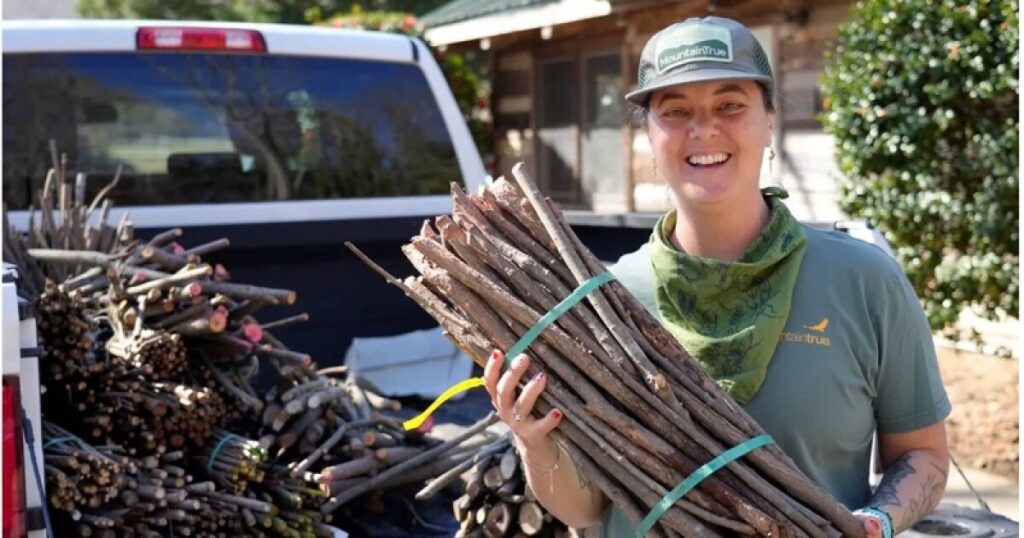
Erica Shanks, the Riverkeeper for the Green River in Polk County, has been actively involved in restoration efforts. Observing the damage from flooding and debris removal, she and her team have planted native trees such as elderberry and river birch to stabilize riverbanks. These trees, grown from dormant cuttings called “live stakes,” are expected to grow and strengthen the ecosystem over the coming years.
Shanks emphasized that the trees will start contributing to flood prevention by establishing deep roots in their first year. By the third and fourth years, these trees will become integral to the local habitat. “Mama Green will be able to do a lot of that restoration work kind of on her own,” Shanks stated, referring to the river’s natural resilience.
Mitch Woodward, an extension agent from NCSU, has been educating landowners on the benefits of native plants and distributing live stakes for planting. He underscored the importance of native vegetation in maintaining riverbank stability against the backdrop of increasing rainfall due to climate change. “The areas that had a lot of native vegetation, trees, shrubs, I mean even weeds, the banks held up fairly well in most locations,” Woodward noted.
Efforts to reestablish native vegetation continue, highlighting both their environmental and cultural significance. Organizations like Riverlink and Conserving Carolinas are working alongside universities and local governments on educational and planting initiatives. Adam Griffith from NCSU is collaborating with the Eastern Band of the Cherokee Indians to plant rivercane, a native bamboo with deep roots used in Cherokee basket weaving.
As western North Carolina develops, impervious surfaces such as roads and roofs increase stormwater runoff, making even small rains potentially hazardous. Woodward advocates for managing water flow through the “3 S’s”: slow it down, spread it out, and soak it in before it reaches streams.