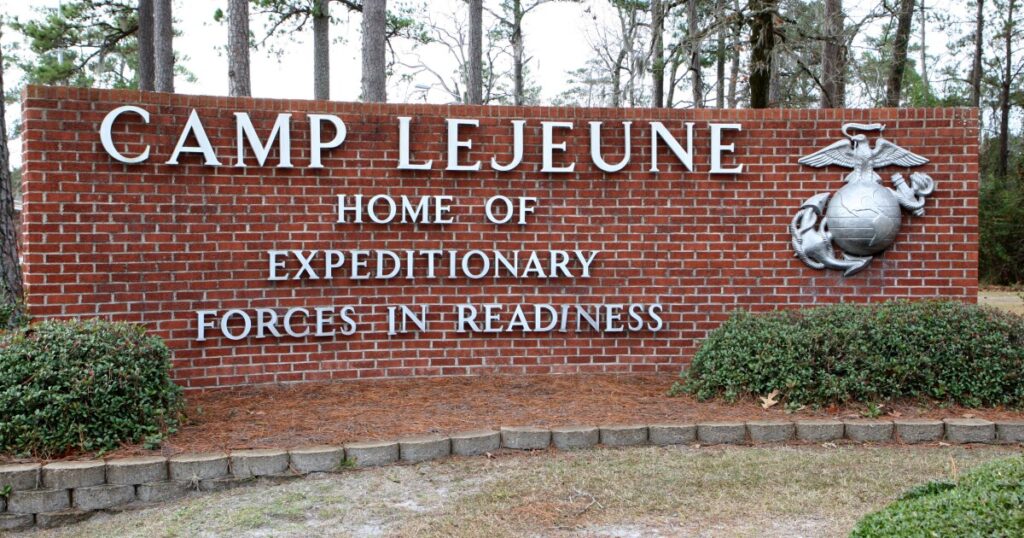
The ongoing legal battle concerning water contamination at Camp Lejeune took a significant turn last week as judges ruled against the government’s attempt to dismiss key evidence. This evidence, derived from the Agency for Toxic Substances and Disease Registry (ATSDR), employs computer modeling to recreate the contamination timeline of Camp Lejeune’s drinking water, which dates back to limited testing periods between the 1950s and 1980s.
Agency for Toxic Substances and Disease Registry
Related content: Camp Lejeune Justice Act Series
ATSDR’s computer-generated models have revealed that contamination was concentrated in areas such as Hadnot Point and Tarawa Terrace. The pollutants, including trichloroethylene, tetrachloroethylene, and benzene, stemmed from incidents such as fuel leaks and dry-cleaning operations. While Holcomb Boulevard generally received clean water, it occasionally got contaminated supplies from Hadnot Point.
The computer models are instrumental in identifying the locations and times when exposure occurred, aiding health research into conditions like cancer and birth defects.

U.S. Veterans Administration
The judges criticized the government’s efforts to sideline this evidence, highlighting that it had previously used ATSDR’s findings to establish a connection between water contamination and disease. The court emphasized that the ATSDR’s research is vital for proving causation and accused the government of attempting to weaken its own scientific conclusions with trivial objections.
Background:
The initial discovery of water contamination at Camp Lejeune dates back to 1982, although the most severely affected wells were not shut down until 1985. While base newsletters in 1984 underplayed the contamination, the extent of exposure only became widely known through media reports in the late 1990s. Official notifications to past residents began in 1999 as part of a federal health study.
Contaminants originated from multiple sources, including leaking storage tanks, waste disposal sites, and spills, with three out of eight water treatment facilities found to be affected. A 2014 study in Environmental Health identified tetrachloroethylene, trichloroethylene, and their derivatives, alongside benzene, in water samples from the 1980-1985 period. According to the CDC, prolonged exposure to tetrachloroethylene can lead to cancers and brain chemistry alterations.
More than a million individuals may have been exposed to these toxins near Jacksonville. The Camp Lejeune Justice Act of 2022, enacted as part of the Honoring Our PACT Act, permits those affected between 1953 and 1987 to file lawsuits against the U.S. government for damages. This legislation lowered legal obstacles, requiring plaintiffs to prove that contaminated water was “as likely as not” the cause of their ailments.
Although the act allowed victims two years from its signing to pursue legal action, resulting in over 400,000 claims, no cases have gone to trial, and settlements remain rare.