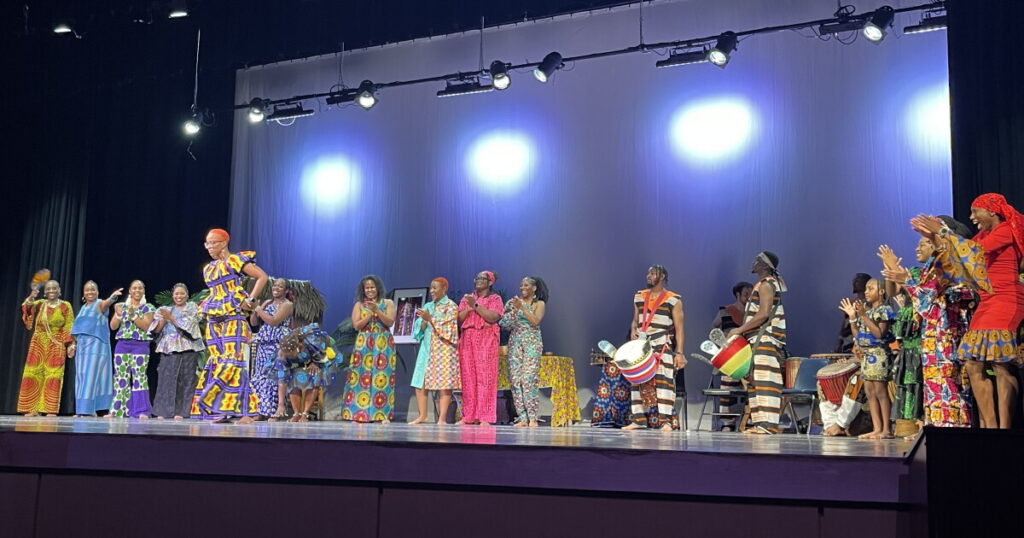
West African traditions took center stage in Kannapolis last weekend, drawing hundreds of community members to witness a cultural performance that many said was both moving and rare. The event offered a window into traditions that, for many African Americans, can be difficult to access or even find.
The production, titled “Initiation,” was held at Kannapolis Middle School and was organized by Share Arts Movement African Arts, a local group dedicated to preserving and sharing West African art forms. The performance featured dozens of women dancing across the stage, children dressed in vibrant, colorful attire, and live drumming rooted in the traditions of Mali and Guinea.
LeShea Stukes, co-founder of Share Arts Movement African Arts, described the show’s central theme as a celebration of the journey from girlhood to womanhood — a passage honored through movement, art, and ceremony.
Stukes explained the emotional peak of the production:
“So the climax of the show is a rhythm called bow. That’s the actual initiation, where the women of the village come and embrace the women through dance, through facial art, through dressing, through lighting of candles.”
The Role of the Drums
Central to the performance were two traditional West African drums — the djembe and the dunun — both of which have deep roots in countries like Mali and Guinea. Stukes emphasized that the drums were not simply accompaniment; they were a form of communication between musician and dancer.
“When that drummer decides to raise the tempo up, that’s the communication to the dancer,”
Stukes said.
“There are the djembe and the dunun. The djembe is the one they play between their knees with their hands, and the dunun is the bigger one. It’s like the heartbeat and the rhythm.”
What the Audience Took Away
For many in attendance, the performance carried personal significance. Miya Lee, a 24-year-old dancer from Charlotte, said the show connected her to a part of her heritage she rarely gets to see reflected back at her.
“Just been brought up, you don’t get your African side, if you are African American, shown to you, if you don’t really go looking for it,”
Lee said.
“Being able to come and see this, a full-blown production, and just seeing the passion through the dancers, really inspires me to become a better dancer.”
Tau Khamisi Mkweli, 39, arrived dressed in traditional African attire and said the performance reinforced why events like this matter.
“I think it’s beautiful,”
Mkweli said.
“It’s always great to see the tradition stay alive and the culture exist because you know the Western culture is very strong.”
The evening concluded with an audience tradition of its own — community members throwing money onto the stage as a show of appreciation and celebration for the performers.