When a city declares a water shortage, most residents know the basics — cut back on lawn watering, follow the schedule, and conserve. But what happens when the lawn in question is a collegiate athletic field used by student athletes every day?
Greensboro, North Carolina is currently operating under a Stage II water shortage response plan, triggered by persistent drought conditions. The city’s restrictions limit most residents and businesses to one day of outdoor watering per week, and only by hand-held hose, container, or drip irrigation system. Sprinkler systems are off-limits under general household rules.
Universities and other institutions that maintain playing fields, however, fall under a separate set of guidelines. Rather than a strict one-day-per-week limit, these facilities have two approved alternatives for staying within the city’s requirements.
How Universities Are Managing Under the Rules
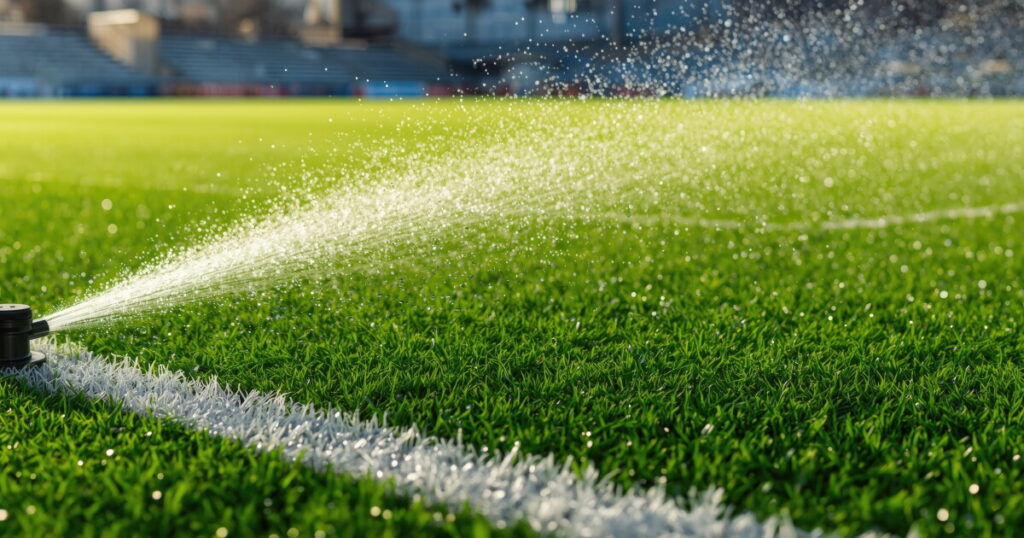
Greg Clarke, associate athletics director for facilities and operations at North Carolina A&T State University, explained how the system works in practice. Field managers can either manually set their irrigation systems to run for a specific, shortened duration, or they can program controllers to automatically reduce total water usage by a set percentage.
“You can go punch in the control system that you want to water it for, say, 30 minutes, 20 minutes manually,”
Clarke said.
“Or in the system, you can say, ‘Hey, I want to use,’ as in this case, they tell you to cut it by 40 percent. So you want 60 percent usage, and the controller will take care of your percentages and your watering.”
Institutional users are also restricted to watering only between 10 p.m. and 5 a.m., keeping irrigation activity out of peak daytime hours when evaporation rates are highest.
Timing Matters: Grass Type and Season Play a Role
The time of year makes a significant difference in how challenging these restrictions are to manage. Clarke noted that Bermuda grass — common on athletic fields in the region — grows most aggressively during the summer months of June through August, making water conservation harder to balance with field maintenance during that window.
By autumn, however, the pressure eases considerably. Clarke pointed out that fall overseeding, while requiring some additional watering upfront, does not demand the same sustained irrigation as summer growth.
“If you choose to overseed with a perennial rye or whatever type rye that you use, you may spend maybe a couple of days or so watering that in, but for the most part, your heavy use of water is behind you,”
he said.
City officials have confirmed that the Stage II water shortage response plan will remain in effect until further notice. They have expressed hope that restrictions could be loosened in the coming weeks, though any change will depend entirely on rainfall and broader weather conditions.