Controversy Erupts Over North Carolina’s New Congressional District Map
Amidst debates over gerrymandering and voting rights, North Carolina’s recent redistricting decision has sparked significant criticism and potential legal challenges. The state’s contentious new congressional map is being described as a strategic move to secure Republican dominance, raising concerns about racial and political fairness.
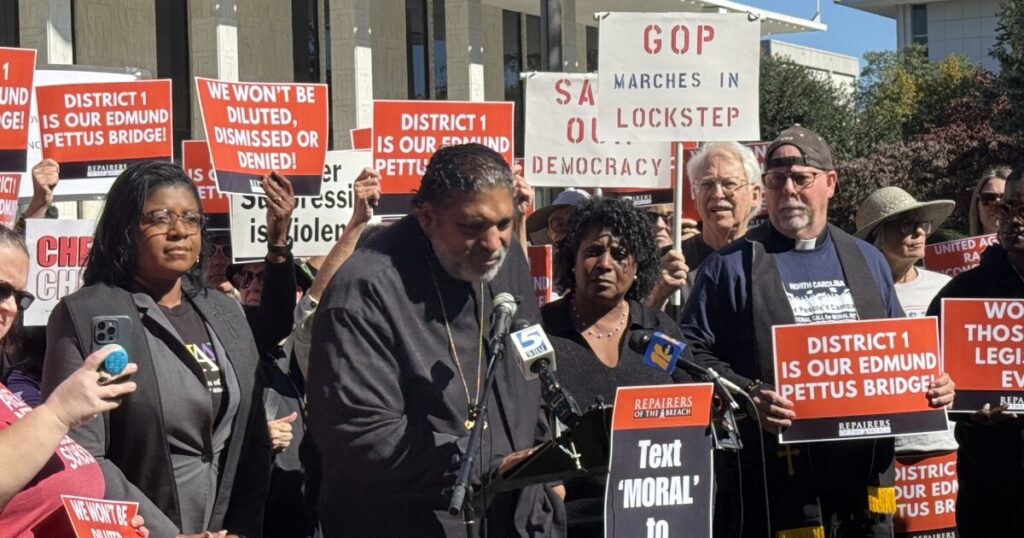
Bishop William Barber, a prominent civil rights advocate in North Carolina, criticized the redistricting efforts, labeling them as “racist” and an “attack on Black Belt counties.” Barber, known for founding the Moral Monday movement and his long tenure at Goldsboro’s Greenleaf Christian Church, announced his intention to be involved in legal actions against the map change.
The new map involves transferring 10 counties between the 1st and 3rd Congressional Districts, potentially making the 1st District more favorable for Republican candidates. U.S. Rep. Don Davis, a Democrat, currently represents the district.
During a demonstration outside the North Carolina Legislative Building, Barber addressed supporters holding signs with messages such as “District 1 is our Edmund Pettus Bridge” and “We Will Not Be Diluted, Dismissed or Denied.”
Republican leaders in the North Carolina General Assembly initiated the redrawing process last week, aiming to establish 11 secure Republican districts. State Senate leader Phil Berger explained that the new map aligns with the preferences of North Carolina voters, as evidenced by Donald Trump’s victories in the last three presidential elections. “The people of North Carolina, again, on three separate occasions have voted to do that and it is something that is an appropriate thing for us to do under the law and in conjunction with basically listening to the will of the people,” Berger stated.
Despite more than 12,000 public comments on the proposal, the map passed without any amendments. Representative Pricey Harrison noted that only a small fraction of public feedback supported the new map.
While midterm redistricting without court orders is uncommon, North Carolina’s State Constitution does not restrict when the General Assembly can redraw congressional maps, although it does limit changes to State House or State Senate seats to the first session after new U.S. Census data is released.
Barber referenced a recent poll by Opinion Diagnostic for Common Cause NC, highlighting that 84% of respondents believe it is unacceptable for politicians to manipulate electoral maps for party advantage. “Just because you’re elected doesn’t mean you get to run roughshod over the Constitution,” Barber asserted.
A Voting Rights Act Challenge?
Republican legislators maintain that racial data was not considered in the redistricting process, focusing instead on political data related to the 2024 presidential election. However, Kat Roblez from Forward Justice argues that “race and political preference are deeply linked,” and the new map undermines the political influence of Black communities.
The potential lawsuits may invoke the Voting Rights Act of 1965, which courts have interpreted as protecting minority groups’ ability to elect candidates of their choice. Barber emphasized, “That was the basis of the Voting Rights Act, to ensure that people — Black and brown and others who had traditionally been pushed aside and who had traditionally had tricks done on them would have the power to elect the candidates of their choice.”
The U.S. Supreme Court’s upcoming decision in Louisiana v. Callais could impact future Voting Rights Act cases, especially in regions where race and political preference intersect. If the court sides with the Trump Administration’s Department of Justice arguments, it may become challenging to win such cases. Historically, North Carolina’s 1st District has consistently elected Black Democrats to Congress since 1992, but the new map reduces the district’s Black population from about 40% to 32%.
Barber’s final remark encapsulated the opposition’s stance: “Our fundamental cry is, you cannot draw racist maps and call them fair.”