In a dramatic reshaping of the political landscape, the Asheville City Council primary narrowed a field of 20 candidates to just six who will proceed to the November general election. This fiercely contested race saw all three incumbents—Maggie Ullman, Antanette Mosley, and Sheneika Smith—retain their positions for the upcoming election phase. New entrants Jeffrey Burroughs and Drew Ball have also secured spots, alongside previous council member Keith Young, known for his pivotal role in Asheville’s reparations initiative.
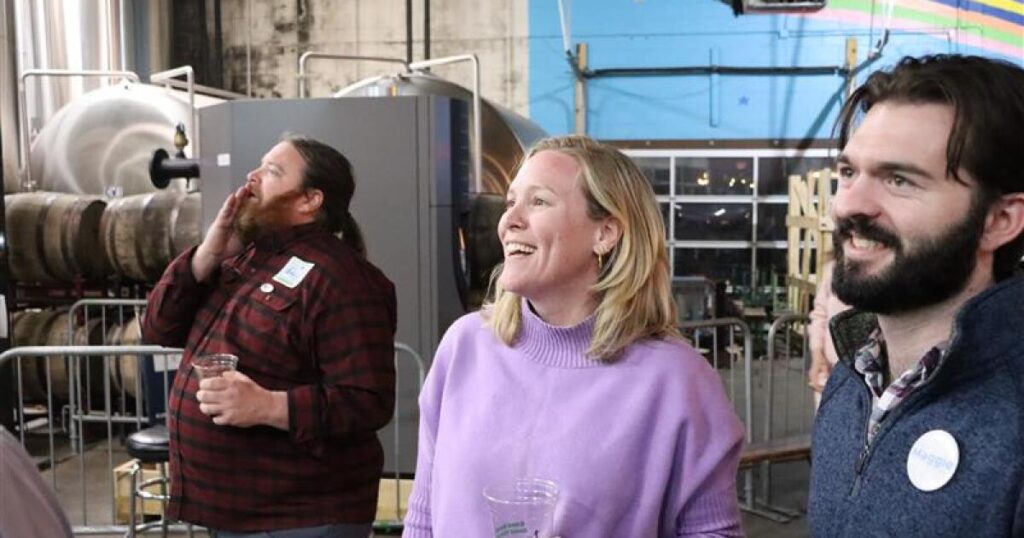
Leading the primary results were Ball and Ullman, each capturing just over 16% of the votes. Ball, who serves as a Buncombe County Commissioner, addressed supporters at a watch party hosted by Buncombe County Democrats at Hi-Wire Brewing. Praising the diverse field, Ball remarked, “It speaks to the character of Asheville that we had 20 awesome people who stepped up to say, ‘I want to help lead this community through these difficult times.’
“All of you have to stay engaged in making our city a better place. because that is how we build a more affordable, more equitable, and a safer Asheville,” he continued, highlighting his commitment to addressing the city’s affordability challenges.
Tackling Asheville’s affordability crisis is central to Ball’s platform. He emphasized the urgent need for solutions, citing the overwhelming concern about housing costs among residents.
“I continuously heard folks talk about affordability. Specifically, housing affordability. And we already kind of knew that. But I was really impressed with how many folks brought that up and how widespread and how unaffordable things are getting,” he told BPR.
Ball’s proposals for alleviating the crisis include revising zoning laws, promoting high-density developments, and forging strong public-private partnerships with developers specializing in affordable housing. Meanwhile, Ullman is also championing improved housing policies, building on her efforts during her first term.
“The city has a great track record of subsidizing housing to be more affordable. But there’s not enough taxpayer dollars to subsidize our way out of this housing crisis. So, we also need to look at the rules we have,” Ullman stated, pointing to recent changes in rules regarding accessory dwelling units.
Ullman shared a personal example to illustrate the impact of policy changes: “I have a 500 ft. garage in my backyard that previously I couldn’t turn into an apartment for my elderly in-laws. Now, we made a tiny tweak and that’s an option for housing, that’s small, attainable, affordable and fits into the neighborhood.”

Jeffrey Burroughs, making their first foray into politics, captured third place with 7% of the vote. Expressing gratitude, they commented, “I’m actually very humbled about how people have shown up for me today, and I just want to continue to serve in the best way that I can.”
Burroughs, a jeweler and president of the River Arts District Artists’ Association, focused their campaign on recovery from Hurricane Helene and chairs the city’s Hurricane Helene Economy Recovery Board.
The remaining spots in the runoff were filled by Young, Mosley, and Smith, each securing just over 6% of the votes.
Among those whose campaigns ended was Nina Ireland, a single mother who highlighted the personal growth and sacrifices involved in the race. Reflecting on her experience, Ireland noted, “I’ve grown so much with just getting up in front of people, talking about subjects that I either live or face on a daily basis and having to be a little bit more vulnerable.”
She added, “I’ve learned that politicians are the real superheroes or real super villains. They can make policies that keep you placed at home. They can make policies that get you displaced. It really made me put things into perspective.”