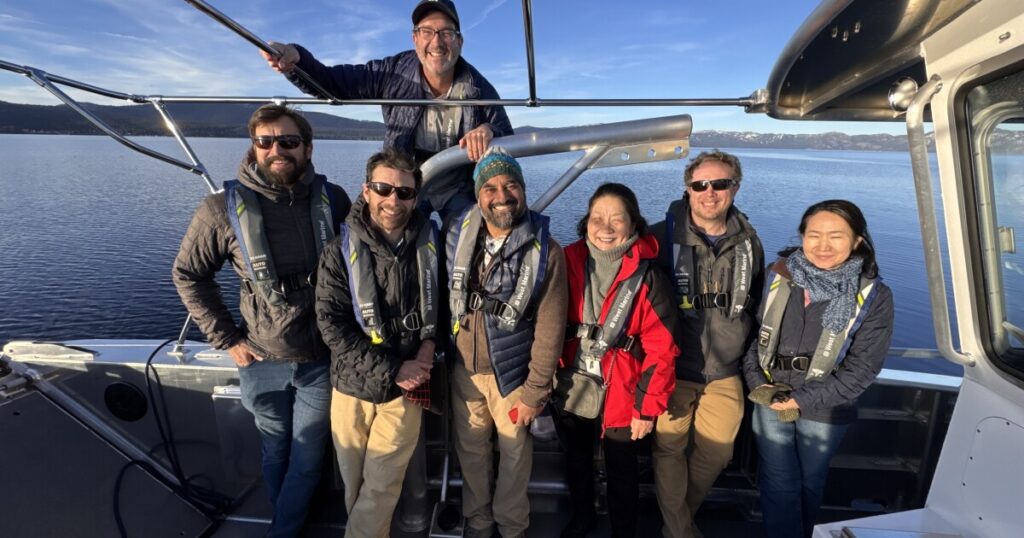
The chill of a Lake Tahoe afternoon did little to deter a group of scientists gathered at the Tahoe City Marina. They were preparing to embark on a mission aboard Liberty, a research vessel operated by the University of Nevada, Reno (UNR), to study the lake’s water clarity and other vital conditions.
Liberty is a key asset in UNR’s research fleet, aiding in the collection of critical data. A new, larger research boat with a capacity for 15 individuals is anticipated to join the fleet this September, expanding the reach of scientific exploration in these waters.
Maria Palma
/
KUNR Public Radio
As the vessel moved farther from shore, Lake Tahoe’s renowned clarity was evident. Zeb Hogan, a research professor, highlighted the lake’s historical association with the Lahontan cutthroat trout. “And so we’ve come together to try to share information, to try to figure out ways to better protect these fish,” Hogan remarked. “And one of the reasons why being out here on Tahoe is so relevant is that Lake Tahoe used to be home to North America’s largest cutthroat trout species.”
Once a resident of the lake, the Lahontan cutthroat trout vanished from these waters in the 1930s due to overfishing, habitat destruction, and competition from non-native species. However, the trout continues to inhabit other parts of Nevada, such as Pyramid and Summit lakes.
Scientists converged at Lake Tahoe for a three-day symposium centered on five giant trout species from the genera Hucho and Parahucho, collectively known as taimen, which face threats from dams, climate change, and excessive harvesting. The event drew participants from diverse regions, including Europe, Mongolia, China, Japan, and Russia, alongside American university researchers. A representative from the Summit Lake Paiute Tribe offered insights into local conservation efforts for the Lahontan cutthroat trout.
Matthew Sloat, science director at the Wild Salmon Center, focuses on large trout, like the Siberian taimen, which ranks among the largest freshwater fish in the salmon family. “We don’t need to know everything about these fish,” Sloat stated. “But we want to know the essentials for keeping them around for future generations.”
International collaboration may be crucial in addressing the challenges faced by large trout species worldwide. Scientists believe that by working together, they can better safeguard these fish from further decline.

Maria Palma
/
KUNR Public Radio
Sudeep Chandra, director of the Tahoe Institute for Global Sustainability, emphasized the importance of connecting local research with global environmental challenges. “What I’d love the community to understand is that we not only work on local issues, but we want to partner and work on global issues and invite the community in to learn about it,” Chandra shared.
By the workshop’s conclusion, the attending scientists had begun drafting a paper synthesizing research on five giant trout species while outlining essential conservation priorities.