In the remote desert of southern Nevada, efforts are underway to restore a vital ecosystem impacted by fire and invasive species. This area is crucial, as it ultimately contributes to the Colorado River, which is a lifeline for millions in the Mountain West.
The journey to this restoration site is a challenging one, requiring an hour and a half trek through difficult terrain.
Kaleb Roedel
/
Mountain West News Bureau
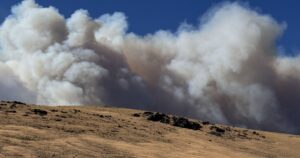
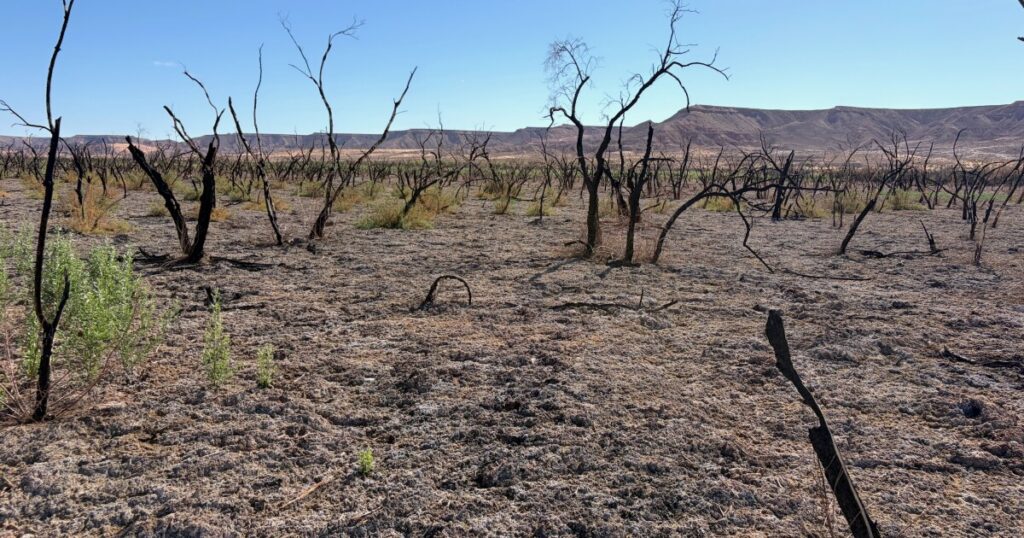
The path to the site traverses dense groves of tamarisk, arid desert washes, and eventually reaches the Virgin River. It then ascends over the charred remnants of the 2023 Huntsman Fire, which devastated approximately 400 acres, leaving behind barren soil and ash.
The landscape has been altered by fires, invasive species, and grazing, affecting both the ecosystem and water movement.
“We’re walking on some pretty salty soils. Salty soil really impedes restoration,” according to Lilly Setters, a botanist from the Bureau of Land Management (BLM).
Such conditions hinder the regrowth of native plants.
Fencing Promotes Early Recovery
Fencing around a restoration site delineates an area meant to protect sensitive habitats from cattle.
Within the fenced zone, Setters notes the resurgence of native riparian flora.

Natasha Majewski
/
Nevada Wildlife Federation
“I can see inside the fence an increase in the abundance of native riparian vegetation. And on the outside the fence, there’s not the same density and cover of that desirable native vegetation,” she stated.
This habitat is crucial for rare species like the Southwestern willow flycatcher and the Virgin River chub.
The restoration process includes removing invasive plants and enhancing water management to increase soil absorption and reduce runoff.
Within weeks of the Huntsman Fire, funding of nearly $450,000 was secured by the BLM for emergency stabilization and recovery.
Collaborative Efforts to Restore Habitat
The restoration initiative involves federal agencies, conservation organizations, and restoration teams working to replace invasive species with native vegetation like cottonwoods and willows.
The objective is to enhance wildlife habitats and reinforce a watershed that contributes to the Colorado River, a critical water source for the region.

Kaleb Roedel
/
Mountain West News Bureau
“When you do work like this, it’s very tangible,” remarked Adria Surovy, a western water specialist with the National Wildlife Federation. “You see the results. And this is something we can do to protect our community and make it more resilient for what’s to come.”
Natasha Majewski of the Nevada Wildlife Federation highlighted how drought conditions have drastically altered the watershed.
“I’ve never gone searching for a river,” she explained. “If you can imagine no water… or just pockets of water and fish kind of flopping around in it.”
Regrowth and Future Plans
Despite setbacks from fire and drought, native species like arrowweed are making a comeback along desert waterways.
Setters is optimistic about the spread of arrowweed, viewing it as a positive indicator of ecosystem recovery.

Kaleb Roedel
/
Mountain West News Bureau
“This arrowweed has gone gangbusters in this area, and I’m actually really happy,” she noted. “We don’t see any bare ground. We don’t see any of that thick, salty crust.”
Such regrowth signifies the gradual restoration of the ecosystem.
Setters aims to expand restoration efforts to other waterways, employing fencing and planting to rejuvenate habitats over time.
However, she warned that progress will require years of effort and sustained funding, especially as the region faces climate change challenges.
Ultimately, the success of restoration is seen in small changes: a patch of green, a fence line, and the gradual revival of a river corridor.
This story was produced by the Mountain West News Bureau, a collaboration between KUNR, Wyoming Public Media, Nevada Public Radio, Boise State Public Radio in Idaho, KUNC in Northern Colorado, KANW in New Mexico, Colorado Public Radio, KJZZ in Arizona and NPR, with additional support from affiliate newsrooms across the region. Funding for the Mountain West News Bureau is provided in part by the Corporation for Public Broadcasting and Eric and Wendy Schmidt.