Unearthing History: Ancient Sea Fossils Lure Explorers to Nevada’s Arid Landscape
In the heat of a July morning, Hilary Loupee navigated her white Jeep through the rugged terrain of a dusty playa. Her mission: uncovering traces of Nevada’s prehistoric marine life. Loupee, who is the president of the Reno Gem and Mineral Society, identifies as a “rock hound” and frequently scours the canyons and hills near Walker Lake for fossils.
“Everybody knows ‘Jurassic Park,’ right?” Loupee remarked, highlighting the evolutionary significance of the Triassic period, which followed the massive extinction event known as ‘the Great Dying,’ where 95% of Earth’s life perished.
During one of her explorations, Loupee stumbled upon what appeared to be a significant find. “As soon as I popped over the hill, the first thing I saw was a very clearly distal femur bone laying on the ground,” she recounted.
Emma Charles
/
KUNR Public Radio
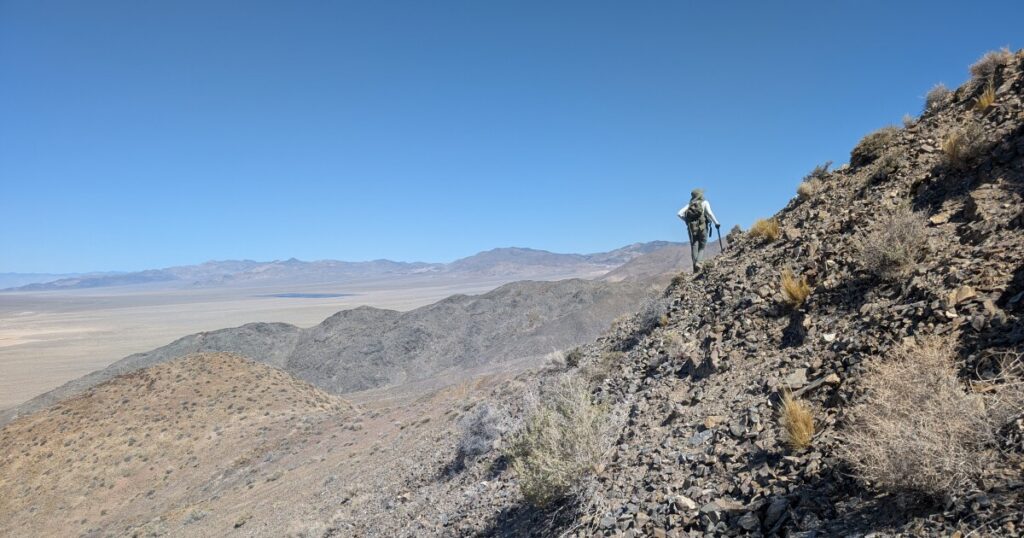
Currently a barren landscape dotted with shale and spiky plants, this region was once submerged under a tropical sea over 200 million years ago, bustling with diverse marine life. Among its ancient inhabitants were the ammonites, squid-like creatures whose spiral-shaped shells are found in abundance here.
The area was also a habitat for ichthyosaurs, ancient reptiles resembling dolphins, known for their long snouts and sharp teeth. These creatures are now immortalized as Nevada’s state fossil, and their legacy is celebrated in state parks and even a local beer.
Loupee’s recent find, however, turned out to be a false alarm. Despite initial excitement, the “femur” was not a fossil. “It was missing the bone texture,” explained Gary McGaughey, a PhD candidate from Idaho State University, who was consulted to verify the discovery.
McGaughey detailed how fossil hunters distinguish real finds: “The first thing that draws your eye to one, if you’re out prospecting, is the shape.” Unlike the jagged rocks around, fossils often have a round, smooth appearance. In addition, using hand lenses to detect spongy, porous textures similar to modern bone is crucial.

Photo courtesy of Hilary Loupee
Despite the setback, Loupee remains undeterred. Her passion for exploring the desert’s hidden treasures continues, and she has made significant finds, including ichthyosaur fossils, in the region before. McGaughey appreciates the involvement of enthusiasts like Loupee, emphasizing the importance of such discoveries. “Keep being excited about paleontology,” he encouraged.

Lupe Alvarez
/
KUNR Public Radio
While Loupee’s recent expedition did not yield the fossil she had hoped for, the journey itself remains rewarding. “It’s like an Easter egg hunt,” she described, emphasizing the joy of discovery and the tranquility of the desert landscape. With each trip, there lies the potential for new revelations, just waiting to be uncovered beyond the next hill.