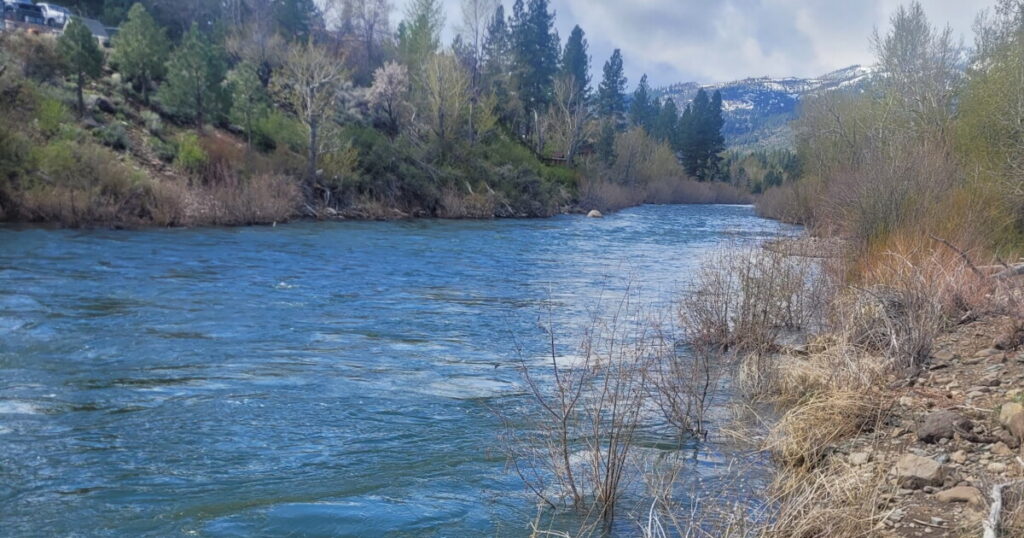
In an intriguing study of the Truckee River, researchers have uncovered the significant impact of seasonal changes on microplastic pollution. The investigation, conducted by the Desert Research Institute, focused on sampling the river’s flow during the low-flow period in fall 2022 and the high-flow season in spring 2023.
Data revealed that microplastic particles averaged 0.4 per liter during the fall but surged to 3.7 per liter in the spring. Monica Arienzo, the leader of DRI’s Microplastics and Environmental Chemistry Lab, vividly explained, “If you take one of those quart mason jars and you dipped that in the Truckee River, the max amount of microplastics we found was one particle per mason jar. While in the spring, the max we found was 10 plastic particles per one of those mason jars.”
Desert Research Institute
The research, spearheaded by Hannah Lukasik as part of her master’s program at DRI and the University of Nevada, Reno, points to the role of riverbank re-wetting and particle resuspension during high-flow periods as key factors in the increased microplastic levels. Lukasik noted, “I think a big contributor would be the re-wetting of the riverbank and the resuspension of the particles, which happens during those high flow events.”
This study addresses a gap in microplastic research within arid river systems, where water flow can dramatically fluctuate throughout the year. Similar research in Colorado and Montana observed comparable microplastic concentration levels, but the Truckee River study emphasizes how these concentrations can vary with river conditions, a crucial consideration for water managers and researchers when planning sampling times.
The study identified PET, polypropylene, and polyethylene as the most common plastics found, suggesting that larger plastic items and single-use plastics are significant contributors. Arienzo expressed that understanding the peak times and locations of microplastic concentrations could aid in devising strategies to prevent litter from infiltrating waterways.
This report was brought to you by the Mountain West News Bureau, a cooperative endeavor involving Boise State Public Radio, Wyoming Public Media, Nevada Public Radio, KUNR in Nevada, KUNC in Northern Colorado, KANW in New Mexico, Colorado Public Radio, and KJZZ in Arizona, as well as NPR. Support for the Mountain West News Bureau comes from the Corporation for Public Broadcasting and Eric and Wendy Schmidt.