The Desert’s Digital Future: Data Centers Transforming the Mountain West
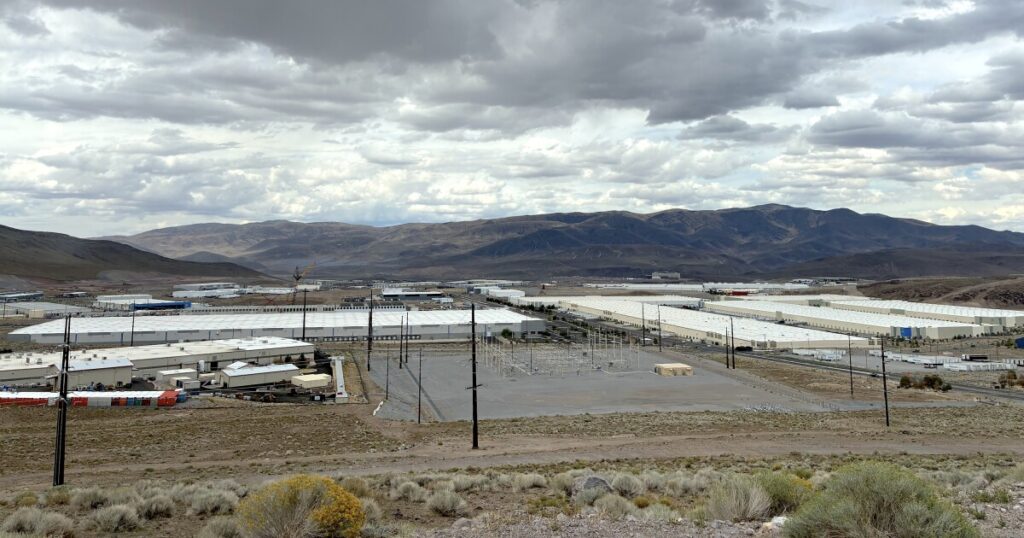
In the heart of the Nevada desert, sprawling data centers are rapidly reshaping the landscape. Brian Armon, a commercial real estate broker, recently drove through the Tahoe Reno Industrial Center, pointing out significant developments like Vantage Data Centers and the under-construction EdgeCore. As Armon notes, these facilities are part of a growing trend where tech giants are converting the desert into a crucial hub for internet infrastructure.
Kaleb Roedel
/
Mountain West News Bureau
Within this expansive business park, east of Reno, Nevada, lies what some describe as the largest AI support system on the planet. This data center hub, which is set to be 1.5 times larger than Reno itself, is situated in the driest state in the U.S., yet it demands a considerable volume of water.
Armon highlights the region’s appeal for data centers due to its ample land, minimal natural disasters, and attractive tax incentives. “We’ve had a massive amount of data centers that have shown up, and more that are looking,” Armon noted.
Data centers are not just confined to northern Nevada. States across the Mountain West, including Nevada, Colorado, Wyoming, and Arizona, are offering significant tax breaks to attract these facilities.

Kaleb Roedel
/
Mountain West News Bureau
Despite economic benefits, public concern is growing due to the water demands of these centers. In locations like Las Cruces, New Mexico, and Tucson, Arizona, citizens are voicing their concerns. The Sierra Club even challenged a project within Reno.
The main issue is water usage. Data centers need substantial water for cooling servers, functioning like “thirsty crops,” according to Stanford hydrologist Newsha Ajami. “You have to continuously water them,” Ajami explained, which poses challenges during droughts.

Kaleb Roedel
/
Mountain West News Bureau
A federal report anticipates that the demand for water by U.S. data centers, currently at 17 billion gallons annually, could double, driven by climate change impacts like rising temperatures and prolonged droughts, says Sean McKenna of the Desert Research Institute.
Currently, about 75% of the Mountain West is experiencing drought conditions, according to the U.S. Drought Monitor. In Nevada, over half of the groundwater basins are over-allocated, as stated by state data.

Kaleb Roedel
/
Mountain West News Bureau
Shari Whalen, general manager of the Tahoe Reno Industrial Center’s water district, stated that they hold rights to over 4 billion gallons annually, primarily from groundwater and treated wastewater. “Our plan is to fully and responsibly utilize the resources we have,” Whalen emphasized, insisting they won’t import water from elsewhere.
However, the district can access up to 325 million gallons a year from the Truckee River if necessary, which flows into Pyramid Lake, the ancestral home of the Pyramid Lake Paiute Tribe. Tribal Chairman Steven Wadsworth expressed concerns that every drop taken from the river could impact their lake’s water levels, which are vital to their cultural identity.

Kaleb Roedel
/
Mountain West News Bureau
Nevada already hosts approximately 60 data centers, with plans for a dozen more. These facilities may eventually rely on water from the river feeding Pyramid Lake, leading to concerns about long-term sustainability.
ABOUT OUR WIRED, WIRED WEST PROJECT
Data centers are booming across the Mountain West as big tech moves to solve its AI storage problem. Nondescript, square, warehouse-type buildings are popping up in neighborhoods, open plains, and rolling foothills. The burgeoning industry leaves many communities grappling with the prospects of increased air pollution, dwindling water supplies, and higher utility bills. All this even as climate models predict more heat, drought and other weather extremes across the Mountain West.
Read the entire series here.
The Mountain West News Bureau is a collaboration between public media stations in Arizona, Colorado, Idaho, Nevada, New Mexico, Utah and Wyoming along with NPR.