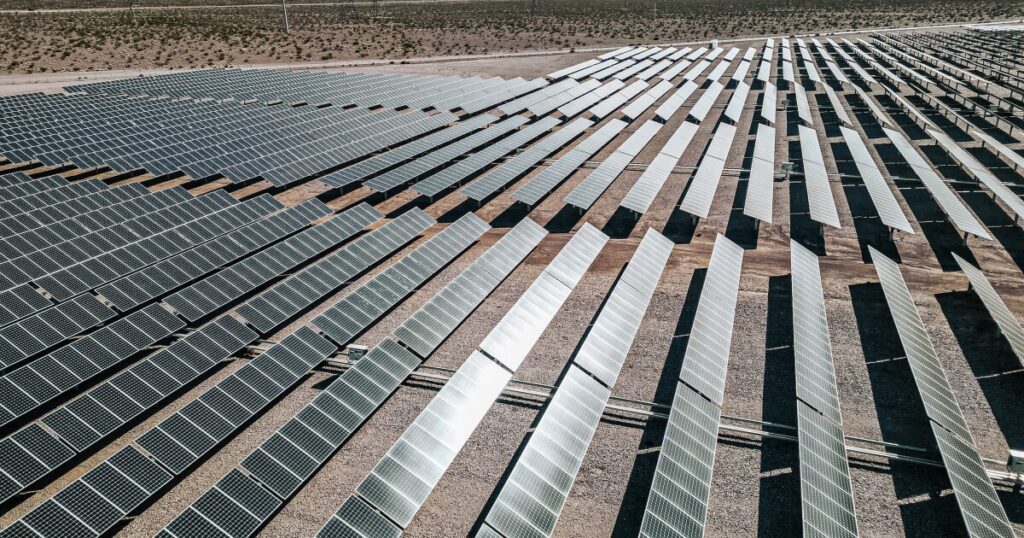
Nevada’s Ambitious Solar Project Halted by Federal Decision
A vast solar power initiative known as Esmeralda 7, planned to span over 185 square miles in southern Nevada, has hit a significant roadblock. The Bureau of Land Management (BLM) terminated its environmental review for the project, leaving its future uncertain. This development casts doubt on the region’s ability to produce enough renewable energy to power nearly 2 million homes as initially intended.
The BLM did not provide detailed reasons for the cancellation, stating only that the review was “terminated for cause.” However, the agency has indicated that proposals for smaller solar projects remain welcome, providing a potential path forward for developers.
Environmentalists, like Jackie Spicer from the Nevada Environmental Justice Coalition, see this decision as part of a concerning trend away from large-scale renewable energy projects on public lands. Spicer emphasized the importance of such projects, stating, “Grid-scale renewable energy and storage are necessary to speed up our transition to a clean energy economy.”
This project was pivotal to Nevada’s clean energy expansion plans and was aligned with the Biden administration’s aim to achieve 100% carbon-free electricity by 2035. The suspension of the Esmeralda 7 initiative follows other recent federal retreats from solar projects, posing a challenge to these goals.
However, conservationists have expressed relief at the project’s halt. Organizations like Basin and Range Watch argue that large solar farms could harm delicate desert habitats. Kevin Emmerich, a co-founder of the group, stated, “Developing that many solar panels in that area would require a lot of removal of habitat. I am not against green energy at all, I just think that this type of wholesale development of these real special areas is not appropriate.”
This situation highlights a broader conflict in the western United States: balancing the urgent need for renewable energy infrastructure with the preservation of the region’s unique natural landscapes.
The BLM’s recent actions reflect this tension, as it has either paused or canceled several major solar projects across the Southwest due to environmental concerns. These decisions could significantly impact the future landscape of clean energy development in the area.
This story was produced by the Mountain West News Bureau, a collaboration between KUNR, Wyoming Public Media, Nevada Public Radio, Boise State Public Radio in Idaho, KUNC in Northern Colorado, KANW in New Mexico, Colorado Public Radio, KJZZ in Arizona and NPR, with additional support from affiliate newsrooms across the region. Funding for the Mountain West News Bureau is provided in part by the Corporation for Public Broadcasting and Eric and Wendy Schmidt.