New Federal Support for Ranchers Introduced Amid Rising Cattle Prices
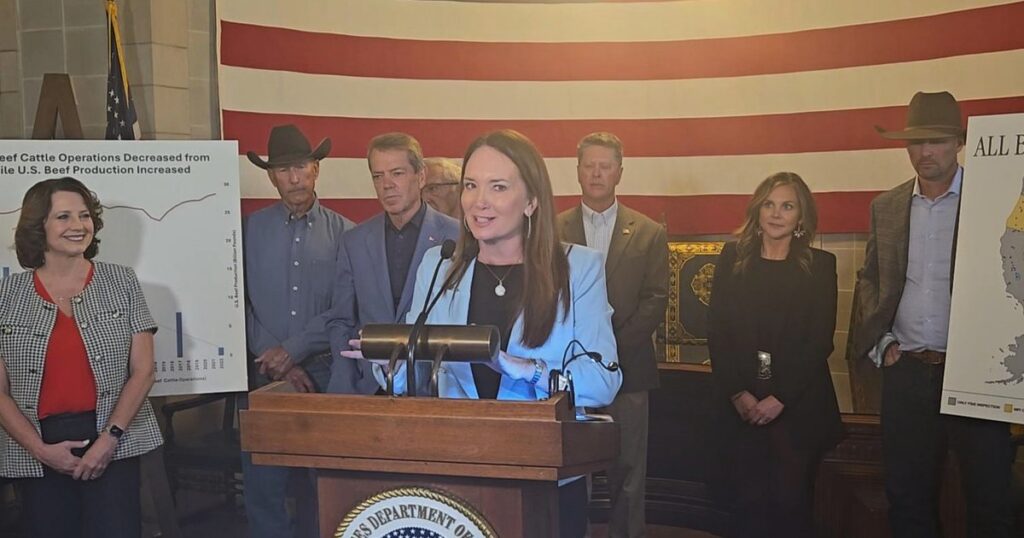
In a significant move to bolster the American ranching community, U.S. Secretary of Agriculture Brooke Rollins, alongside Nebraska Governor Jim Pillen and local cattle producers, gathered to discuss a series of new federal measures aimed at assisting ranchers. The announcement was made against the backdrop of increasing beef prices and ongoing challenges faced by the industry.
The U.S. Department of Agriculture (USDA) unveiled the “Ranchers First Initiative,” which features five new actions and programs designed to support ranchers and enhance beef production across the nation. These efforts are part of a broader strategy to ensure the sustainability and growth of the American beef industry.
Rollins emphasized the critical nature of maintaining ranches, stating, “We hear this over and over that if we lose more ranches, if this trend continues, then we will lose freedom in this country. Where there is beef, there is freedom.” She pointed out the importance of self-sufficiency, linking beef production to national independence and the American dream.
The initiative includes enhancements to USDA Farm Service Agency (FSA) programs, offering increased federal funding opportunities. Notably, two FSA conservation programs can now be combined to expedite grassland recovery after natural disasters, while Livestock Risk Protection (LRP) coverage for heifers has been expanded, allowing ranchers to mitigate losses if retention costs fall below slaughter value.
Furthermore, the initiative aims to strengthen partnerships and increase processing capacity for small ranching operations and beef slaughter facilities—a response to the closure of several processing plants nationwide.
Additional support will be provided through a new Office of Beginning and Veteran Farmers and Ranchers Affairs, prioritizing beef in federal food procurement and extending assistance to emerging ranchers.
During discussions at the Nebraska State Fair, Rollins addressed concerns about the recent screwworm outbreak affecting imports from Mexico. Although the outbreak initially impacted the market, the USDA has successfully contained the pest within the American southwest. “We have had 47 cases in America since it first hit our side of the border in Texas on June the 3rd of this year,” Rollins noted, adding that only two active cases remain.
Beef Prices Rise, but Demand Remains Strong
As agricultural input costs soar, compounded by drought and wildfires, the beef market has emerged as a bright spot amid economic uncertainty. Rollins highlighted the relative affordability of beef, stating, “A bag of Doritos and a Coke actually costs more – significantly more – than a pound of ground beef.” Despite rising prices, consumer demand for beef remains robust.
Data from the U.S. Bureau of Labor Statistics Consumer Price Index indicates that a pound of ground beef now averages $6.89, marking a $1.86 increase since January 2024. Governor Pillen remarked on the enduring value of beef, asserting, “Our value is really incredible, because if it wasn’t a great value, you wouldn’t be buying it, and nobody’s backing off buying it.”
In a related development, President Donald Trump announced a temporary tariff exemption on foreign beef imports, aiming to reduce grocery prices and encourage domestic herd growth. However, this decision faced criticism from Nebraska’s cattle industry leaders and several bipartisan congressional members.
The Nebraska Cattlemen expressed concerns over market stability, stating, “Long-term market stability is imperative for herd expansion, and this type of short-term messaging hinders beef cattle producers by creating uncertainty.” Senator Deb Fischer echoed these sentiments, emphasizing the need to protect American producers.
Rollins acknowledged these concerns and reiterated the administration’s commitment to balancing consumer needs with the interests of ranchers. “A million and a half head of cattle that would have normally crossed through those ports did not cross over the last year and a half (due to screwworm concerns),” she explained, underscoring the challenges faced by ranchers.
Governor Pillen, having voiced his reservations directly to the President, shared, “I got in eyeball-to-eyeball with the president and told him exactly how I saw it and what I believe in.” Despite disagreements, Pillen expressed gratitude for the President’s attention to agricultural issues.
Rollins indicated that additional announcements regarding ranching initiatives are forthcoming, with a focus on translating Trump administration policies into legislative action.