House Advances Legislation to Expand Year-Round Sale of E15 Fuel
In a significant legislative move, the U.S. House has approved a bill aimed at expanding access to 15% ethanol gasoline, commonly known as E15. The bill, H.R. 1346, seeks to eliminate restrictions that currently limit the sale of E15 in several states during the summer due to its high evaporative emission rates.
Prior to the final decision on the E15 legislation, the House voted to separate an E15 provision from the previously passed five-year Farm Bill before forwarding it to the Senate. This strategic move followed initial delays caused by disagreements among legislators from agricultural and oil-producing states.
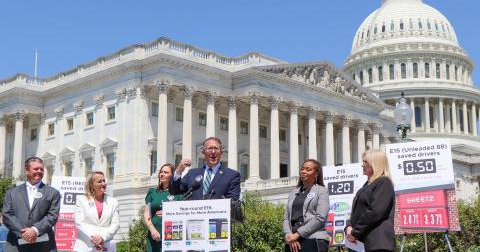
The five-year Farm Bill, which had been approved by a 224-200 vote in the previous month, will now proceed to the Senate without the E15 provision. Nebraska Representatives are hailing the E15 bill as a victory for consumers, corn producers, and the nation’s energy strategy, with District 3 Rep. Adrian Smith leading the charge.
In a press conference, Smith posed a critical question, “This debate comes down to a simple question: do we want more affordable fuel, stronger energy independence, and expanded markets for American agriculture, or do we want to continue allowing uncertainty and politics to stand in the way?” (source).
As geopolitical tensions, notably the ongoing conflict with Iran, continue to impact fuel supplies and prices, E15 is being touted by some as a potential stabilizer for gasoline costs. It is estimated that consumers could save between 10 to 30 cents per gallon by choosing E15 over regular gasoline (source).
During floor debates, District 1 Rep. Mike Flood emphasized the consumer choice aspect of the bill, stating, “This bill allows people to choose or not choose E15 based on their values. They might want cheaper gas, they may not. They might want higher octane, they may not. They might want to support America’s farmers, or they may not.”
Long-term benefits of E15, according to Smith, include increased corn demand by approximately 2.4 billion bushels annually and enhanced market stability for producers (source). “Stronger markets are what we need. We know that crop prices have been pretty painful lately, and producers are feeling that pain,” Smith conveyed to Nebraska Public Media News.
The House engaged in an hour-long discussion on the bill before pausing the vote. A motion was made to return the bill to the Committee on Energy and Commerce for further deliberation. The debate has created a divide, with corn-state legislators advocating for the bill against opposition from oil-state representatives concerned about ethanol production affecting refinery profits and imposing costly renewable fuel requirements (source).
Efforts to ensure year-round E15 sales have persisted for over a decade. There is apprehension among some representatives that the Senate may overlook E15 if it is presented as a standalone bill.
Implementation of the bill carries a financial implication, with the Congressional Budget Office estimating an addition of about $2 billion to the deficit (source).
In March, an emergency waiver was approved to allow nationwide E15 sales temporarily, intended to strengthen the domestic fuel supply amid the U.S. and Israel’s conflict with Iran. The waiver, effective from May 1-20, 2026, is the maximum period permitted under the Clean Air Act.
The proposed legislation seeks to adjust the allowable emissions threshold from ethanol-based fuels. Under the existing regulations, gasoline must not exceed a specified Reid vapor pressure (RVP) (source). Ethanol blends have higher RVP, resulting in increased “evaporative emissions” compared to regular gasoline, which is a concern in high-temperature states during the summer. E15 is already extensively marketed in Nebraska and 30 other states.
Studies indicate that the toxic evaporative emissions from ethanol blends are lower than those from regular gasoline. Additionally, U.S. corn ethanol is reported to have 44%-52% lower total carbon emissions than standard gasoline, according to a 2021 study by the Department of Energy.
The timing for a Senate vote on the E15 bill remains uncertain, with the outcome still unpredictable due to mixed support across party lines.