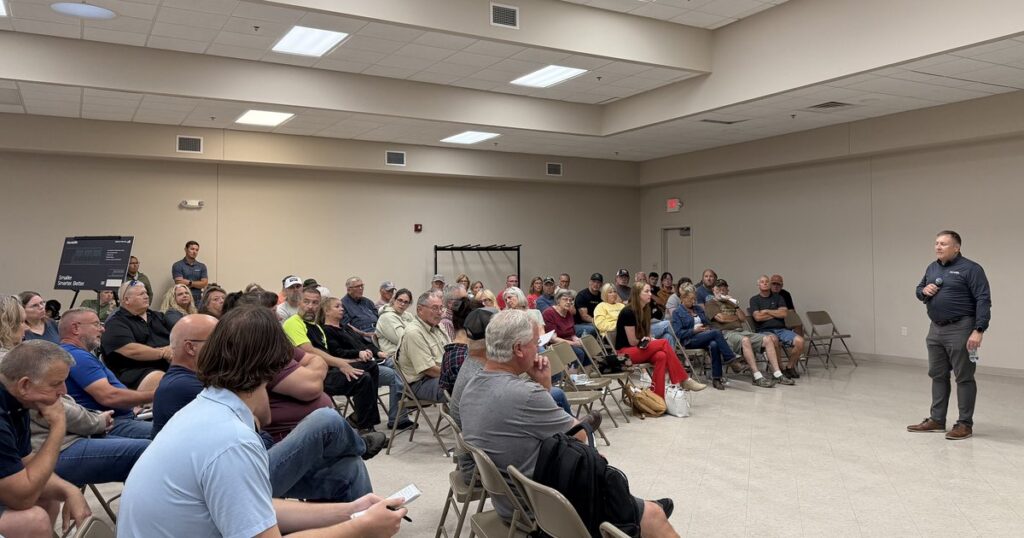
The Hallam auditorium was bustling with activity on Thursday evening as local residents gathered for a town hall meeting to discuss a proposed data center expansion. The event saw a long line of attendees eager to voice their concerns and learn more about the ambitious project by Monolith.
Monolith, known for its production of carbon black, is planning to expand its Olive Creek facility in Hallam. The proposal includes the addition of a 35-megawatt data center and four new carbon black units. To achieve this, Monolith is teaming up with Crusoe, a Denver-based company specializing in AI factory solutions. Crusoe currently has five data center contracts, including a prominent 1.2-gigawatt campus in Abilene, Texas, serving major clients like Oracle and OpenAI.
At the town hall, Monolith CEO Russell Webb expressed confidence in their partnership with Crusoe, stating, “When we started looking at the data center option, we wanted to try to pick a partner that does those type of things, that’s very efficient, that’s the right size. It’s not like a mega partner that builds these humongous data centers.”
The proposed data center will feature up to 36 modular “Spark” units, each comparable in size to a shipping container. According to Monolith, this design choice offers a lower profile compared to an earlier plan for a 140-foot ammonia tank facility. Chief Development Officer Anna Wishart explained, “It is significantly lower profile than the ammonia facility that we had planned.”
Monolith’s data center is set to consume approximately 770,000 gallons of water annually. This figure is well within the company’s current permit, which allows for up to 420 million gallons, as approved by the Lower Platte South Natural Resources District. The project includes two design options for cooling systems: air-cooled units and closed-loop cooling, with Crusoe favoring closed-loop systems for its hyperscale data centers.
In terms of the carbon black unit expansion, the first phase will require around 62 gallons of water per minute, increasing to 250 gallons per minute in the second phase. When operating at 80%, this equates to about 105 million gallons annually. The second phase will see operations extend eastward across Southwest 42nd Street, with room for further expansion of both the data center and carbon black units.
Highlighting the potential benefits of the expansion, Wishart stated, “Looking ahead, we expect from the Spark unit the 10 acres will bring about 15 high-paying jobs, and then the two-phase carbon black expansion will be about 150 jobs.” She emphasized the rarity of such “generational jobs” in the U.S., attributing their scarcity to the outsourcing of manufacturing jobs.
However, residents voiced concerns about the project proceeding without comprehensive studies, particularly regarding noise and light pollution. A noise study is currently underway, but Crusoe has not provided a completion date. Transparency was a major issue for attendees like Cami Slauson, who said, “What we’ve been able to see, and everybody that’s come out here, is nothing has been transparent, and everything gets signed, everything gets voted through, and then nothing is what it seems.”
Concerns were also raised about the impact on local agriculture and ranching. Kathy Stevens, a lifelong resident, worried about the effects on her land and family, stating, “We’re concerned about water, and we know water, how important water is, and noise… [my daughter] commented on how much light was coming off of that plant.”
The community will have further opportunities to discuss the project at the Hallam Village board meeting on August 3, with Monolith planning another town hall later in August.