In a concerning development for road safety, three pedestrian fatalities in quick succession have drawn attention to Omaha’s ongoing struggle with traffic deaths. The incidents began on November 14, when 63-year-old Osborn Henderson Jr. was fatally struck by a pickup truck at the intersection of 84th and Blondo streets. The driver fled the scene. Just two days after this tragic event, a 29-year-old man was killed in a hit-and-run incident while walking along 26th Avenue and Douglas Street. This alarming pattern continued when a 74-year-old man was struck by a sedan on Interstate 80 near 60th Street, marking the third pedestrian death in less than a week.
This surge in fatalities contributes to a grim milestone for Nebraska, which is currently facing its deadliest year for pedestrian deaths in over 30 years, with 27 fatalities reported by November 21. In response to this troubling trend, Omaha is actively working to implement strategies aimed at eliminating traffic fatalities.
Vision Zero Initiative
Identifying a single cause for the recent increase in pedestrian deaths presents a challenge, according to Jeff Sobczyk, Omaha’s Vision Zero coordinator. He noted that multiple factors are at play, including the increasing size of newer vehicles, which makes them harder to stop and increases blind spots. “However, a lot of that has to do with vehicles. Newer mile vehicles are getting bigger and bigger, and with that mass means they’re harder to stop, and there’s more energy that goes into a crash,” Sobczyk stated. “Blind spots increase too.”
The Vision Zero initiative, adopted in 2023, seeks to reduce traffic-related fatalities and serious injuries in Omaha, with an ambitious target of eliminating all such deaths by 2045. The initiative traces its origins back to 2017, when former Mayor Jean Stothert’s Active Living Advisory Committee recommended forming a task force to tackle road safety. “It’s an ambitious but necessary goal,” Stothert emphasized. “The safety of everyone who uses our roads is critically important for a safe city like Omaha.”
In 2021, Sobczyk was appointed as coordinator, and by 2022, the City Council had approved a $345,896 contract with WSP USA, a consulting firm, to develop a comprehensive action plan. The Vision Zero Omaha Action Plan outlines strategies and priorities, with 117 identified projects aimed at improving road safety.
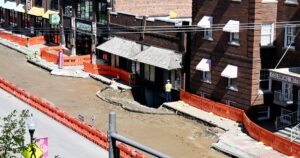
Key improvements were made in 2024, with several projects completed in the past year. These include a reconfiguration of 108th Street between Maple and Fort streets, as well as pedestrian safety upgrades on Center Street between 51st and 60th streets, featuring new medians and crosswalks. “It’s a lot of targeted improvements like that that are kind of quick build at a low cost, but a high safety impact,” Sobczyk explained. “And then with these quick build projects, the goal is long term, to start budgeting for more of a permanent install when the money is available.”
Future Steps
As of 2025, Omaha has recorded nine pedestrian deaths, a decrease from last year’s record-breaking 14 fatalities. While traffic incidents occur throughout the city, the majority are concentrated east of 72nd Street, particularly in North and South Omaha. These areas often feature older infrastructure with limited pedestrian protections, leading to higher risks for road users.
Sobczyk highlighted that these neighborhoods often have single-car households, increasing reliance on walking and public transit. “We’re trying to target these safety measures in those areas in most need,” he said. “These tracts are often households with single car ownership, so there’s people more likely to be walking, taking transit, so they’re far more exposed in these areas.”
As Vision Zero approaches its second anniversary, plans are underway for a comprehensive safety study of Ames Avenue, a notorious corridor for both drivers and pedestrians, slated for 2026. “If we’re systemically looking at this, this can be addressed, and it’s worked in other countries,” Sobczyk noted. “It’s starting to work in cities, and we’re seeing the evidence. And I think Omaha, over time, we’ll start seeing the evidence, with the data ticking downward.”