Expansion of Nebraska’s Weather Station Network Boosts Data Accuracy for Farmers and Agencies
In a significant development for Nebraska’s weather monitoring capabilities, the University of Nebraska-Lincoln has announced the expansion of the Nebraska Mesonet system, thanks to substantial new funding.
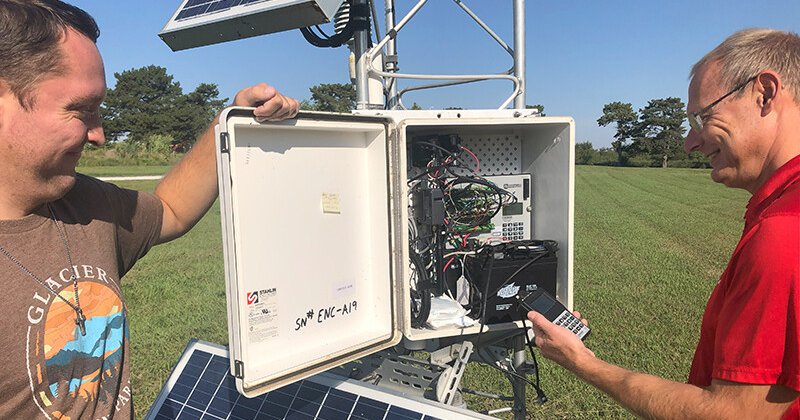
This year, the system has grown by 21 stations, bringing the total number of stations across the state to 94. This expansion was made possible by $1.48 million in funding from multiple sources, including the U.S. Army Corps of Engineers, the U.S. Department of Agriculture’s Farm Service Agency, and the Lower Loup and Upper Elkhorn Natural Resources Districts.
Ruben Behnke, who manages the Nebraska Mesonet, aspires to further increase the number of stations to 200 over the next few years. He emphasized the importance of a dense network, stating, “To properly cover the state, you need a relatively dense network. Otherwise, you’re providing data that’s not appropriate to people who are trying to put water on their crops. Even more financially important is applying for financial disaster relief through the Farm Service Agency for drought, flood, hail or other disasters.”
Looking ahead, the Army Corps of Engineers has pledged an additional $900,000 for the year 2026, and Behnke is actively seeking more funding to support further upgrades and expansions.
The recent funding marks a significant turnaround for the Nebraska Mesonet, which faced reductions in its network due to financial constraints just three years ago. Originally launched in 1981 with five stations, the network expanded to 81 stations before dwindling to as low as 55 in 2022 due to funding challenges.
The Corps of Engineers is not only focusing on Nebraska but is also working to expand Mesonet systems in five states along the Missouri River, aiming to add a total of 35 stations in Nebraska. Many of these new stations are planned for the north-central region, which currently lacks sufficient coverage.
The data collected by the Nebraska Mesonet is invaluable to farmers, who are its primary users, and is also utilized by state and federal agencies, including the U.S. Army Corps of Engineers, the USDA, the Nebraska Forest Service, the Nebraska Natural Resources Districts, and the Nebraska Emergency Management Agency.
John Erixson, the Nebraska state forester, highlighted the critical role of Mesonet data in firefighting efforts. “During an active wildfire, real-time weather data is essential for firefighter safety and for making tactical decisions,” he explained. “Rapid changes in wind speed or direction can dramatically alter fire behavior, potentially endangering crews and communities. By monitoring Mesonet stations near active fires, incident commanders can better anticipate these shifts, improving the chances of containing fires quickly and safely.”